Thursday, 28 April 2022

The Willows

Algernon Blackwood  - The Willows
Originally published in 1907 as part of his collection,  'The Listener and Other Stories',  Algernon Blackwood's 'The Willows' has long established itself as a masterpiece of supernatural stories.  It tells of a canoe trip down the Danube and two nights spent on a sandy island amidst the oppressive presence of the willows where the two travellers are subjected to a number of inexplicable experiences.

Famously 'The Willows' was a favourite of H.P. Lovecraft writing in 'Supernatural Horror in Literature', "Here art and restraint in narrative reach their very highest development, and an impression of lasting poignancy is produced without a single strained passage or a single false note".  

This reading was originally aired on BBC7 between 29th of March and the 1st of April 2005 and is read rather wonderfully by Roger Allam who I'm sure many will recognise from his appearences in 'Endeavour', 'V for Vendetta', 'Game of Thrones' and 'The Thick Of It'.

..........................................................................................

If you enjoy what we do here on Wyrd Britain and would like to help us continue then we would very much welcome a donation towards keeping the blog going - paypal.me/wyrdbritain

Affiliate links are provided for your convenience and to help mitigate running costs.

Sunday, 24 April 2022

Hawk the Slayer

Wyrd Britain reviews 'Hawk the Slayer'.
Co-written by novice director Terry Marcel and legendary Hammer composer Harry Robertson (The Oblong Box, The Vampire Lovers, Twins of Evil) and born out of their shared love for sword and sorcery novels, 'Hawk the Slayer' crams every Tolkien and Robert E. Howard trope it can afford - a witch, an elf, a dwarf, a suspiciously ungigantic giant, a magic sword and massed armies of several - into it's £600,000 budget (of which star Jack Palance was reportedly paid a sixth) to create a ridiculously fantastic travesty of a movie that personally I have a bit of a soft spot for.  

Wyrd Britain reviews 'Hawk the Slayer'.
The storyline is essentially a thinly disguised riff on The Magnificent Seven with the six shooters swapped for swords and bows and with the action relocated to a chilly, dry ice drenched park in Buckinghamshire.  Obviously made with an eye to the international market the producers cast two Americans in the leads, the aforementioned Palance and debutant action hero John Terry and they are both, well, they're both pretty terrible.  Of the latter it's perhaps kindest to say that he's ineffectual and wooden and way out of his depth but would mature into roles in 'The Living Daylights', 'Full Metal Jacket' and 'Lost' whilst the former gives a scenery chewing performance of epic awfulness.  Acting around them we have a troupe of reliable Brit supporting actors such as Carry on... staple Bernard Bresslaw (who would return to the fantasy genre again three years later in Krull), One Foot in the Grave's Annette Crosbie, Patricia Quinn (The Rocky Horror Picture Show), Harry Andrews (Theatre of Blood), Patrick Magee (The Skull) and Roy Kinnear (The Bed Sitting Room) all of whom do much of the heavy lifting and keeping admirably straight faces.

Wyrd Britain reviews 'Hawk the Slayer'.
Released at a time when fantasy movies of this sort were extremely thin on the ground and when interest in the fantastical was hitting fever pitch in the wake of Star Wars, Hawk was a box office bomb but one that quickly acquired a devoted fan following and whilst no sequels were ever made (until Garth Ennis' 2022 comic series) it has been credited with triggering the flurry of similar movies that followed in it's wake such as Dragonslayer, Excalibur, Conan the Barbarian, The Beastmaster and the aforementioned Krull to name just a few.

..........................................................................................


If you enjoy what we do here on Wyrd Britain and would like to help us continue then we would very much welcome a donation towards keeping the blog going - paypal.me/wyrdbritain

Affiliate links are provided for your convenience and to help mitigate running costs.

Sunday, 17 April 2022

An Inspector Calls

Wyrd Britain reviews the 2015 BBC adaptation of J.B. Priestley's play  'An Inspector Calls'.
1912 and with the possibility of the first world war looming the Birling's, Arthur (Ken Stott), Sybil (Miranda Richardson) and Eric (Finn Cole) are gathered around the dining table having just finished a celebratory meal to mark the engagement of daughter Sheila (Chloe Pirrie) to Gerald Croft (Kyle Soller), the son of a rival businessman, when the arrival of Inspector Goole (David Thewlis) brings news of the suicide of a young and pregnant working class girl Eva Smith (Sophie Rundle).  As each family member is interegated by Goole it soon transpires that they are all acquainted with the dead woman and have all, in some way, contributed to her demise.

Made for the BBC in 2015 screenwriter Helen Edmundson and director Aisling Walsh's adaptation of J.B. Priestley's play is a masterclass of subtle and sympathetic television that maintains the heart of the play and augments it via judicious use of flashbacks to further expand on the life of the doomed Eva.  It holds true to Priestley's core ideal of social responsibility present in his disdain for the attitudes and beliefs of the middle (the Birling's) and upper (Croft) classes in their treatment of those considered their social inferiors.

..........................................................................................

If you enjoy what we do here on Wyrd Britain and would like to help us continue then we would very much welcome a donation towards keeping the blog going - paypal.me/wyrdbritain

Affiliate links are provided for your convenience and to help mitigate running costs.

Thursday, 14 April 2022

The Machinery of the Moment

The British Space Group - The Machinery of the Moment
Wyrd Britain is a blog about stories, about the fictions we create around this odd little country some of us call home; stories about thin places and lost places, stone circles and ancient woodlands, about rabbit holes and hills of dreams, time travellers and triffids.  

The Wyrd Britain label expands on this theme by releasing music that also tells stories,  music with a narrative and a sense of the mysterious that would be at home within the occult territories of a stranger Britain.

Following on from 2020's 'The Ley of the Land' 'The Machinery of the Moment' tells a story of an extended moment. Of the point where perception of time - or perhaps even time itself - collapses and we exist in a state of timelessness; a minute in an hour, an hour in a minute, a lifetime lived in the second between the tick and the tock.

'The Machinery of the Moment' is the fifth release from Ian Holloway's current project 'The British Space Group'.  It is a deliberate attempt to merge the music he has created under various guises over the last two decades and released on labels like Quiet World, Fungal and Siren Wire with his love of the strange and supernatural fiction featured on the Wyrd Britain blog. 

'The Machinery of the Moment' is available for download or as a limited edition CDr by clicking on the player below.


 ..........................................................................................


If you enjoy what we do here on Wyrd Britain and would like to help us continue then we would very much welcome a donation towards keeping the blog going - paypal.me/wyrdbritain

Affiliate links are provided for your convenience and to help mitigate running costs.

Monday, 11 April 2022

The Comforters

Wyrd Britain reviews 'The Comforters' by Muriel Spark.
Muriel Spark
Penguin Books

Caroline Rose is plagued by the tapping of typewriter keys and the strange, detached narration of her every thought and action. Caroline has an unusual problem - she realises she is in a novel. Her fellow characters also seem deluded: Laurence, her former lover, finds diamonds in a loaf of bread - has his elderly grandmother hidden them there? And Baron Stock, her bookseller friend, believes he is on the trail of England's leading Satanist.

I bought this as part of a batch of vintage Penguins to sell in the Wyrd Britain shop but having checked out it's blurb on Goodreads I just had to read it and I'm really rather pleased I did.

Sparks' first novel, originally published in 1957, is the story of the various groups of people that orbit the fantastically devious Louisa Jepp.  These groups include Caroline Rose newly Catholic and hearing the sounds of a typewriter and a voice narrating her every thought and action, Caroline's on / off fiance and Louisa's grandson Laurence who's investigating why his grandmother is hiding diamonds in the bread, Baron Stock, a bookseller with an overpowering interest in the occult and Georgina Hogg an unpleasant, bore of a woman who "suffers from chronic righteousness."

Spark's novel is a charming, witty and idiosyncratic romp with a cast of fairly loveable eccentrics.  It toys with the strange and supernatural throughout mostly in the form of Caroline's narrator and the Baron's quest to unmask England's premier Satanist but it's one true moment is as explicit as it is fleeting and provides a discomforting premonition of a somewwhat dark turn at the novel's end.

I've always been very much a whim reader generally chosing my next read on the spur of the moment and in truth there's nothing about that ^ awful cover art on the edition I read that would entice me but a good blurb was the catalyst for triggering this whim which paid unexpected dividends providing an object lesson in not judging a book by it's cover as it turned out to be ridiculously good fun.

Buy it here - UK / US.

..........................................................................................

If you enjoy what we do here on Wyrd Britain and would like to help us continue then we would very much welcome a donation towards keeping the blog going - paypal.me/wyrdbritain

Affiliate links are provided for your convenience and to help mitigate running costs.

Friday, 8 April 2022

The City of Dreadful Night

The City of Dreadful Night by James Thomson
image by Kevin O'Neill 
As I came through the desert thus it was,
As I came through the desert: All was black,
In heaven no single star, on earth no track;
A brooding hush without a stir or note,
The air so thick it clotted in my throat;
And thus for hours; then some enormous things
Swooped past with savage cries and clanking wings:
      But I strode on austere;
      No hope could have no fear.

As I came through the desert thus it was,
As I came through the desert: Eyes of fire
Glared at me throbbing with a starved desire;
The hoarse and heavy and carnivorous breath
Was hot upon me from deep jaws of death;
Sharp claws, swift talons, fleshless fingers cold
Plucked at me from the bushes, tried to hold:
      But I strode on austere;
      No hope could have no fear.

As I came through the desert thus it was,
As I came through the desert: Lo you, there,
That hillock burning with a brazen glare;
Those myriad dusky flames with points a-glow
Which writhed and hissed and darted to and fro;
A Sabbath of the Serpents, heaped pell-mell
For Devil's roll-call and some fête of Hell:
      Yet I strode on austere;
      No hope could have no fear.

As I came through the desert thus it was,
As I came through the desert: Meteors ran
And crossed their javelins on the black sky-span;
The zenith opened to a gulf of flame,
The dreadful thunderbolts jarred earth's fixed frame:
The ground all heaved in waves of fire that surged
And weltered round me sole there unsubmerged:
      Yet I strode on austere;
      No hope could have no fear.

As I came through the desert thus it was,
As I came through the desert: Air once more,
And I was close upon a wild sea-shore;
Enormous cliffs arose on either hand,
The deep tide thundered up a league-broad strand;
White foambelts seethed there, wan spray swept and flew;
The sky broke, moon and stars and clouds and blue:
      And I strode on austere;
      No hope could have no fear.

As I came through the desert thus it was,
As I came through the desert: On the left
The sun arose and crowned a broad crag-cleft;
There stopped and burned out black, except a rim,
A bleeding eyeless socket, red and dim;
Whereon the moon fell suddenly south-west,
And stood above the right-hand cliffs at rest:
      Still I strode on austere;
      No hope could have no fear.

As I came through the desert thus it was,
As I came through the desert: From the right
A shape came slowly with a ruddy light;
A woman with a red lamp in her hand,
Bareheaded and barefooted on that strand;
O desolation moving with such grace!
O anguish with such beauty in thy face.
      I fell as on my bier,
      Hope travailed with such fear.

As I came through the desert thus it was,
As I came through the desert: I was twain,
Two selves distinct that cannot join again;
One stood apart and knew but could not stir,
And watched the other stark in swoon and her;
And she came on, and never turned aside,
Between such sun and moon and roaring tide:
      And as she came more near
      My soul grew mad with fear.

As I came through the desert thus it was,
As I came through the desert: Hell is mild
And piteous matched with that accursèd wild;
A large black sign was on her breast that bowed,
A broad black band ran down her snow-white shroud;
That lamp she held was her own burning heart,
Whose blood-drops trickled step by step apart;
      The mystery was clear;
      Mad rage had swallowed fear.

As I came through the desert thus it was,
As I came through the desert: By the sea
She knelt and bent above that senseless me;
Those lamp-drops fell upon my white brow there,
She tried to cleanse them with her tears and hair;
She murmured words of pity, love, and woe,
She heeded not the level rushing flow:
      And mad with rage and fear,
      I stood stonebound so near.

As I came through the desert thus it was,
As I came through the desert: When the tide
Swept up to her there kneeling by my side,
She clasped that corpse-like me, and they were borne
Away, and this vile me was left forlorn;
I know the whole sea cannot quench that heart,
Or cleanse that brow, or wash those two apart:
      They love; their doom is drear,
      Yet they nor hope nor fear;
But I, what do I here?

By James Thomson (1834 - 1882)


..........................................................................................

If you enjoy what we do here on Wyrd Britain and would like to help us continue then we would very much welcome a donation towards keeping the blog going - paypal.me/wyrdbritain

Affiliate links are provided for your convenience and to help mitigate running costs.

Wednesday, 6 April 2022

The Irregular Casebook of Sherlock Holmes

Wyrd Britain reviews Ron Weighell's 'The Irregular Casebook of Sherlock Holmes' from Zagava Books.
Ron Weighell
Zagava

Sherlock Holmes, wrote his friend and chronicler John H. Watson, was an 'unofficial adviser and helper to everybody who is absolutely puzzled', and as such Holmes came into contact with 'all that is strange and bizarre'. Cases such as THE HOUND OF THE BASKERVILLES or 'The Sussex Vampire' show the great detective dealing with matters which certainly are strange and bizarre; yet in all the sixty cases in the Sherlockian canon, Holmes proves that the supernatural plays no part in the matter under investigation.
What if, however, those sixty cases did not tell the entire story? In THE IRREGULAR CASEBOOK OF SHERLOCK HOLMES, we encounter five cases which test Holmes's powers to the limit; strange and bizarre cases involving forces that are not of this world. Missing manuscripts, strange sects, sudden death, and mysterious encounters all lead Holmes and Watson into a twilight world of mystery, magic, and danger, where nothing is commonplace and people are not what they seem. 

Over the last few years I've had the real pleasure of reading a few of Ron Weighell's stories but this is the first time I've gotten to read his stories 'en-masse' and I'm hugely impressed.

Here Weighell embraces his love of the deerstalker detective and merges him with his love for supernatural fiction.  In Weighell's hands we find Holmes and Watson in the company of M.R. James investigating a mystery linked to Dr John Dee and with Arthur Machen investigating a cult entangled with the Holy Grail.  We also find him clambouring across rooftops in pursuit of a werewolf, in Egypt hunting a sorceror and swashbuckling on the canals of Venice.

I'm no Holmes devotee but I do enjoy the stories and I'm always open to a new one but personally I find the arch rationalist Holmes to be a poor fit with supernatural stories and the ones that I've read such as those in the 'Shadows Over Baker Street' anthology have mostly disappointed but Weighell has a delicate touch and the weird is kept at a subtle distance with enough ambuiguity for Holmes' world view to remain mostly intact and for this to be a very enjoyable collection indeed.

NOTE - Due to quality issues Zagava have withdrawn their POD range which is a real shame as books as good as the ones they release deserve to be celebrated and hopefully the printing issues can be rectified soon. In the meantime there is a digital edition available at the link below. 

Buy it here - UK / US.

..........................................................................................

If you enjoy what we do here on Wyrd Britain and would like to help us continue then we would very much welcome a donation towards keeping the blog going - paypal.me/wyrdbritain

Affiliate links are provided for your convenience and to help mitigate running costs.

Sunday, 3 April 2022

Room for an Inward Light

Wyrd Britain reviews 'Room for an Inward Light' from the BBC2 series 'Leap in the Dark'.
'Leap in the Dark' was a long running BBC2 series that ran from 1973 to 1980 which over it's 4 series morphed from documentaries to dramas all with a supernatural theme.  'Room for an Inward Light' was the penultimate episode of the 4th series from which we've featured several episodes before - Alan Garner's 'To Kill A King', David Rudkin's 'The Living Grave' and Russell Hoban's 'Come and Find Me' - and was written by the playwright / novelist David Pownall.

Here we find struggling novelist Thomas Myers (Brian Blessed) who contacts critic Bernard Charlton (Christopher Strauli) for help after reading an article he'd written about how there were great authors working away in anonymity.  Realising that the cranky, eccentric and prolific Myers is exactly the type of undiscovered genius he'd been searching for Charlton takes on the role of agent and begins his quest to find him a publisher.

Wyrd Britain reviews 'Room for an Inward Light' from the BBC2 series 'Leap in the Dark'.
The cast of three - the two men are joined by 'Carry On' actress Carol Hawkins in the third act - are pretty solid with Strauli playing the slightly bemused critic very well and Blessed for whom subtlety is never the most obvious attribute actually displaying some here amidst the characteristic bluster.  Pownall's script is significantly more straightforward than those others mentioned above but certainly surprised when it didn't go in the time-worn direction I was half expecting but I was left with the feeling that the entire script was written in order to crowbar in one particular pun.  The end result though I have to say isn't wonderful but it is certainly watchable.


..........................................................................................

If you enjoy what we do here on Wyrd Britain and would like to help us continue then we would very much welcome a donation towards keeping the blog going - paypal.me/wyrdbritain

Affiliate links are provided for your convenience and to help mitigate running costs.

Saturday, 2 April 2022

Treacle Walker

Wyrd Britain reviews "Treacle Walker" from Alan Garner and published by Fourth Estate.
Alan Garner
4th Estate

Treacle Walker is a stunning fusion of myth and folklore and an exploration of the fluidity of time, vivid storytelling that brilliantly illuminates an introspective young mind trying to make sense of everything around him.
'Ragbone! Ragbone! Any rags! Pots for rags! Donkey stone!'
Joe looked up from his comic and lifted his eye patch. There was a white pony in the yard. It was harnessed to a cart, a flat cart, with a wooden chest on it. A man was sitting at a front corner of the cart, holding the reins. His face was creased. He wore a long coat and a floppy high-crowned hat, with hair straggling beneath, and a leather bag was slung from his shoulder across his hip.
Joe Coppock squints at the world with his lazy eye. He reads his comics, collects birds' eggs and treasures his marbles, particularly his prized dobbers. When Treacle Walker appears off the Cheshire moor one day - a wanderer, a healer - an unlikely friendship is forged and the young boy is introduced to a world he could never have imagined.

I must admit, and I've no idea why I thought this, but I had kind of assumed that Garner had retired from writing but this little 152 page novella shows him to be a writer still right at the top of his idiosyncratic game.

Treacle Walker tells the story of Joseph (Joe) Coppock and the incidents that coincide with the arrival of the rag 'n' bone man of the title.  Told in a delightful, poetic lilt we find Joe trapped in a fairy tale adventure as a folkloric cavalcade of fantastic phenomena both vex and aid him as he tries to quietly reads his comic.

I've never been the biggest of Garner fans having missed the opportunity to read him as a kid I found his books a tad frustrating as an adult but here we have what must surely go down as one of his definitive works.  Despite Garner's predominant reputation as a writer of intelligent fantasies for younger readers this is very much aimed at a mature reader and is in many ways a love letter to Garners own youth of marbles and comics, steam trains, rag 'n' bone men and playing amongst the ghosts and legends of a perpetually haunted country.  It's a darkly funny tale of another world, a mythic world filled with old lore, a world of deep, dark woods and the mischievous creatures that live within them, a world of magic and imagination leaking through into our own that draws from all the tales that transported and terrified us as kids and it's utterly wonderful.

..........................................................................................

If you enjoy what we do here on Wyrd Britain and would like to help us continue then we would very much welcome a donation towards keeping the blog going - paypal.me/wyrdbritain

Affiliate links are provided for your convenience and to help mitigate running costs.

Wednesday, 30 March 2022

The Animals Praise the Antichrist

Wyrd Britain reviews 'The Animals Praise the Antichrist' by Alex Older from Crashed Moon Press.
Alex Older
Crashed Moon Press

It's time to write it all down. I don't know how much longer I'm going to stay. I'm writing it for me and I'm writing it for you, even though you'll probably never see it. I'm talking to you, Christa, and to no one else.
Filled with yearning for lost love, writing against the backdrop of a world in chaos, Alex records an intimate account of his time with Christa, his half-Swedish girlfriend, who disappeared seven years earlier in opaque circumstances.

I was first alerted to this book via David Tibet (of Current 93) enthusing about it on his Instagram page after which Alex very kindly sent me a copy for review and I'm so very glad he did.

With it's roots in the stories of the likes of, in particular, Alan Garner and also in the work of folks such as M. John Harrison and Joel Lane and in the post punk politics of the late 1980s Older has constructed a poignant, supernatural love story of the doomed (not a spoiler) romance between two outsider teens both from neglectful homes who find common ground in their shared love of music and their animosity towards the casual cruelties of the world around them.

As the two - Alex and Christa - meet and develop their relationship and as their mutual alienation from their peers and their families deepen other forces are gathering in their town, grey clad figures with a seemingly intense interest in the two, and in Christa especially, move into the area en masse and the inevitable crossed path becomes a revelatory experience for the couple.

Older takes a refreshingly sedate approach allowing the pair's romance time to establish and develop before its eventual severing (still not a spoiler) and the cataclysmic events that surround it.  The peripheral characters are lightly sketched with just enough detail to intrigue and their motivations, actions and the events they instigate remain as enigmatic as they are catastrophic.

It's a remarkably mature first novel that wears it's influences, or perhaps I should say heritage, on it's sleeve and incorporates it's more unusual elements into the mundane with very satisfying subtlety in what is a spellbinding read.

..........................................................................................

If you enjoy what we do here on Wyrd Britain and would like to help us continue then we would very much welcome a donation towards keeping the blog going - paypal.me/wyrdbritain

Affiliate links are provided for your convenience and to help mitigate running costs.

Thursday, 24 March 2022

The Trials of Koli: Rampart Trilogy 2

Wyrd Britain reviews 'The Trials of Koli' book two of M.R. Carey's Rampart Trilogy.
M.R. Carey
Orbit

The Trials of Koli is the second novel in M R. Carey’s breathtakingly original Rampart trilogy, set in a strange and deadly world of our own making.
Beyond the walls of Koli’s small village lies a fearsome landscape filled with choker trees, vicious beasts and shunned men. As an exile, Koli’s been forced to journey out into this mysterious, hostile world. But he heard a story, once. A story about lost London, and the mysterious tech of the Old Times that may still be there. If Koli can find it, there may still be a way for him to redeem himself – by saving what’s left of humankind.


I loved the first book of this new trilogy from Mike Carey and had high hopes for this second one that were well met.

Set in a post-apocalyptic 'Ingland' where the population is greatly reduced following 'The Unfinished War' and live in increasingly isolated villages in a country covered in genetically modified plants and animals all of which have a hankering for fleshy, tasty humans.

Thrown out of his village in the first book for purloining some very rare tech - a (subsequently sentient) music player - from the vaults of the controlling family, Koli falls in with a travelling medic and a young girl who'd previously been part of an apocalyptic death cult.

Book 2 continues their travels towards London and we get to meet more of the denizens of the world in the form of the army of the powerful village of Half-Ax and the gentle fisher folk of the lagoon.  We also get to see what was happening back in Koli's former home as Carey flips the narrative over to tell Spinner's story as Koli's childhood friend also finds herself at odds with that self same controlling family and the soldiers of Half-Ax.

What we have is verty much the middle book in a trilogy that tells a solid and enjoyable road story in the same warm, affectionate and engaging style of the first that drops in just enough hints of what's to come to whet the appetite for the series finale.

Buy it here - UK / US.

..........................................................................................

If you enjoy what we do here on Wyrd Britain and would like to help us continue then we would very much welcome a donation towards keeping the blog going - paypal.me/wyrdbritain

Affiliate links are provided for your convenience and to help mitigate running costs.

Sunday, 20 March 2022

City Under the Sea

Wyrd Britain reviews 'City under the Sea' (or 'War-Gods of the Deep') starring Vincent Price.

Lo! Death has reared himself a throne
In a strange city lying alone
Far down within the dim West,
Where the good and the bad and the worst and the best
Have gone to their eternal rest.
Resignedly beneath the sky
The melancholy waters lie.
But lo, a stir is in the air!
The wave, there is a movement there!
As if their tops given death
His undivided time.

Known in the US as 'War-Gods of the Deep', 'City Under the Sea' is a Vincent Price helmed movie from American International Pictures home of Price's Phibes movies as well as Roger Corman's Edgar Allan Poe movies to which this owes much of it's genesis, parts of it's title and flashes of it's script including that opening quote above which paraphrases Poe's poem, 'The City in the Sea' and was one of a number of movies produced by the studio that was lumbered with a Poe related title - see also 'The Conqueror Worm' the entirely irrelevant US title of 'The Witchfinder General'.

Wyrd Britain reviews 'City under the Sea' (or 'War-Gods of the Deep') starring Vincent Price.
Tab Hunter plays mining engineer Ben Harris who along with (Mary Poppins' David Tomlinson) Harold Tufnell-Jones FRA (Fellow of the Rooster Association) is plunged into the submerged city of Lyonesse in pursuit of landlord's daughter Jill Tregillis (Susan Hart).  There they meet Sir Hugh (Vincent Price) and his band of  smugglers who along with their subservient 'gill men'  have been hiding in the sunken city kept alive by the rejuvenating gases of the increasingly active volcano upon which the city is built.

It's an engaging enough romp and there's a decidedly low budget feel to the movie that rarely ventures beyond the confines of the studio. Price is uncharacteristically subdued here leaving much of the scenery unchewed whilst John Le Mesurier cuts a delicately sympathetic figure as the Rev Jonathan Ives. Hunter in his first starring role makes for a clumsy lead as does Hart but Tomlinson is well within his comfort zone as the buffoonish Tufnell-Jones.  The movie makes a valiant attempt at replicating the appeal of Jules Verne stories such as '20,000 Leagues Under the Sea' but ultimately falls far short thanks to a lacklustre script and some uninspired direction from Jacques Tournier, here making his last film after a career that included such highlights as 'Cat People' and 'Night of the Demon'.


..........................................................................................

If you enjoy what we do here on Wyrd Britain and would like to help us continue then we would very much welcome a donation towards keeping the blog going - paypal.me/wyrdbritain

Affiliate links are provided for your convenience and to help mitigate running costs.

Saturday, 19 March 2022

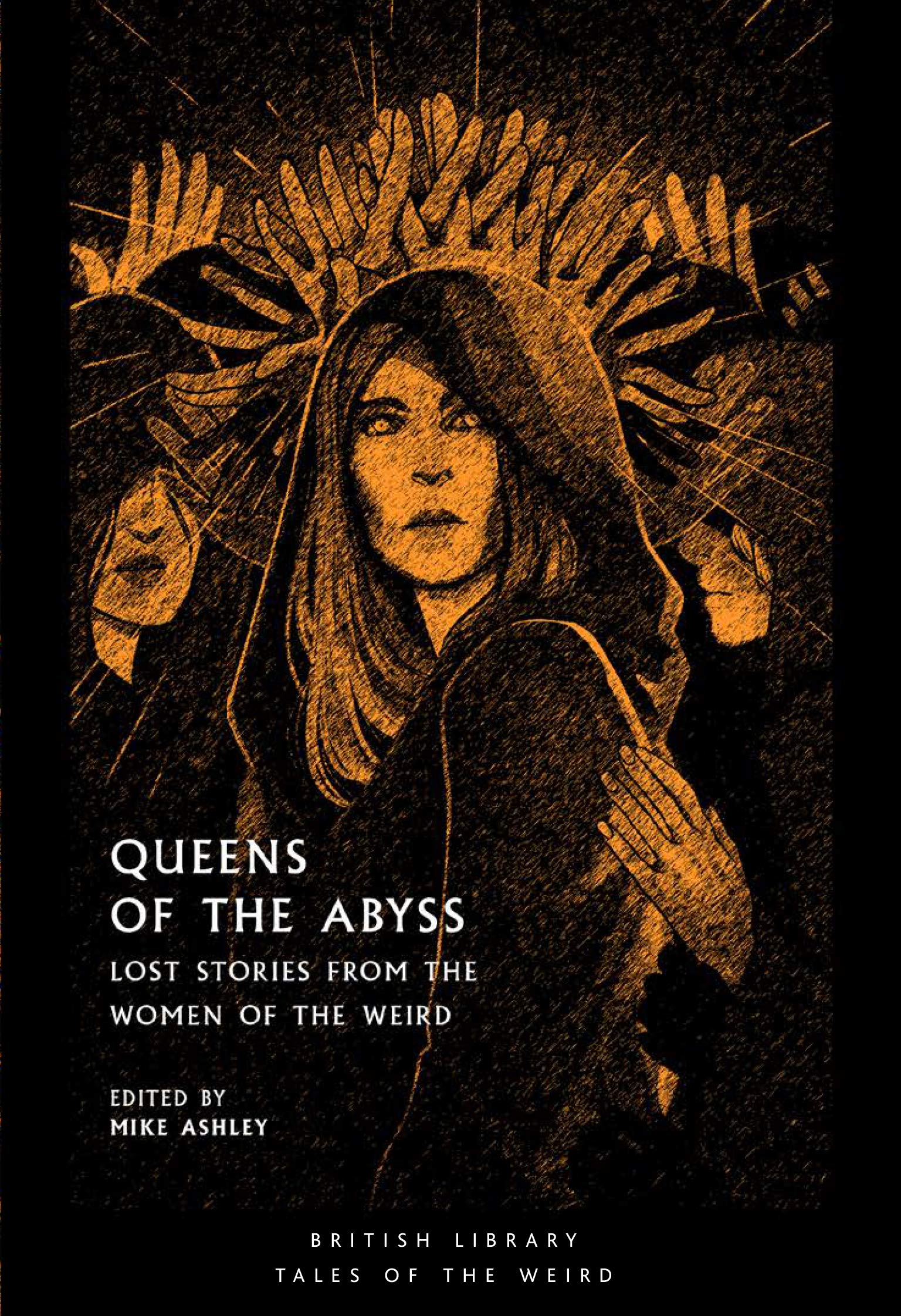
Queens of the Abyss: Lost Stories from the Women of the Weird

Wyrd Britain reviews 'Queens of the Abyss: Lost Stories from the Women of the Weird' edited by Mike Ashley and published by British Library.
Mike Ashley (ed)
British Library

It is too often accepted that during the 19th and early 20th centuries it was the male writers who developed and pushed the boundaries of the weird tale, with women writers following in their wake—but this is far from the truth. This new anthology follows the instrumental contributions made by women writers to the weird tale, and revives the lost authors of the early pulp magazines along with the often overlooked work of more familiar authors. See the darker side of The Secret Garden author Frances Hodgson Burnett and the sensitively-drawn nightmares of Marie Corelli and Violet Quirk. Hear the captivating voices of Weird Tales magazine contributors Sophie Wenzel Ellis, Greye La Spina, and Margaret St Clair, and bow down to the sensational, surreal, and challenging writers who broke down the barriers of the day. Featuring material never before republished, from the abyssal depths of the British Library vaults.

I've read a fair few of these British Library anthologies now and generally (as is often the case with anthologies) they've been a bit of a mixed bag but leaning towards the good and this one is no exception.

Wyrd Britain reviews 'Queens of the Abyss: Lost Stories from the Women of the Weird' edited by Mike Ashley and published by British Library.
Firstly let's address the word 'Lost' in the title. Yes, for the most part these are all pretty damn obscure stories buut I'm not sure you could ever describe Marjorie Bowen's tale of selfishness and indolence, 'The Bishop of Hell', which I probably have in at least a dozen anthologies in my collection.  May Sinclair's 'The Nature of the Evidence' whilst certainly being more obscure than Bowen's tale again hardly counts as a 'lost' story.  The others though are far less anthologised, some deservedly so, but some proved a real treat.

Mary Braddon's 'A Revelation' opens the book in classic Victorian style all familial intrigue and visions from beyond the grave.  It's a solid but fairly uninspiring sort of story. Marie Corelli has a more religious side on display with her story of love, betrayal and forgiveness in the naively charming 'The Sculptor's Angel' whilst Edith Nesbit follows a similar route but with the forgiveness spurned in 'From the Dead'.  Frances Hodgson Burnett's 'The Christmas In The Fog' is a purportedly true Xmas tale of her travel across the Atlantic, it's very Dickensian and very dull whilst Marie Belloc Lowndes gives us a love story that's too convenient by half.

Alicia Ramsey's 'A Modern Circe' is a slight folklorish tale of seductive witchcraft and murder which would probably have been dragged out to novel length these days but it's quite long enough here.  Greye La Spina's vampire tale 'The Anti-Macassar' on the other hand would have benefitted greatly from more room as what is a sprightly and enjoyable story is almost spoiled by a jarring ending.

We slip into science fiction for Sophie Wenzel Ellis' 'White Lady' as a young man falls in love with a plant he's invented much to the dismay of his fiance.  It's suitably silly but if that premise sounds your sort of thing then I'd rather direct your attention towards Valancourt Books' reprint of Ronald Fraser's fabulously bonkers 'Flower Phantoms'.

G.G. Pendarves - who I'm sure I've read before but can't quite place - provides a real highlight with the creepily brutal 'The Laughing Thing' whereas Lady Eleanor Smith's 'Candlelight' was a witty but ultimately rather pointless farce.  Jessie Douglas Kerruish provides a fun tale of 'The Wonderful Tune' that raises the dead but Margaret St Clair's science fiction tale 'Island of the Hands' just felt out of place.

'The Unwanted' of Mary Elizabeth Counselman's rural Alabamatale is enjoyably daft but with a gentle heart before the book ends strongly with Leonora Carrington's fabulously odd 'The Seventh Horse'.

As I mentioned it's another strong entrant into this series but as has been the case with each of the others I've read it's a little patchy although as I've said often before what didn't work for me may well prove to be your favourite and if you've an interest in strange tales of the early 20th century then you really should be exploring this series.

Buy it here - UK / US.

..........................................................................................

If you enjoy what we do here on Wyrd Britain and would like to help us continue then we would very much welcome a donation towards keeping the blog going - paypal.me/wyrdbritain

Affiliate links are provided for your convenience and to help mitigate running costs.

Sunday, 6 March 2022

Legend of the Werewolf

Wyrd Britain reviews 'Legend of the Werewolf' starring Peter Cushing
One of the very few films made by Tyburn Film Productions,`The Legend of the Werewolf ' is a fun and occasionally funny romp very much in the tradition of the classic Hammer films but made at a time (1975) when such films were already seeming pretty old hat alongside US contemporaries such as 'The Exorcist' and 'The Texas Chain Saw Massacre' as well as UK movies like 'Death Line'.

Found running wild in the French woods as a child Etoile had been raised by wolves before being adopted by a circus family and displayed as the 'Wolf Boy'.  As an adult Etoile (David Rintoul - who I think many parents among you will recognise as the voice of 3 Peppa Pig characters including 'Dr Brown Bear') runs away to the city and finds work in a zoo alongside the keeper (Ron Moody).  There he falls in love with a prostitute (Lynn Dalby) but develops an irritating habit of growning hair, fangs and claws and snacking on her clientelle.

Directed by Hammer (and Amicus) veteran Freddie Francis from a script by Anthony Hinds (son of Hammer's founder William Hinds) who also wrote 'The Curse if the Werewolf' for, well, I'm sure you can see the pattern for yourself by now, starring Peter Cushing and with a cameo from Michael Ripper the links to the venerable studio were numerous and overt and the end result is an enjoyable last gasp of the classic British horror.


 ..........................................................................................


If you enjoy what we do here on Wyrd Britain and would like to help us continue then we would very much welcome a donation towards keeping the blog going - paypal.me/wyrdbritain

Affiliate links are provided for your convenience and to help mitigate running costs.

Tuesday, 1 March 2022

V for Vendetta

Wyrd Britain salutes Alan Moore and David Lloyd's 'V For Vendetta' on the 40th anniversary of it's publication.

1st March 2022 marks 40 years since the publication of the first issue of Warrior magazine featuring, amongst others,  the very first episode of Alan Moore and David Lloyd's groundbreaking 'V for Vendetta'.

Telling the story of the anarchist revolutionary 'V' as he unleases his plan to take down the fascist 'Norsefire' government that's come to power in the UK following a limited nuclear war that's left much of the world in ruins. He does this concealed behind the iconic imagery of Guy Fawkes and with the (often unwitting / unwilling) help of his young protege Evey.

'V for Vendetta' was to live long past Warrior's demise in early 1985 with DC comics reprinting and completing a coloured version of the story between September 1988 and May 1989 and then of course there was the movie adaptation in 2005. 

Wyrd Britain salutes Alan Moore and David Lloyd's 'V For Vendetta' on the 40th anniversary of it's publication.
Despite the superhero trappings 'V' is a far more complex character than was the norm in comics at that time and his actions throughout the book are often, at the very least, morally ambiguous as Moore led the charge to drag mainstream comics kicking and screaming out of it's comfortable little rut. Indeed one of the things that made Moore's work on 'V for Vendetta' so impressive is that he was doing it at the same time as he was writing other pioneering strips such as 'Marvelman' (later 'Miracleman') and 'The Bojeffries Saga' for the same magazine, 'D.R. & Quinch', 'The Ballad of Halo Jones', 'Skizz' and a barrel full of 'Future Shocks' for 2000AD, 'Captain Britain' for Marvel UK and 'The Saga of the Swamp Thing' for DC.  He even made time to release a 7" single with David J of Bauhaus as 'The Sinister Ducks'.

So, Wyrd Britain would like to take this opportunity doff our capotain hats to thank Moore, Lloyd and the team at Warrior and then DC for bringing us one of the seminal stories of modern comics.


..........................................................................................

If you enjoy what we do here on Wyrd Britain and would like to help us continue then we would very much welcome a donation towards keeping the blog going - paypal.me/wyrdbritain

Affiliate links are provided for your convenience and to help mitigate running costs.