This 1960 movie brings bickering, impoverished couple Jean (Patricia Dainton) and David Linton (Tony Wright) into ownership of a haunted house formerly belonging to Jean's aunt. Once there, the alcoholic, philandering David can not wait to offload the property and drink the proceeds, but Jean falls for the house and the settled life it promises.
Ghostly mishaps begin immediately with the poltergeist, named Patrick by the housekeeper Mrs O'Brien (Anita Sharp-Bolster), taking an instant dislike to David, an animosity only strengthened by his escalating contempt and murderous intent towards Jean.
For a movie filled with drink, adultery, theft, and attempted murder, 'The House in Marsh Road' is a decidedly polite affair. It's clunky editing belies a pretty packed script that would certainly have benefitted from another 30 minutes or so to really nail the landing but the core cast are fine, if a bit well-mannered, with Sandra Dorne (who also appeared in the ventriloquist horror, 'Devil Doll') as the vampish Valerie Stockley being the standout.
If you enjoy what we do here on Wyrd Britain and would like to help us continue, then we would very much welcome a donation towards keeping the blog going - paypal.me/wyrdbritain
Affiliate links are provided for your convenience and to help mitigate running costs.
Lennard Pearce (Grandad in Only Fool and Horses) stars as "Edward Langdon' an MP who, after the ritual murder of his wife, comes up with the novel idea of raising a mediaeval heretic (David Allister) from the dead, directing it to blow up a school, and therefore gaining support for his attempt to bring back the death penalty.
Pulled into his plan are Eileen' (Gwyneth Powell - Grange Hill's 'Mrs McClusky'), mother of one of the murdered children, a fish porter (Roger Bizley) and a psychiatrist (John Bennett) all of whom have a previous connection with the revenant.
Written, directed and produced by Ian F.H. Lloyd, it's a slow and strange little film with an almost lysergic atmosphere. With it's lethargic pacing, odd camera angles - so very many close-ups - and arthouse sensibilities it's not going to be for everyone, but revolving around a suitably eldritch performance from Allister as the undead heathen it's an intriguing entry in the annals of wyrd British film.
If you enjoy what we do here on Wyrd Britain and would like to help us continue then we would very much welcome a donation towards keeping the blog going - paypal.me/wyrdbritain
Affiliate links are provided for your convenience and to help mitigate running costs.
1967s 'Torture Garden' was the second of the Amicusportmanteau movies and, to these eyes at least, the worst of the seven. Starring, at the insistence of the American money men, Burgess Meredith and Jack Palance, and consisting of several stories by 'Psycho' author, Robert Bloch (who also adapted them), it's a hammy and bloodless affair.
With a framing device based around a carnival sideshow where, for a price, 'Dr Diablo' (Meredith) provides an extra scary experience for a group of punters allowing them a look through the shears of 'Atropos' (one of the Fates) at "things that can be". The "things" they see involve a homicidal psychic cat, a jealous piano, movie robots and Edgar Allan Poe and, with the exception of the last one, they are all as daft as they sound.
Meredith is in full 'Penguin' mode here hamming it up terribly, and I've never been an admirer of Palance, although he is at least playing somewhat against type here. Peter Cushing is relegated to a supporting role in the Poe segment and there are several Brit stalwarts like Michael Ripper and Maurice Denham striving valiantly too rescue the thing but the stories are weak and, whilst I've always liked how Amicus strove to present their stories with a more contemporary and even transatlantic setting in contrast to Hammer's gothic trappings this one feels both too American and not American enough. As always with these anthologies though the stories are quick and director Freddie Francis always had a masterful eye but this is one of the those movies that is worth watching more for it's place in history than for it's merits.
If you enjoy what we do here on Wyrd Britain and would like to help us continue, then we would very much welcome a donation towards keeping the blog going - paypal.me/wyrdbritain
Affiliate links are provided for your convenience and to help mitigate running costs.
Having located the lost tomb of Ra-Antef the team of archaeologists and Egyptologists (Jack Gwillim, Ronald Howard & Jeanne Roland) bring the plundered remains back to Britain where their brash American financier (Fred Clark) plans to exhibit the mummy as part of a touring show. Unfortunately there is the inevitable curse and their journey home is dogged by murder, mayhem and an enigmatic stranger (Terence Morgan) all of which they seem to take entirely in their stride.
By the mid 60s Hammer Films were releasing around half a dozen movies a year so it's inevitable that there's some slippage in quality amongst them. The studio's second mummy movie, bereft of Hammer's A-team of Cushing and Lee who've been replaced, for the most part, with a cast of unremarkable, jobbing actors, is a mess of cliches and contrivances that bumbles along entirely forgetting to unleash the Mummy until well over halfway through the film. Indeed, 'The Curse...' is such a stinker that the absurdity of the revelation in the final act is entirely predictable and it almost never fails to make me laugh every tme I get to it but it has some nice set pieces and the finale in the sewers is effectively done offering an unusual grandeur and a much needed change of setting.
Mummy movies are a tricky prosect to pull off - implacable, shuffling, encroaching murder monsters work so much better as a zombie hoard - and it takes some real filmic flair to pull it off which this movie has very little of as it's as slow, lumbering and wheezy as its monster but still, for all it's many faults, I like it and it's long been a rainy day movie at Wyrd Manor.
If you enjoy what we do here on Wyrd Britain and would like to help us continue then we would very much welcome a donation towards keeping the blog going - paypal.me/wyrdbritain
Affiliate links are provided for your convenience and to help mitigate running costs.
Young Nick Foster (Arnaud Morell) has a lot on his plate what with his parents being in America, moving into a new house, being the new boy at a posh new school, an occult obsessed R.E. teacher (Bert Parnaby), an incompetent au pair, two sisters (Donna Glaser & Sadie Herlighy) with terrifying hairdos, a bedroom that sounds like it's falling apart and a computer that keeps asking for help so it's little wonder that he's seeing a psychiatrist (Susannah York) and his new classmates are plotting to kill him because they think he's possessed.
Made by the Children's Film Unit - a charity that enabled young people to train in and experience all aspects of film-making - and screened on Channel Four in December 1985, 'Daemon' is a fun little creeper that doesn't quite make the best use of it's generous runtime and makes a vague, clunky, stab at some social commentary about the furore over video nasties but the kid actors are pretty solid, there's a nicely sympathetic performance from York - a patron of the charity - who genuinely seems to be enjoying herself and a suitably manic one from Parnaby and it all builds to a solid conclusion.
If you enjoy what we do here on Wyrd Britain and would like to help us continue then we would very much welcome a donation towards keeping the blog going - paypal.me/wyrdbritain
Affiliate links are provided for your convenience and to help mitigate running costs.
Adapted, as I'm sure you already know, from the John Wyndham classic, 'The Midwich Cuckoos', 'Village of the Damned' is the story of an invasion of sorts that begins when the entire village of Midwich is sealed off from the outside world by a cone of sleep. For four hours everything - human and animal, villager and visitor - inside the village boundaries immediately falls asleep. Waking with no memories of what has transpired it's not until 2 months later, when every woman of child bearing age is discovered to be pregnant, that the scale of the enigma begins to be revealed. The pregnancies develop inhumanly quickly and the babies are born simultaneously with each displaying strikingly similar characteristics. This accelerated development continues as the children mature at four times the speed of an entirely human child and display notable telepathic abilties.
Narrowing the focus from the novel, the film concentrates on one family, Professor Gordon Zellaby (George Sanders - 'Psychomania'), Anthea Zellaby (Barbara Shelley - 'Quatermass and the Pit') and their 'son' David (Martin Stephens - 'The Innocents') who ostensibly acts as the leader of the children, who are, despite not appearing for the the first 30 odd minutes, the undisputed stars - as well as the focus - of the film. The children, who operate a hive mind, are neatly conformist, joyless, quick to anger and utterly ruthless in it's expression and an obvious metaphor for the Nazi and Communist regimes that had so preoccupied minds over the previous decades and a reflection of the fear of the newly maturing baby-boomers and the societal changes they were inspiring - "Couldn’t you learn to live with us, and help us live with you?".
Anglo-German director Wolf Rilla in his only foray into science fiction plays a subtle hand avoiding those cliches that potentially would have littered the film if the originally planned US productions hadn't floundered. His version (and vision as one of the scriptwriters) emphasises the mundane reality of the village made weird by the actions of the cuckoos in the nest, the cosiness that Wyndham was famously accused of shown to be only a thin veneer covering the turmoil raging below - the accusations, the abuse, the fear, the violence - and the focus is kept deliberately narrow only hinting at the wider picture. There are no answers provided, Gordon Zellaby's solution is one of coldly pragmatic necessity that is a reflection of the children's nature - "if you didn’t suffer from emotions, from feelings, you could be as powerful as we are" - and the who and the how of the children is never revealed and both they and the movie are all the more chilling for it.
If you enjoy what we do here on Wyrd Britain and would like to help us continue then we would very much welcome a donation towards keeping the blog going - paypal.me/wyrdbritain
Affiliate links are provided for your convenience and to help mitigate running costs.
Here he plays an egomaniacal theatre director at the 'Théâtre de Mort' - a loosely disguised Théâtre du Grand-Guignol - where he is moulding a young actress with a tragic past 'Nicole Chapelle' (Jenny Till) into a star. Untrusting of both his intentions and his bullying manner are the fragile former ballerina 'Dani Gireaux' (Leila Goldoni - 'Invasion of the Body Snatchers') and her damaged police doctor 'Charles Marquis' (Julian Glover in one of his first starring roles and only a year away from becoming 'Colonel Breen') who also happens to be assisting in the investigation of a spate of murders.
Playing with Hammer-esque gothic pretentions along with hypnotism, vampirism and the occult - it even manages to crowbar in some near naked voodoo too - this is a film that never quite manages to fulfil its promises - like the murder victims it's remarkably bloodless - or make the most of the various narrative threads it hints at - everyone is just about damaged enough to be the culprit - but American director Samuel Gallu injects some nice giallo inspired stylistic flourishes and manages to hold everything together keeping us guessing as to the culprit all the way to the reveal but the final result is flawed and a little underwhelming but still an entertaining way to spend 90 minutes.
NB - at the end of the video below there's a short snippet of Christopher Lee talking about the movie.
Loosely based around H.P. Lovecraft's 'The Colour Out Of Space', 'Die, Monster, Die!' finds American 'Stephen Reinhart' (Nick Adams - 'Rebel Without a Cause', 'Invasion of Astro-Monster') called to the home of his fiance, 'Susan' (Suzan Farmer - 'Dracula: Prince of Darkness'), in the village of Arkham, where, shunned by all the villagers, yokels and doctors alike, her father 'Nahum' (Boris Karloff) is conducting experiments using a meteor that has landed in the grounds. Unortunately Nahum's experiments are having catastrophic effects mutating plants, animals and, inevitably, people.
The film is a bit of a mish mash of Hammer horror gothic pretentions - the faded grandeur of Hammer's own Oakley Court, mist wreathed graveyards and skeletons hanging from chains in cobwebby cellars - with Lovecraftian science fiction but Karloff is a reliable figure around which the story revolves, his deluded experiments as he attempts to revive the family's fortunes and banish memories of his diabolic father providing a sympathetic - if underdeveloped - core but Adams' brash personality - and ill fitting clothes - make him an unlikable lead, especially when cold-cocking Susan's mutated mother (Freda Jackson - 'The Brides of Dracula') with a candelabra.
It is however a fairly pacey romp that never really takes a breath and is often quite pretty to look at and, provided you don't think too hard about the plot, makes for a fun, and all too rare, Lovecraft adaptation.
If you enjoy what we do here on Wyrd Britain and would like to help us continue then we would very much welcome a donation towards keeping the blog going - paypal.me/wyrdbritain
Affiliate links are provided for your convenience and to help mitigate running costs.
Spanish director José Ramón Larraz' channels both his European contemporaries and the British gothic tradition in this fabulously gory sexploitation horror as murdered lovers Fran (Marianne Morris) and Miriam (Anulka Dziubinska) return to 'life' as vampires and lure unsuspecting men back to their mansion in the woods (actually the much filmed Oakley Court in Brey, Berkshire) for sexy time and, well, dinner.
Larraz plays fast and loose with the whole vampire thing keeping many of the gothic trappings - the house, the flowing black gowns, the graveyards, the aversion to daylight - but by making use of knives and broken glass these fangless - and often clothesless - vampires slice their unwitting lovers to drink, writhing orgasmically in the blood - this movie is anything but subtle - and becoming increasingly animalistic as the movie progresses.
What little story there is just about holds together as the two feed on a succession of men whilst seemingly keeping one, Ted (Murray Brown), around for snacks, licking at a slit on his arm - I did mention the aversion to subtlety - while being watched by curious caravanners Harriet (Sally Faulkner) and John (Brian Deacon). I wonder if there was an early script idea that explained more of the ladies origins - Who killed them? How they became vampires? Why they have a cellar full of Carpathian wine? - as there're a couple of indications, at the beginning and at the very end, that Ted was responsible for their murder but this is never explored and neither Fran nor Miriam seem to recognise him nor he them.
Beyond the fact that the story is really only an excuse to get some bums and boobs on the screen, Larraz, on the whole, does a pretty good job and the film is a fun watch. The sex scenes are typically overlong and overblown but when he puts his mind to it he manages to craft some scenes of ominous dread - most notably in the various scenes exploring the wine cellars - has an eye for a classic gothic trope and introduces some enjoyably oneiric touches particularly for Ted as he becomes increasingly weaker from all the blood loss, not to mention the wine and sex.
If you enjoy what we do here on Wyrd Britain and would like to help us continue then we would very much welcome a donation towards keeping the blog going - paypal.me/wyrdbritain
Any affiliate links are provided for your convenience and to help mitigate running costs.
It was only a matter of time before we got to the film that launched - well, revived - a studio and created countless cinematic legends and so here we are in the company of the venerable Professor Bernard Quatermass.
When Hammer released 'The Quatermass Xperiment' in 1955 it was a familiar commodity to the British public with Nigel Kneale's creation having been made as a six part serial by and shown to great success on the BBC just two years earlier.
The story follows the return of the sole survivor of the rocket ship launched by Quatermass' 'The British Experimental Rocket Group' and of the alien parasite that takes over his body leading to one of the most iconic endings in movie history.
Director Val Guest tweaking a screenplay by Richard Landau from the original script by Kneale does a masterful job of building the suspense ably assisted by a sympathetic performance from Richard Wordsworth (great-great-grandson of William) as the doomed astronaut Victor Carroon, a gently comedic performance from Jack Warner as Inspector Lomax and a slightly lumpen but enjoyably brusque performance in the title role from Brian Donlevy, an American brought in to help sell the movie to the US.
The end result is a movie whose impact, beyond the rejuvenating of Hammer studios and the myriad films and careers that flowed from it, still resonates today.
If
you enjoy what we do here on Wyrd Britain and would like to help us
continue then we would very much welcome a donation towards keeping the
blog going - paypal.me/wyrdbritain
Affiliate links are provided for your convenience and to help mitigate running costs.
Made in 1974 by Cyclone & Getty Pictures Corp and occasional director Jack Cardiff - more famous for his work as a cinematographer for the likes of Alfred Hitchcock and John Huston - 'The Mutations' (also known as 'Freakmaker') is the story of a mad scientist by the name of Professor Nolter (Donald Pleasence) who's attempting to create a plant / animal hybrid by feeding rabbits to a tree and by kidnapping and experimenting on his own students. Helping him in these endeavours is freak show owner Mr Lynch played, under heavy prosthetics, by Tom Baker in a very familiar looking outfit and who 2 months and 4 days on from the movie's release make his debut as The Doctor.
Truly it's a bit of a mess and really only composer Basil Kirchin who provides an often beautifully dissonant but also groovily jazzy and filmic score and the various cast members populating the freak show come out of the movie with their heads held high. Pleasence and Baker are both reliable enough and the fabulous Jill Haworth ('The Haunted House of Horror', 'It!' & 'Tower of Evil') is reduced to a little more than a bit part with the leads being given to the woefully wooden Brad Harris and Julie Ege neither of whom have the charisma or the acting chops to carry the film.
Cardiff isn't much of a director and after a promising start the film begins to lag and the monster when it appears is hysterically bad but beyond the creature feature there's a rather lovely little riff on Tod Browning's masterpiece 'Freaks' that's bursting to get out but never quite manages too.
If
you enjoy what we do here on Wyrd Britain and would like to help us
continue then we would very much welcome a donation towards keeping the
blog going - paypal.me/wyrdbritain
Affiliate links are provided for your convenience and to help mitigate running costs.
Starring Anne and Vicki Michelle
'Virgin Witch' is the story of two sisters who have run away from
home to become models but instead find themselves embroiled in a coven
of witches run by Patricia Haines and Neil Hallet.
One of the final films produced by the venerable Tigon British Film Productions - home of 'Witchfinder General' and 'The Blood on Satan's Claw' - it really is a load of sexploitation tosh and if there's an award for the director most successful at getting their actresses out of their clothes then Ray Austin must have been in the running in 1972 with the first 8 shots of the movie all being of topless women - although Pete Walker would perhaps have given him a run for the title with 'The Flesh and Blood Show' which opens with Luan Peters answering the door and running around her flat completely naked for several minutes.
The story, such as it is, is entirely secondary to the nudity as Austin
shoehorns in as much nubile flesh as possible. His direction is turgid and neither of the Michelle sisters have either the chops or presence to front the movie but I suspect their acting skills weren't top of the director's mind when they were hired
and both have subsequently disowned the film. Anne would, a year later,
go on to appear as a member of 'The Living Dead' biker gang in the
wonderful 'Psychomania' while her sister would appear in the gloriously trashy 'Spectre' and find fame in the dire 'Allo, 'Allo!' which she really should disown. The movie, after a slow start, does eventually pick up the pace and makes an attempt at forging an
ending that while intending to evoke the hallucinatory, bacchanalian,
orgiastic excess of a 1970s idea of a witches sabbath instead just looks
utterly daft and the whole thing just fizzles out.
If
you enjoy what we do here on Wyrd Britain and would like to help us
continue then we would very much welcome a donation towards keepin the
blog going - paypal.me/wyrdbritain
Affiliate links are provided for your convenience and to help mitigate running costs.
1970's 'Cry of the Banshee' was director Gordon Hessler's third film for American International Pictures (AIP) starring Vincent Price following 'The Oblong Box' and 'Scream and Scream Again' and is by far the less successful of the three - but still infinitely better than the Kiss movie he was to make in 1978.
Price is cast as Lord Edward Whitman a ludicrously evil presence at the centre of the film taking delight in hunting and torturing the nubile young ladies he and his sons, literally, brand as witches. Leading the witches is Elisabeth Bergner as Oona who in revenge for the death of her 'children' asks Satan for help which arrives in the form of Patrick Mower as Lord Whitman's groom, Roderick, a former foundling and the proud wearer of an ostentatious necklace.
Alongside them are Essy Persson as his wife Patricia who proves to be even more of a scenery chewer than Price which is quite something to behold as well as the likes of Sally Geeson, Michael Elphick and the great Hugh Griffith who's always worth watching.
This film is magnificently terrible, it's script is barely coherent, the acting is terrible and the film is entirely daft and it makes for a fairly punishing watch unless, of course, you, like me, have a bit of a penchant for the magnificently terrible in which case you'll have a great time and it does have a fabulous animated title sequence by Terry Gilliam.
If you enjoy what we do here on Wyrd Britain and would like to help us continue then we would very much welcome a donation towards keeping the blog going - paypal.me/wyrdbritain
Affiliate links are provided for your convenience and to help mitigate running costs.
One of the very few films made by Tyburn Film Productions,`The Legend of the Werewolf ' is a fun and occasionally funny romp very much in the tradition of the classic Hammer films but made at a time (1975) when such films were already seeming pretty old hat alongside US contemporaries such as 'The Exorcist' and 'The Texas Chain Saw Massacre' as well as UK movies like 'Death Line'.
Found running wild in the French woods as a child Etoile had been raised by wolves before being adopted by a circus family and displayed as the 'Wolf Boy'. As an adult Etoile (David Rintoul - who I think many parents among you will recognise as the voice of 3 Peppa Pig characters including 'Dr Brown Bear') runs away to the city and finds work in a zoo alongside the keeper (Ron Moody). There he falls in love with a prostitute (Lynn Dalby) but develops an irritating habit of growning hair, fangs and claws and snacking on her clientelle.
Directed by Hammer (and Amicus) veteran Freddie Francis from a script by Anthony Hinds (son of Hammer's founder William Hinds) who also wrote 'The Curse if the Werewolf' for, well, I'm sure you can see the pattern for yourself by now, starring Peter Cushing and with a cameo from Michael Ripper the links to the venerable studio were numerous and overt and the end result is an enjoyable last gasp of the classic British horror.
If you enjoy what we do here on Wyrd Britain and would like to help us continue then we would very much welcome a donation towards keeping the blog going - paypal.me/wyrdbritain
Affiliate links are provided for your convenience and to help mitigate running costs.
For Hammer, director Terence Fisher had a definite penchant for the classics having filmed various stories featuring Dracula both with and without his brides, Frankenstein and his various problematic patchwork monsters, mummies, werewolves, operatic phantoms, both faces of Dr Jekyll, the gorgon and even a couple of outings for Sherlock Holmes where the so called 'great detective' entirely fails to notice that he's transformed into Sir Henry Baskerville in the second one.
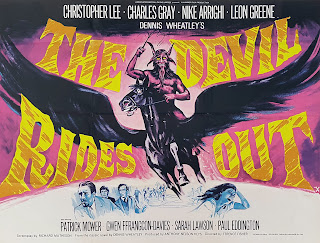
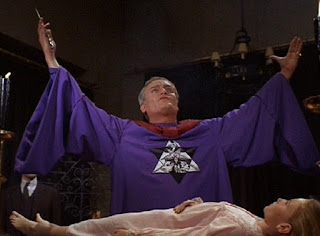
In this, one of his final films, Fisher introduced us to the aristocratic occultist 'Nicholas, The Duke de Richleau' (Christopher Lee) in an adaptation of Dennis Wheatley's 1934 novel. Here, the noble Duke and his good natured compatriot 'Rex Van Ryn' (a dubbed Leon Greene) spring to the aid of another friend 'Simon Aron' (Patrick Mower) who along with the glamorous psychic 'Tanith Carlisle' (Niké Arrighi) has fallen under the influence of satanic high priest 'Mocata' (Charles Gray).
Often cited as Fisher's best movie it certainly is a fantastically entertaining black magic romp filled with magic circles, spells, demonic conjuring, high speed chases and timely interventions. The script by 'I Am Legend' author Richard Matheson is breathless and it's cast, also featuring future prime minister Paul Eddington, are faultless with Gray in particular dripping with malice - as an aside I heartily recommend you take the time to watch him eat a ghost in 'The Gourmet'. I have always thought the ending to be something of a cop out but it's not a huge problem given how much fun the rest of the movie is.
If you enjoy what we do here on Wyrd Britain and would like to help us continue then we would very much welcome a donation towards keeping the blog going - paypal.me/wyrdbritain
Affiliate links are provided for your convenience and to help mitigate running costs.
Co-produced by regular Jesus Franco producer Harry Alan Towers, the man behind the series of 'Fu Manchu' films based on the books of Sax Rohmer and starring Christopher Lee, 'The Secret of Dorian Gray' was an Anglo, American, Italian, German attempt at relocating Wilde's novel into the world of late 1960s London in what they describe on screen "A modern allegory based.on the work of Oscar Wilde".
European movie heart-throb Helmut Berger makes for a suitably callous and narcissistic lead ever youthful and rampaging across Europe in a hedonistic, orgiastic, spree as, back home, hidden away in the attic his portrait degenerates. Supporting him are two screen stalwarts in Richard Todd (Asylum, House of Long Shadows) as the artist 'Basil Hallward' and Herbert Lom (The Pink Panther) as corrupting influence 'Henry Wotton' both of whom help distract from the sometimes clumsy acting and dubbing of various members of the cast.
Admittedly I'm stretching my own rules here as this is barely a British
movie but to my tastes it's mix of 60s Italian eroticism and the
permissiveness of fashionable, swinging London with Wilde's fin de siècle classic makes for the perfect amalgam. And, combined with some fabulous set and costume design, the cinematographers eye of director Massimo Dallamano (who had worked with Sergio Leone on both 'A Fistful of Dollars' and 'For A Few Dollars More') and an amazing soundtrack from Peppino de Luca & Carlo Pes - played by I Marc 4 - this is a real favourite around here.
If you enjoy what we do here on Wyrd Britain and would like to help us continue then we would very much welcome a donation towards keeping the blog going - paypal.me/wyrdbritain
Affiliate links are provided for your convenience and to help mitigate running costs.
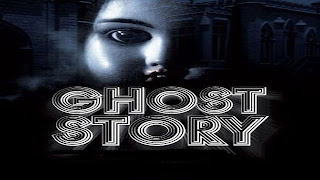
Three years after he made his directorial debut with the Jekyll and Hyde adaptation 'I, Monster' for AmicusStephen Weeks took matters into his own hands with a script he co-wrote with Philip Norman and Rosemary Sutcliff that locates itself in that most classic of settings, the haunted house.
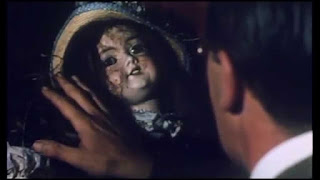
Three university acquaintances meet up at an uninhabited country pile for a weekend of shooting. The mismatched trio, wet and needy Talbot (Larry Dann), bullying Duller (Vivian Mackerrell) and aloof McFayden (Murray Melvin), are, we soon discover, barely on nodding terms and have been gathered together to test whether their presence in the house will bring forth the ghost. Living up to his name the blunt Duller, despite his fervent desire to see a ghost finds nothing but frustration and boredom, MacFayden is unsettled but it's the sensitive Talbot who via a creepy porcelain doll is thrown back in time into the middle of the avaricious and incestuous history of the previous inhabitants of the house, brother and sister Sophy (Marianne Faithfull) and Robert (Leigh Lawson) and their maid Rennie (Penelope Keith) along with the doctor (Anthony Bate) and Matron (Barbara Shelley) of the nearby asylum.
'Ghost Story' was obviously made on a budget much of which I suspect was used up on the odd decision to film mostly in India. Weeks does conjure up an effectively creepy atmosphere via some unusual camera angles, some effective visual sleight of hand and a great score from Pink Floyd collaborator Ron Geesin but the film is poorly lit and let down by some truly desperate acting from the main cast and, particularly in the early part of the film some clumsy attempts at comedy. It does have its moments though and as it builds to a climax there are some very effective moments including one sequence that put me in mind of the glorious hallucinatory ending of the Ealing classic 'Dead of Night' and in the final reckoning 'Ghost Story' provides some entertaining no budget creepiness.
If you enjoy what we do here on Wyrd Britain and would like to help us continue then we would very much welcome a donation towards keeping the blog going - paypal.me/wyrdbritain
Affiliate links are provided for your convenience and to help mitigate running costs.
In this version Freud obsessed psychiatrist Dr Charles Marlowe (Christopher Lee) invents a potion that "destroys the super-ego" rendering people either utterly docile, or competely amoral. It's not long - following two human tests and an animal one that makes this very much not a film for cat lovers - before Marlowe is testing it on himself whereupon he transforms into a grinning, psycopathic, hedonist named Edward Blake.
'I, Monster' has long had a poor reputation mostly due to it's studio bound and slightly talky script and Amicus were never at their best when parroting Hammer's gothic pretentions but with a strong central performance aided by typically solid support from a much underused Peter Cushing and some fairly bog standard support from the reliably terrible Mike Raven it's a solid enough adaptation that's perhaps slightly over-reverential of the source material making it drag a bit as he stretches the story out to fill the run time.
If you enjoy what we do here on Wyrd Britain and would like to help us continue then we would very much welcome a donation towards keeping the blog going - paypal.me/wyrdbritain
Affiliate links are provided for your convenience and to help mitigate running costs.
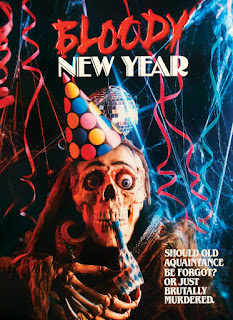
It's 1987 and in an improbable series of events five English teenagers and one American find themselves shipwrecked on an island after fleeing an angry trio of be-denimed fairground workers named Dad, Ace and The Bear. On the island they discover a hotel all decked out to celebrate New Year, in June, where they each experience inexplicable events before falling prey to the spirits in the hotel and the angry fairground folk.
The cast are uniformly terrible and as such you'll be glad to see the
back of them and will care little when they meet their timely demise.
This was the fifth and final horror that director Norman J. Warren made between 1977 ('Satan's Slave') and 1987 and is certainly the weakest. It has some dumb fun ideas but unfortunately they're all ones we've seen before in better movies by the likes of Fulci and Raimi but if you think of it as a big silly tribute to the various things and folks it's cribbed from then it makes for a fun, relentlessly daft, ride.
If you enjoy what we do here on Wyrd Britain and would like to help us continue then we would very much welcome a donation towards keeping the blog going - paypal.me/wyrdbritain
Someone is offing Santas in this wonderfully terrible 1984 slasher directed by and starring Edmund Purdom.
Featuring a brief cameo from Caroline Munro this is a low low budget, barely cohesive (or coherent) attempt at the video nasty market that is neither gory enough nor T&A enough to work. Various Santas are subjected to some inventive ends whilst the murders are investigated by the most inept coppers this side of Keystone but uninspired acting and directing means it never really gets going although it does trigger some unintentional chuckles along the way.
If you enjoy what we do here on Wyrd Britain and would like to help us continue then we would very much welcome a donation towards keeping the blog going - paypal.me/wyrdbritain
Affiliate links are provided for your convenience and to help mitigate running costs.