Here he plays an egomaniacal theatre director at the 'Théâtre de Mort' - a loosely disguised Théâtre du Grand-Guignol - where he is moulding a young actress with a tragic past 'Nicole Chapelle' (Jenny Till) into a star. Untrusting of both his intentions and his bullying manner are the fragile former ballerina 'Dani Gireaux' (Leila Goldoni - 'Invasion of the Body Snatchers') and her damaged police doctor 'Charles Marquis' (Julian Glover in one of his first starring roles and only a year away from becoming 'Colonel Breen') who also happens to be assisting in the investigation of a spate of murders.
Playing with Hammer-esque gothic pretentions along with hypnotism, vampirism and the occult - it even manages to crowbar in some near naked voodoo too - this is a film that never quite manages to fulfil its promises - like the murder victims it's remarkably bloodless - or make the most of the various narrative threads it hints at - everyone is just about damaged enough to be the culprit - but American director Samuel Gallu injects some nice giallo inspired stylistic flourishes and manages to hold everything together keeping us guessing as to the culprit all the way to the reveal but the final result is flawed and a little underwhelming but still an entertaining way to spend 90 minutes.
NB - at the end of the video below there's a short snippet of Christopher Lee talking about the movie.
There is, perhaps, little new information here for horror devotees but as an introduction and an overview to the genre it's hard to beat and Gatiss is always an engaging host.
If you enjoy what we do here on Wyrd Britain and would like to help us continue then we would very much welcome a donation towards keeping the blog going - paypal.me/wyrdbritain
Any affiliate links are provided for your convenience and to help mitigate running costs.
Regular Wyrd Britain readers may have noticed that I have a soft spot for the late 60s and early 70 horrors where the gothic was melded with the modern and dusted with a sprinkling of (usually poorly understood) groovy, countercultural cool. So, it'll probably come as no surprise when I tell you that I'm a fan of Christopher Lee's final two Dracula movies that were made and released in the early 70s, 'Dracula A.D. 1972' and 'The Satanic Rites of Dracula' (presented below with it's awful US title) despite their well deserved reputations.
Written by 'Doctor Who' ('Inferno', 'The Mind of Evil'), 'Ace of Wands' and future 'Sapphire and Steel' writer Don Houghton, who'd also written the previous movie and who would subsequently write the following one,'The Legend of the 7 Golden Vampires', the film incorporates distinct spy-fi elements - giant computers, tiny tape recorders and weaponised plagues - mixed with ostentatious occult dialogue - "Evil rules, y'know - it really does! .. Nothing is too vile; nothing is
too dreadful - too awful; you need to know the terror, the horror,
Lorrimer; to feel the threat of disgust - the beauty of obscenity!" - in an attempt to revitalise the series, it didn't work.
Dracula, for me at least, works best on a human level as a man who's just looking for love and lunch and so this version of him as the enigmatic head of a genocidal global cabal seems odd and Lee made a much more likely world dominating villain as Scaramanga in the following years' 'The Man with the Golden Gun' and had made his disatisfaction with the movie known long before release. Peter Cushing, reprising the role of Lorrimer Van Helsing, is, as always, perfect and it's always a treat to see him and Lee together even in the scene where one of them is doing a terrible Bela Lugosi impersonation but the stand-out scene is with Freddie Jones who, in his brief appearence as Dr. Julian Keeley, delivers the lines quoted above to a Cushing who's slowly realising the depth of his friends madness.
You have to admire Hammer and Houghton's ambition but the film just doesn't have the necessary spark to do what they wanted it to and has the feel of an ambitious but overlong TV pilot along the lines of 'Baffled!' or 'Spectre'. Shorn of his gothic trapping the Count looks a little silly and much of the plot feels entirely pointless but there's an overabundance of energy with the likes of Joanna Lumley, Michael Coles, Richard Vernon and William Franklyn fighting bikers, snipers and biters whilst fashioning improvised stakes and crosses before the movie ends with the single most novel (note I didn't say good) take on a Dracula staking ever filmed, death by prickly thorns (and fence). But as I said at the start, I kind of love it. For me what it is far outweighs what it isn't and what it is is fun, not at all horrifing or terrifying or even suspenseful and it is, in so many ways, just bad but I still love it.
If you enjoy what we do here on Wyrd Britain and would like to help us continue then we would very much welcome a donation towards keeping the blog going - paypal.me/wyrdbritain
Any affiliate links are provided for your convenience and to help mitigate running costs.
Read by Christopher Lee, 'The Hound of Death" was first published in the collection of the same name in 1933, which, unusually for Agatha Christie, consisted of several stories of a supernatural bent.
The story of an Englishman intrigued by the story of a young Belgian nun who is believed to have conjured a bolt of lightning killing a group of invading German soldiers and destroying her convent and leaving behind only the outline of a hound scorched into the ruins. Visiting her in her new home in Cornwall he discovers her wracked by hallucinations and under the treatment of a young and ambitious doctor.
There is much here that will be familiar to Christie fans but this unusual foray into the realms of the supernatural makes for an enjoyably heady mix particularly when narrated by so distinctive and iconic a voice as Lee's with all it's associated cultural weight.
If
you enjoy what we do here on Wyrd Britain and would like to help us
continue then we would very much welcome a donation towards keeping the
blog going - paypal.me/wyrdbritain
Any affiliate links are provided for your convenience and to help mitigate running costs.
For Hammer, director Terence Fisher had a definite penchant for the classics having filmed various stories featuring Dracula both with and without his brides, Frankenstein and his various problematic patchwork monsters, mummies, werewolves, operatic phantoms, both faces of Dr Jekyll, the gorgon and even a couple of outings for Sherlock Holmes where the so called 'great detective' entirely fails to notice that he's transformed into Sir Henry Baskerville in the second one.
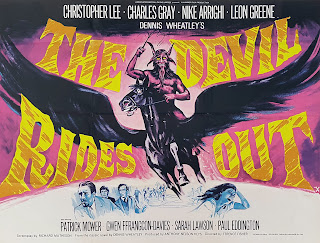
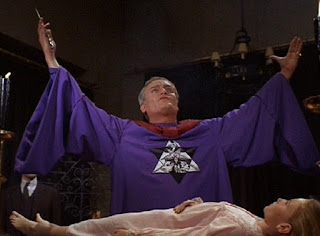
In this, one of his final films, Fisher introduced us to the aristocratic occultist 'Nicholas, The Duke de Richleau' (Christopher Lee) in an adaptation of Dennis Wheatley's 1934 novel. Here, the noble Duke and his good natured compatriot 'Rex Van Ryn' (a dubbed Leon Greene) spring to the aid of another friend 'Simon Aron' (Patrick Mower) who along with the glamorous psychic 'Tanith Carlisle' (Niké Arrighi) has fallen under the influence of satanic high priest 'Mocata' (Charles Gray).
Often cited as Fisher's best movie it certainly is a fantastically entertaining black magic romp filled with magic circles, spells, demonic conjuring, high speed chases and timely interventions. The script by 'I Am Legend' author Richard Matheson is breathless and it's cast, also featuring future prime minister Paul Eddington, are faultless with Gray in particular dripping with malice - as an aside I heartily recommend you take the time to watch him eat a ghost in 'The Gourmet'. I have always thought the ending to be something of a cop out but it's not a huge problem given how much fun the rest of the movie is.
If you enjoy what we do here on Wyrd Britain and would like to help us continue then we would very much welcome a donation towards keeping the blog going - paypal.me/wyrdbritain
Affiliate links are provided for your convenience and to help mitigate running costs.
In this version Freud obsessed psychiatrist Dr Charles Marlowe (Christopher Lee) invents a potion that "destroys the super-ego" rendering people either utterly docile, or competely amoral. It's not long - following two human tests and an animal one that makes this very much not a film for cat lovers - before Marlowe is testing it on himself whereupon he transforms into a grinning, psycopathic, hedonist named Edward Blake.
'I, Monster' has long had a poor reputation mostly due to it's studio bound and slightly talky script and Amicus were never at their best when parroting Hammer's gothic pretentions but with a strong central performance aided by typically solid support from a much underused Peter Cushing and some fairly bog standard support from the reliably terrible Mike Raven it's a solid enough adaptation that's perhaps slightly over-reverential of the source material making it drag a bit as he stretches the story out to fill the run time.
If you enjoy what we do here on Wyrd Britain and would like to help us continue then we would very much welcome a donation towards keeping the blog going - paypal.me/wyrdbritain
Affiliate links are provided for your convenience and to help mitigate running costs.
In 'The Two Faces of Dr Jekyll' we find Paul Massie, a Canadian actor with a short history of appearances in British movies of this time, labouring under some ridiculous fake facial hair, as the driven and slightly deranged Dr Henry Jekyll attempting to "free the creature within" at which he succeeds with, for those around him at least, terrifying results unleashing his suave and utterly sociopathic alter ego Edward Hyde.
Massie, as Jekyll, is a bit of a ham but comes alive with wide eyed malice as Hyde whilst those around him, including Dawn Addams ('The Vampire Lovers') as Kitty Jekyll, Christopher Lee as the scrounging, caddish Paul Allen and David Kossoff ('The Mouse That Roared') s Dr Littauer, flounder against an uninspired script that despite some typically garish nightclub scenes and a tour of the lowlights of London never really manages to elicit much of a spark from neither cast nor director.
If you enjoy what we do here on Wyrd Britain and would like to help us continue then we would very much welcome a donation towards keeping the blog going - paypal.me/wyrdbritain
Affiliate links are provided for your convenience and to help mitigate running costs.
Professor Emmanuel Hildern (Peter Cushing) returns from an expedition to New Guinea with the skeleton of a mythological evil giant that he soon discovers can be revived through contact with water. Having being denied further funding by his asylum running half-brother Dr James Hildern (Christopher Lee) he begins to rush his experiments to use the skeleton to immunise the world from evil injecting his serum firstly into his lab monkey and, soon after, into his daughter Penelope (Lorna Heilbron). Needless to say things soon start to deteriorate for all involved as several storylines begin to converge leading to a grim but pleasingly ambivalent ending.
Here, director Freddie Francis has perhaps made a movie with slightly too many loose ends for them all to be successfully and fully explored in the time given but in the tradition of a number of other Tigon movies ('The Blood on Satan's Claw' & 'Witchfinder General') it's ambitions are to be celebrated and with Francis' cinematographer's eye it looks lovely.
If
you enjoy what we do here on Wyrd Britain and would like to help us
continue then we would very much welcome a donation towards keeping the
blog going - paypal.me/wyrdbritain
Affiliate links are provided for your convenience and to help mitigate running costs.
Investigating the disappearance of his brother, Peter, antiques dealer Robert Manning (Mark Eden) travels to Craxted Lodge in the town of Greymarsh Peter's last known whereabouts and coincidentally the town their family had previously called home back in ye olde days. Upon arrival he makes the acquaintance of the master of the house Morley (Christopher Lee) and his niece Eve (Virginia Wetherell) - who has a seeming penchant for throwing bacchanalian parties before dinner has even been served - and learns of their ancestor Lavinia (a body-painted and horned headdress adorned Barbara Steele) who had been burned at the stake as a witch - no prizes for guessing whose family had lit the fire - and local historian Professor John Marsh (Boris Karloff)
Lee is as effortlessly suave as ever but is essentially phoning in a part that he could play in his sleep and Eden, who had a long career including several roles in Wyrd Britain friendly TV shows but who is most well remembered in this country for his villainous stint in the soap opera Coronation Street (there's even a real world plaque marking the spot where his character died), just isn't lead material. Steele has essentially nothing to do beyond wearing that amazing looking costume and a very frail Karloff, just a year on from his late career highlight in Michael Reeves' 'The Sorcerers') and in one of his final roles gives a typically solid performance and there's even a quick, amusing and surprisingly meta joke at his expense.
If you enjoy what we do here on Wyrd Britain and would like to help us continue then we would very much welcome a donation towards keeping the blog going - paypal.me/wyrdbritain
Affiliate links are provided for your convenience and to help mitigate running costs.
Brash, materialistic American writer Kenneth Magee (Desi Arnaz, Jr.) accepts a bet from his publisher Sam Allyson (Richard Todd) that he can write a gothic classic of the calibre of Wuthering Heights in 24 hours given the right atmosphere. Relocating to a supposedly deserted manor house in Wales named, 'Bllyddpaetwr Manor where, in its gloomy corridors, he meets the eccentric Grisbane family and learns their terrible secret.
Made seemingly with the sole purpose of finally getting four horror icons Christopher Lee, Peter Cushing, Vincent Price and John Carradine onto the big screen together which is an absolute pleasure to see with each playing very much to type - Price in particular letting rip with his customary OTT style - with each making a memorable entrance from the shadows but unfortunately there is little else to recommend here.
Director Pete Walker ('The Flesh and Blood Show') and screenwriter Michael Armstrong's 'comedy' horror is a wasted opportunity all round with a paper thin plot and unfunny jokes cobbled together within an adaptation of the novel / play / movies Seven Keys to Baldpate.
Arnaz and Julie Peasgood (as Allyson's secretary Mary) have neither the chops nor the presence to carry the film and the presence of the four greats cannot make up for some very poor acting and the woeful script that inflicts on us an ending that will make you want to kick your TV screen in. It is, though, the one time that we got to see Cushing, Price, Lee, and Carradine together on screen and for that reason and pretty much only that reason it's worth at least a watch.
If you enjoy what we do here on Wyrd Britain and would like to help us continue then we would very much welcome a donation towards keeping the blog going - paypal.me/wyrdbritain
Affiliate links are provided for your convenience and to help mitigate running costs.
Written by 'Psycho' author Robert Bloch the movie revolves around a Scotland Yard Detective's rather lacklustre investigation of the disappearance of the latest tenant, a famous horror movie actor, and the stories he's told of the fates of the previous occupants.
We have shadows of Bloch's most famous creation here with two tales of madness and two of the supernatural. The stories are of variable quality with the third story featuring Christopher Lee being the standout but each has its charms as Peter Cushing elevates the second simply by his presence and Jon Pertwee and Ingrid Pitt's joyously hammy performances in the fourth are a sheer delight
In contrast to its title the movie is a remarkably bloodless affair - not a single drop - and seems designed to play to a slightly different audience to its brother portmanteaus. It's great fun though. It knows it's silly but tries to play it as straight as possible right up to the point where it just can't hold it in anymore and sticks some rubbish fangs onto The Doctor.
If you enjoy what we do here on Wyrd Britain and would like to help us continue then we would very much welcome a donation towards keeping the blog going - paypal.me/wyrdbritain
Affiliate links are provided for your convenience and to help mitigate running costs.
Five passengers board a train from London to (the fictional town of) Bradley. They all settle into the same compartment where they're joined by an old man by the name of 'Dr Schreck' who proceeds to use a tarot deck, his "house of horrors", to tell their fortunes. Spoiler - they're all doomed!
The most striking thing about the movie is the casting; Peter Cushing and Christopher Lee are quite understandable (not to mention pretty much compulsory) as are the host of reliable familiar faces littering each segment such as Michael Gough and Bernard Lee but the other four men in the compartment make for a strange bunch. Neil McCallum was a jobbing actor with nothing of note on his resume before this (or after to be honest), Alan Freeman was a popular BBC radio DJ presenting the long running 'Pick of the Pops' show who had no prior acting experience, Roy Castle was a comedic light entertainer making the shift into movies and who later that same year would again share a bill with Peter Cushing in 'Dr. Who and the Daleks' (UK / US) (also made by Amicus) and, perhaps strangest of all, future Hollywood royalty Donald Sutherland who having studied in the UK had appeared in a movie with Christopher Lee the previous year, the Italian horror 'Castle of the Living Dead ' (UK / US), and would make a movie for Hammer, 'Fanatic', that same year and then episodes of 'The Avengers' and 'The Saint' before Hollywood beckoned.
The five stories revolve around several established horror tropes - a werewolf, a killer plant, voodoo, vengeful body parts and vampires - to varying degrees of success and seriousness. I have a real soft spot for this movie and for me it's Lee versus the disembodied hand that is the standout segment although perhaps the most memorable is Roy Castle's jazz voodoo story - also featuring Kenny Lynch, the Tubby Hayes Quartet and a great tune - but the general goofiness of Castle's performance and some casual racism have always grated on me slightly. McCallum's werewolf tale is the most Hammeresque of the five tales with it's big old house, ancient curses and hidden crypts whereas Freeman versus the foliage and Sutherland's sanguinary spouse most closely ressemble the Amicus template of movies to come although neither is particularly memorable.
It's far from being the best of the Amicus portmanteaus - I'll let you debate which is - but to my mind it's definitely the most fun. For the most part it's tongue is firmly planted in it's cheek and even when it's being serious director Francis seemingly can't help injecting a hint of silliness - Michael Gough taunting Lee with paper cut-out chimps. Like I said earlier I have a enduring soft spot for this movie, it's one of several that I turn to when I need a smile putting on my face as it never fails. Very few of it's constituent parts - one, maybe - would be able to hold their heads high in more rarified company but all together here they complement each other wonderfully.
If you enjoy what we do here on Wyrd Britain and would like to help us continue then we would very much welcome a donation towards keeping the blog going - paypal.me/wyrdbritain
Affiliate links are provided for your convenience and to help mitigate running costs.
Lee plays retired policeman Colonel Bingham who is reinstated to the force to investigate the deaths of various wealthy members of the board of trustees of a Scottish orphanage. His investigations soon focus on 'Mary' (played by Gwyneth Strong later to be better known as Cassandra in 'Only Fools and Horses'), the sole survivor of a bus crash that has killed 3 more trustees, and her, mad as a hatter, mother played by Diana Dors who is way out of her depth here gnawing on every available piece of scenery and, not her fault I know but, if you watch closely you'll notice that while fleeing the police on the island she hides under the same bush twice which always makes me chuckle.
The end result is unfortunately a bit of a mess with the film suffering under a miniscule budget, underwhelming characters - Lee in particular, perhaps because of the producer responsibilities hanging over him, seems unable to invest any actual life into his role - and a script in desperate need of a rewrite. In his career Sasdy made some great work but he did have a tendency for sluggish pacing in his movies and such is the case here and frankly there are too many red herrings and scenes that in retrospect just make no sense and at the end alongside the who, the what and the why we are never given a satisfying how and so are left with a somewhat unfulfilling but shockingly brutal ending.
'Nothing But the Night' has a poor legacy and, in truth it's one that is well deserved, but equally it's always fun to see the two greats together and we can only lament what could have been and chalk this up as an intriguing failure and in its finale see a premonition of the greatness to come in Lee's next movie.
If you enjoy what we do here on Wyrd Britain and would like to help us continue then we would very much welcome a donation towards keeping the blog going - paypal.me/wyrdbritain
Affiliate links are provided for your convenience and to help mitigate running costs.
Made in 1965 by the Amicus studio 'The Skull' is another pairing of the Peter Cushing / Christopher Lee dream team. This time out they play collectors of the arcane, Cushing's Dr Christopher Maitland because he writes about it and Lee's Sir Matthew Phillips as a lover of such objects. They source their various macabre mementos at auctions where we first meet the three stars and from dodgy dealer in macabre memorabilia Anthony Marco (Patrick Wymark) who brings to Cushing's attention the skull of the Marquis de Sade.
The skull, it transpires, has a distinctly chequered post-mortem past and had been the property of Sir Matthew who, finally released from its malign influence, definitely doesn't want it back and warns Maitland away from it but unfortunately it's already got its teeth into him and events soon spiral out of control.
With a screenplay initially written by Amicus head Milton Subotsky from an original story by 'Psycho' author Robert Bloch the film was directed (and rewritten) by the legendary Freddie Francis the director of a plethora of Hammer and Amicus delights and the bonkers genius that is 'Mumsy, Nanny, Sonny & Girly' as well as being cinematographer on 'The Innocents' and David Lynch's cinematographer of choice on 'The Elephant Man', 'Dune' and 'Straight Story'. 'The Skull' is as stunning looking as you'd expect from a man with Francis' pedigree although it has to be said the occasional skulls eye view is a bit naff but the hallucinatory Kafka-esque courtroom scene will tell you exactly why Lynch chose to work with Francis.
Cushing and Lee (who, it transpires, cheats horribly at snooker) are both on fine form and Wymark is gloriously creepy. It's by no means an action packed movie and indeed is a slow build
carried along by the strength of the cast and that it looks so damn
pretty.
If you enjoy what we do here on Wyrd Britain and would like to help us continue then we would very much welcome a donation towards keeping the blog going - paypal.me/wyrdbritain
Affiliate links are provided for your convenience and to help mitigate running costs.




 /
/  ), '
), '

 /
/  ), '
), ' /
/  ), '
), ' /
/  ), '
), ' /
/  ), '
), ' /
/  ).
). 
 /
/  ) (also made by Amicus) and, perhaps strangest of all, future Hollywood royalty
  /
/  ), and would make a movie for Hammer, '


 /
/  or watch it below.