Dion Fortune Weiser Books Dr. Taverner runs a
nursing home -- but it is not by any means a conventional one. It is a
hospital for all manner of unorthodox mental disturbances, ranging from
psychic attack and disruptions in group minds to vampirism. These are
cases that conventional psychology cannot cure. Only the secret
knowledge of Taverner, based on esoteric training, is enough to unravel
the solutions.Each story in this collection is a complete case, as
gripping and as entertaining as the stories of Sherlock Holmes. They
take you into the inner worlds of the human mind -- a world full of
strange twists and unexpected happenings!
Dion Fortune was an occultist, a member of the Hermetic Order of the Golden Dawn and the founder of the Fraternity of the Inner Light and she is still regarded as one of the most influential and important figures in that field. Alongside the books she wrote on those topics she also wrote six books of fiction including this collection of short stories detailing the escapades of psychiatrist and magician Dr. Taverner.
I love an occult detective tale so despite it's awful cover art jumped at this as soon as I discovered its existence. In the grand tradition of these things we have a detective and chronicler set up with the twist being perhaps that Dr Tavener is perhaps far more occult than detective. In the pages of this chronicle we find Taverner and his Watson, Dr Rhodes, encounter vampires, rogue magicians, devil dogs, astral projections, greedy relatives and more in a series of sprightly tales.
Fortune was no particular wordsmith and, especially in the earlier stories, one often feels like she is trying to recruit the reader into her Fraternity and perhaps engaging in a sort of wish fulfilment. However, when she gets into her swing on the later tales such as the excellent 'A Daughter of Pan', 'The Sea Lure' and 'A Son of the Night' she shows she can spin a very entertaining yarn and seems far more comfortable with more earthy mysteries than those dealing with more 'traditional' horrors and by the end I was fully invested in the lives of the two leads.
If you enjoy what we do here on Wyrd Britain and would like to help us continue then we would very much welcome a donation towards keeping the blog going - paypal.me/wyrdbritain
Affiliate links are provided for your convenience and to help mitigate running costs.
Ghosts, shamans, aliens,
angels and the weirdness of life all make their appearance in this new
collection of Rosalie Parker’s strange tales. Her stories depict subtly
shifting realities, and celebrate the fluidity of the barrier between
the uncanny and the everyday. These twenty-five stories vary from contes
to longer pieces, and explore the traditions of the weird tale in fresh
and original ways.
This is my second trip into the imagination of Rosalie Parker, co-publisher of the fabulous Tartarus Press and editor of their Strange Tales series although the two collections of hers that I've read have been released by fellow Yorkshire publishing house PS Publishing. Like the previous volume (Damage), 'Through the Storm', consists of a large number of fairly short tales (often between 5 and 10 pages in length) that explore matters strange and again like the previous there is a distinctly bucolic air to the stories with Parker taking a delight in the elemental settings such as the moors and the sea and finding little to recommend in domesticity or security.
For me she is always at her best when she's letting her imagination fly off in the most unexpected directions at which point her work resonates most loudly and shimmers with uncanny life such as in 'The Cinema' or when she goes for the heart like in 'Fever' where we find the venerable master of the weird still exploring the byways of his beloved London and finding solace in the now ancient soil of his own Caerleon and still sharing those adventures with those who need them.
'Through the Storm' is one of those curious books that seems like it should whizz past. Each story takes no more than a few minutes to read but I quickly found myself eking it out over the course of several weeks and dipping in each day eager to see where she was taking me today.
If you enjoy what we do here on Wyrd Britain and would like to help us continue then we would very much welcome a donation towards keeping the blog going - paypal.me/wyrdbritain
Affiliate links are provided for your convenience and to help mitigate running costs.
'Satan's Slave' is the first of a trio of horror films released between 1976 and 1978 by director Norman J Warren who died earlier this week (11/3/21).
Travelling to visit the uncle and cousin she'd previously known nothing about - never a good sign - Catherine Yorke (Candace Glendenning - 'Tower of Evil' (UK / US) & 'The Flesh and Blood Show' (UK / US)) is involved in a car crash that kills her parents. Recuperating in her Uncle Alexander's mansion and getting to know her creepy and psychotic cousin Stephen (Martin Potter) whilst experiencing vivid flashbacks to the torture and murder of a young woman she remains entirely unaware of their true nature and the plans they have for her.
'Satan's Slave' with it's country house and it's nefarious necromancers owes a debt to the films of the Hammer and Amicus studios and the books of Dennis Wheatley but this is pure 1970s hexploitation never missing an opportunity to put a male character in a robe or to get a female character out of hers. Neither Glendenning nor Potter have much in the way of screen presence but Michael Gough with his effortless portrayal of the suavely devilish Alexander and Barbara Kellerman as his secretary Frances both have talent to spare.
The story moves at a snail's pace and there really isn't enough here to fill it's 80 minute runtime and would have benefitted from losing 20 minutes or so but as a low budget schlock horror with it's toes dipped in both the Brit horrors of the past decade and the new Euro horrors of the (then) current decade it's an interesting and fun watch.
If you enjoy what we do here on Wyrd Britain and would like to help us continue then we would very much welcome a donation towards keeping the blog going - paypal.me/wyrdbritain
Affiliate links are provided for your convenience and to help mitigate running costs.
The music from week twenty six and our final week of our celebration of the 37 years worth of Peel Sessions.
This week... The Vapors (1979) Brand X (1976) The Clash (1978) Urusei Yatsura (1996) Broadcast (2003) The First 3 Peel Sessions: Traffic, Tomorrow, The Pink Floyd (1967)
If you enjoy what we do here on Wyrd Britain and would like to help us continue then we would very much welcome a donation towards keeping the blog going - paypal.me/wyrdbritain
Affiliate links are provided for your convenience and to help mitigate running costs.
M. John Harrison GollanczShaw had a breakdown, but he's getting himself back together. He has a single room, a job on a decaying London barge, and an on-off affair with a doctor's daughter called Victoria, who claims to have seen her first corpse at age thirteen. It's not ideal, but it's a life. Or it would be if Shaw hadn't got himself involved in a conspiracy theory that, on dark nights by the river, seems less and less theoretical... Meanwhile, Victoria is up in the Midlands, renovating her dead mother's house, trying to make new friends. But what, exactly, happened to her mother? Why has the local waitress disappeared into a shallow pool in a field behind the house? And why is the town so obsessed with that old Victorian morality tale, The Water Babies? As Shaw and Victoria struggle to maintain their relationship, the sunken lands are rising up again, unnoticed in the shadows around them.
From his unlovely and lonely bedsit Shaw lives a life of dislocation and vague disinterest. His life is stalled and he has little interest in restarting it. A chance meeting in a graveyard nets him a new job delivering mysterious but seemingly mundane parcels around the country, attending séances and answering the phones on a barge-cum-office for a one man publisher / website.
Meanwhile, Shaw's occasional lover Victoria has taken up residence in her deceased mother's house in the Midlands where she meets a cafe owner with a fondness for water and the strange group that make up her (Pearl's) extended family.
Essentially we are treated to two views of a series of events as enigmatic as any Robert Aickman story and throughout I couldn't shake the feeling that what I was reading was a 21st century British reinvention of Lovecraft's Innsmouth stories as strange, aquatic beings slowly populate the land. It's far less straightforward than that though as Harrison avoids explanatory clichés and amidst the strangeness tells a very human story of obsessions, of strained and confused personal interactions and of the difficulties of communication in a time when it is essentially easier than ever to reach out but perhaps harder than ever to be heard and understood.
If you enjoy what we do here on Wyrd Britain and would like to help us continue then we would very much welcome a donation towards keeping the blog going - paypal.me/wyrdbritain
Affiliate links are provided for your convenience and to help mitigate running costs.
Whilst Nigel Kneale will always, thanks to the success of Quatermass, be most strongly remembered for his science fiction stories throughout his career he would regularly return to stories of a more supernatural bent where he could explore the intersection between the rational and the supernatural such as the brilliant 'Murrain', in episodes of his TV series 'Beasts' such as 'Baby' and, in 1966 for Hammer Studios, in 'The Witches' his adaptation of Norah Loft's novel 'The Devil's Own'.
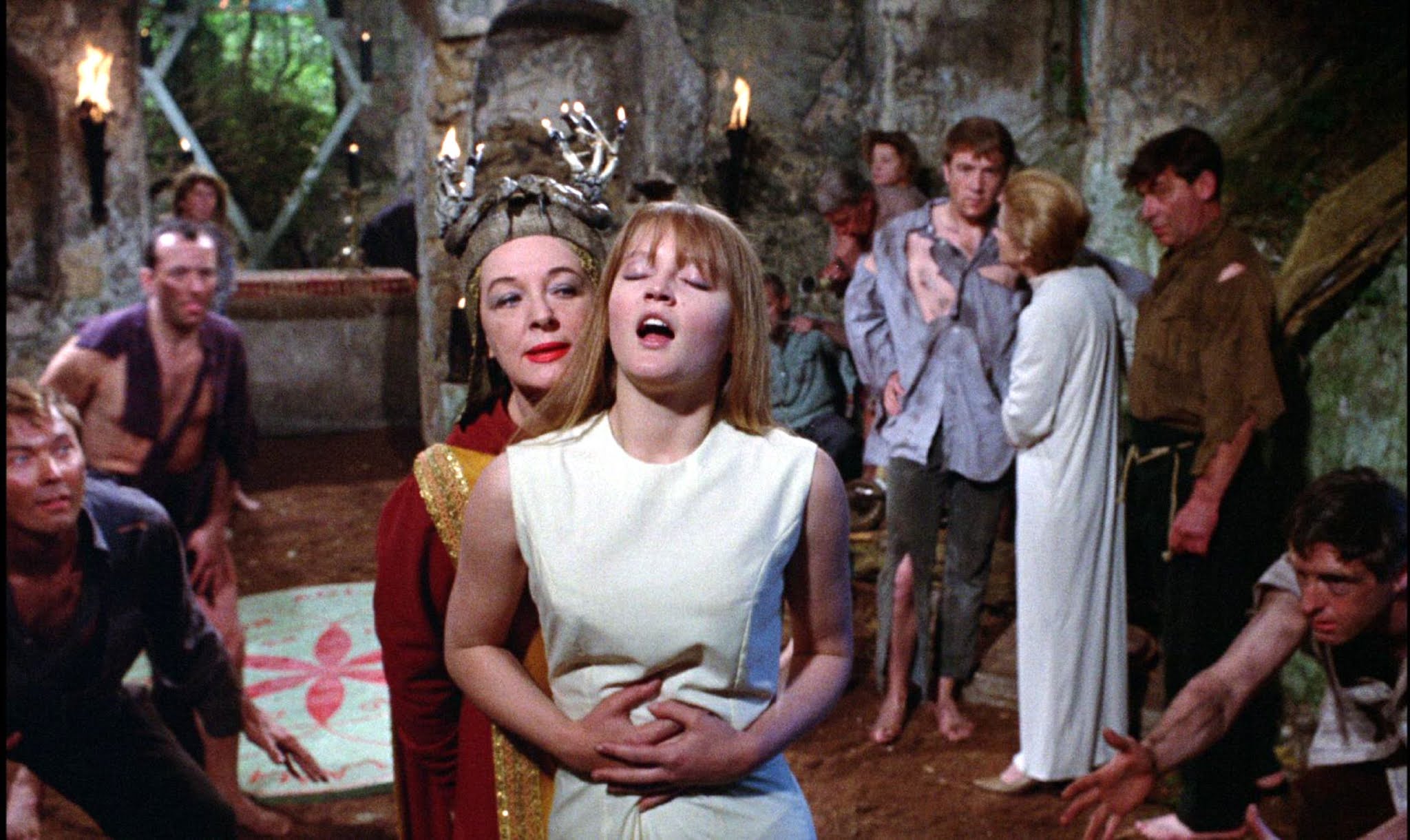
Recovering from a breakdown following a traumatic incident with an annoyed witch doctor in Africa, Gwen Mayfield (Joan Fontaine) takes a job as headmistress at a small school in the village of Heddaby. There she encounters local bigwigs, writer Stephanie Bax (Kay Walsh) and her brother Alan (Alex McCowen) who has a penchant for dressing as a vicar because "...it gives me a sense of security."
On the surface Heddaby seems idyllic if a little on the insular side but the discovery of a headless, pin stuck doll and the sudden illness of her star pupil Ronnie (a teenaged Martin Stephens - 'The Innocents' (UK / US) & 'Village of the Damned' (UK / US)) brings her to the conclusion that there's a witch at work in village potentially in the form of the sadistic cat whispering and grand-daughter mangling Granny Rigg (Gwen Ffrangcon-Davies).
Intended as a vehicle for reinvigorating Fontaine's flagging film career the movie's poor reception instead marked its end and it's not particularly surprising as despite having had a fairly glittering and Oscar winning career (for Alfred Hitchcock's 'Suspicion') she's a personable but largely ineffective lead here overshadowed by Walsh and most everyone else.
For most of the movie director Cyril Frankel manages a convincing air of
escalating unease but following a dramatic scene shift midway through
the movie which could have and should have marked the beginning of the
climax it all seems to somehow get away from him and the movie
culminates in what is essentially an extended dance routine. There are shades here of 'Night of the Eagle' and it uses much of the now familiar 'folk horror' template but 'The Witches' is little more than a flawed curio but entertaining in its own idiosyncratic way.
If
you enjoy what we do here on Wyrd Britain and would like to help us
continue then we would very much welcome a donation towards keeping the
blog going - paypal.me/wyrdbritain
Affiliate links are provided for your convenience and to help mitigate running costs.
If you enjoy what we do here on Wyrd Britain and would like to help us continue then we would very much welcome a donation towards keeping the blog going - paypal.me/wyrdbritain
Affiliate links are provided for your convenience and to help mitigate running costs.
If you enjoy what we do here on Wyrd Britain and would like to help us continue then we would very much welcome a donation towards keeping the blog going - paypal.me/wyrdbritain
Affiliate links are provided for your convenience and to help mitigate running costs.
Somewhere on a
salt-and-shingle island, inside a ruined concrete structure known as The
Green Chapel, a figure called The Armourer is leading a black mass with
terrible intent. But something is coming to stop him. Five
more-than-human forms are traversing land, sea and time towards The
Green Chapel, moving to the point where they will converge and become
Ness. Ness has lichen skin and willow-bones. Ness is made of tidal
drift, green moss and deep time. Ness has hagstones for eyes and speaks
only in birds. And Ness has come to take this island back. Nature writer Macfarlane and artist Donwood have collaborated once before on 'Holloway', a search for hidden track ways and coincidentally the only other one of Macfarlane's books that I've read having been given it as a gift a few years back. This time though the author steps away from the real into the realm of fiction with an apocalyptic prose poem based around the Orford Ness in Suffolk. The Ness, now owned by the National Trust, was previously a military development site and testing ground for nuclear and chemical stupidities which, though now abandoned, still wears the scars of its previous inhabitants. Macfarlane's prose poem finds echoes of these brutal inhabitants and confronts them with the spirit of the Ness itself as its various aspects reclaim the land in a story about the impermanence of man and the permanence of nature and the natural's inevitable victory over the un. It's a quick and interesting read but not for me a wholly satisfying one. I am at heart a fairly simple soul and as much as I enjoy a beautifully constructed sentence, an engaging turn of phrase and a grand concept I also love a story and whilst Ness satisfies the first three requirements with aplomb the last one not so much and so I closed it with the slightly disappointed feeling that something was missing. It's pretty much the same issue I have with poetry in general and not just the prose version as seen here but I'd like to stress that this is my very own personal foible and beyond that Ness makes for intriguing reading.
Buy it here - UK / US.
..........................................................................................
If
you enjoy what we do here on Wyrd Britain and would like to help us
continue then we would very much welcome a donation towards keeping the
blog going - paypal.me/wyrdbritain
Affiliate links are provided for your convenience and to help mitigate running costs.
Starring Boris Karloff, Catherine Lacey, Elizabeth Ercy and Ian Ogilvy 'The Sorcerers' is the story of disgraced hypnotist Dr Marcus Monserrat (Karloff) who, over a characteristically sad looking Wimpy hamburger, somehow convinces bored hipster Mike Roscoe (Ogilvy) to allow himself to be strapped into the machine he's invented. Said machine looks to be straight out of 'The Prisoner' (UK / US) and after some suitably psychedelic lighting effects and an electronic squall worthy of the Radiophonic greats it allows Monserrat and his wife Estelle (Lacey) to control Roscoe's mind and perceive everything he does. It's not long though before the flood of emotions and experiences overwhelm Estelle and her darker nature comes to the fore.
Karloff is always a powerful presence and Ogilvy a reliable leading man but the movie belongs to Catherine Lacey's powerful performance as her addict's craving for new experiences degenerates into murderous madness.
Of the three movies director Michael Reeves made in his short career the
third, 'The Witchfinder General' (UK / US), is undoubtedly his most widely
celebrated but for me, as good as that movie is, it's this his second
movie made the previous year, 1967, that's his best and shows just how good he was and would've been.
If you enjoy what we do here on Wyrd Britain and would like to help us continue then we would very much welcome a donation towards keeping the blog going - paypal.me/wyrdbritain
Affiliate links are provided for your convenience and to help mitigate running costs.
If you enjoy what we do here on Wyrd Britain and would like to help us continue then we would very much welcome a donation towards keeping the blog going - paypal.me/wyrdbritain
Affiliate links are provided for your convenience and to help mitigate running costs.
For '3 Wyrd Things' I ask various creative people whose work I admire to tell us about three oddly, wonderfully, weirdly British things that have been an influence on them and their work - a book or author, a film or TV show and a song, album or musician.
This month: Joe Banks
Joe is a music writer with a résumé that includes Mojo, The Guardian, Electronic Sound, The Quietus, Prog and Shindig.
In 2020 Joe published (on Strange Attractor Press) 'Hawkwind:Days of the Underground' (Buy it here - UK / US) his exhaustive biography of the space rock legends. Covering the years from inception (1969) to 'Levitation' (1980) with numerous side trips along the way it's a glorious and timely repositioning of this idiosyncratic band as one of the cornerstones of underground music in the UK. To accompany the book Joe maintains a Hawkwind treasure trove at www.daysoftheunderground.com/
I am really pleased to be able present Joe's choices to you and heartily recommend you follow him on twitter at - JoeBanksWriter
Growing up in Britain in the 1970s, it was possible to stumble across all manner of unexpectedly strange and frightening programmes on TV, particularly if you were a child of a “nervous disposition” or just easily spooked. Indeed, an entire cottage industry based around memories of terrifying PIFs, Christmas ghost stories and scary kids’ shows has developed over the past decade or so – it sometimes feels as though the perceived uncanniness of the past is being used as a communal bulwark against the divisive, hyper-stimulated present.
But while I experienced plenty of cosy chills watching Doctor Who, and felt genuinely unsettled by ITV’s Quatermass, it was being caught off-guard by something nasty lurking in programmes that were ostensibly light entertainment that affected me the most. For instance, there was an item on early evening magazine show Nationwide that freaked me out for months, the appearance of a werewolf in a suburban house, which I’ve subsequently discovered was connected to the story of the Hexham Heads (Britain had an unquenchable thirst for all things paranormal in the ‘70s, and Nationwide regularly ran pieces on topics such as UFOs and poltergeists). And then there was this scene from a screening of Carry On Screaming, which again completely terrified me.
The board comedy of the latter should perhaps have neutralised the weirdness of that scene, but the context actually ended up heightening my sense of fear. And that was also very much the case with the first wyrd thing I’ve chosen. Irish comedian Dave Allen was a regular presence on British TV throughout the ‘70s, an intelligent and urbane raconteur with a uniquely laid back style of delivery – sat on a high leather chair, dapperly suited and with a tumbler of whisky (actually ginger ale) at his side, he didn’t so much tell jokes as weave stories with occasional laughs, the antithesis of the quip-spouting stand-up. I loved his presentation and the often fiercely irreligious sketches that peppered his shows, for which he’s perhaps still best known.
But along with the Catholic Church, Allen also had a dark fascination for the supernatural, with longer filmed pieces that accurately aped the gothic horror of Hammer, building real tension before the inevitable comic (and often ludicrous) pay-off. The ultimate manifestation of this was the horror-driven monologues that he would sometimes close his shows with, the studio lights darkening and the camera pulling in, as Allen revealed himself to be a master storyteller of the macabre. There was one in particular that really got to me – I remember nothing about it except the languorous, dread-filled tone of Allen’s voice, and the atmosphere in the back room where I was watching it becoming icy with an awful anticipation. And even when the punchline came, the spell wasn’t completely broken – there was still a horrible sense of unease, that something remained hidden in those words, and that this was a bloody odd way to make people laugh.
Book
The Unexplained (1980-83)
As noted above, Britain was completely nuts for anything of a paranormal or supernatural bent during the ‘70s, the floodbanks of credibility having seemingly been washed away by the countercultural enlightenment of the late ‘60s. With the authority of Church and State eroding, and with the country in the midst of both political and social flux, all kinds of strange ideas and belief systems began to creep in from the margins. If traditional institutions could no longer be trusted and/or believed in, then perhaps other, more mysterious, forces were abroad? It’s surprising how quickly and firmly this notion took hold of mainstream culture, with TV and newspaper items on UFOs, ghosts and the Loch Ness Monster vying for space with reports on the latest industrial dispute or IRA bombing, creating a wyrd imaginal dissonance.
This obsession with all manner of mysterious phenomena persisted well into the ‘80s – in fact, it was probably at its zenith when, in 1980, Orbis Publishing launched the ‘partwork’ magazine, The Unexplained. Partwork magazines, where each weekly issue built towards a completed set of large format, binder-bound volumes, were hugely popular during the ‘70s. My dad had bought and assembled an earlier Orbis series about WW2 – I remember poring over these volumes full of battle photography, cut-away schematics of Messerschmitt fighters, and the often disturbing propaganda posters generated by the conflict. I had also recently completed my own, slightly less troubling Orbis series, The Encyclopedia Of Birds.
But The Unexplained was something else altogether. Leaving the joys of ornithology behind, I had plunged headfirst into the murky underside of the everyday and embraced the world of possibility – or more prosaically, and no doubt like many other boys (and girls) of my age, I just really liked the idea of monsters and aliens and weird stuff in general, despite being quite capable of scaring myself witless (see above). As soon as I saw the TV ad for this new series – “How much do we really know, and how much are we allowed to know?” – I immediately badgered my mum to take out a subscription. The magazine looked great, with lots of colour pictures and illustrations, and each issue had five-six articles on an impressively broad range of topics, the first few editions taking in such unexplained phenomena as Bigfoot, black holes, ball lightning, and every child’s favourite, spontaneous human combustion.
Despite the conspiracy theory posturing of the ad, the overall tone of the magazine itself was one of open-minded enquiry rather than tinfoil-hatted fanaticism, accessible to a general readership but hinting at a shadowy canon of arcane knowledge for those who wanted to go deeper… As it was, I was quite happy to stay at the popularist level, obtaining classic books such as Alien Animals, The World Atlas Of Mysteries and the frankly terrifying Photographs Of The Unknown, without experiencing any kind of occult epiphany. It was just what I was into, and certainly by the end of The Unexplained’s run, I had moved onto other things, music in particular. Yet The Unexplained remains a classic totem for those times, a window into a different way of looking at the world, and a gently eccentric corrective to the harsh realities of Thatcherite Britain.
Music Peter Hammill – pH7 (1979) Buy it here - UK / US.
As I’ve confessed elsewhere on the internet, I was a Teenage Prog Rock Fan. Having grown up in a market town in the East Midlands, it was practically de rigueur that the first genre of music I was seriously into was heavy metal. But after the NWOBHM, the early ‘80s saw a resurgence in that most hated, and downright feared (according to the NME anyway) genre of music: progressive rock. Hard now to convey just what a bogeyman ‘prog’ was seen to be by music’s cultural gatekeepers, but its return, even in a diminished and mostly derivative form, was a cause for much mockery and gnashing of teeth. And yes, we’re talking Marillion here.
However, from my perspective as a young rock fan looking to expand my horizons, neo-prog (as it subsequently became known) was a welcome development. Not only did it lead to me encountering the genuinely wonderful Twelfth Night, but it also sent me back in time to investigate where this stuff had originally come from. And after wading through the likes of Genesis, Yes and Camel, I got to the hard stuff: King Crimson and Van Der Graaf Generator. VDGG in particular presented a challenge to my rockist mindset, dispensing for the most part with guitars and promoting the saxophone to lead instrument. But I soon realised this was all essentially moot in the face of the band’s driving force and self-proclaimed “Jimi Hendrix of the voice”, Peter Hammill.
Hammill is an extraordinary figure within British music, and a cult hero of the wyrd. He’s capable of both raging with elemental energy and penning lyrics of remarkable sophistication, ranging from coruscating self-examination to meditations on the nature of existence, often with apocalyptic overtones. He’s also been incredibly prolific throughout his 50+ year career, and there’s any number of albums I could have chosen to highlight his unique talents. But for me, 1979’s pH7 is his finest solo achievement, a perfect melding of Hammill’s fiery intelligence, his commanding but never pompous vocals, and a stripped-back, new wave-channelling sound, austere yet utterly compelling. I also have a strong memory of being given a tape of this album just before going to university, and spending those first few weeks sat in my room, listening to it on headphones in the dark.
Its delights are many, and it’s one of Hammill’s most socially conscious, outward-looking albums, with topics covered including biological weapons (‘Porton Down’), disability (‘Handicap And Equality’), political corruption (‘The Old School Tie’) and the end of the world (‘Mr X Gets Tense’). There’s never any sense of earnest hand-wringing here, but instead a direct and visceral engagement with the issues in question. Musically, it’s often thrillingly intense as well: there’s the paranoid, machine-driven stomp of ‘Careering’; the electro-classical ‘Mirror Images’, like something from Wendy Carlos’s score for A Clockwork Orange; and most intriguing, the crunching yet expressionistic setting of ‘Imperial Walls’, the translation of a 9th century Anglo-Saxon poem. A terrific, mind-expanding record, and a great cover too.
If you enjoy what we do here on Wyrd Britain and would like to help us continue then we would very welcome a donation towards keeping the blog going - paypal.me/wyrdbritain
Affiliate links are provided for your convenience and to help mitigate running costs.
If you enjoy what we do here on Wyrd Britain and would like to help us continue then we would very much welcome a donation towards keeping the blog going - paypal.me/wyrdbritain
Affiliate links are provided for your convenience and to help mitigate running costs.
John Mller (ed) British Library Woods play an important and recurring role in horror, fantasy, the gothic and the weird. They are places in which strange things happen, where you often can’t see where you are or what is around you. Supernatural creatures thrive in the thickets. Trees reach into underworlds of earth, myth and magic. Forests are full of ghosts.
In this new collection, immerse yourself in the whispering voices between the branches in Wistman’s Wood on Dartmoor, witness an inexplicable death in Yorkshire’s Strid Wood and prepare yourself for an encounter with malignant pagan powers in the dark of the New Forest. This edition also includes notes on the real locations and folklore which inspired these deliciously sinister stories.
It's been a while since I picked up any of these British Library Tales of the Weird books but the've continued to release some very intriguing collections and I've grabbed three recently which have caught my eye. This one, with my fondness for arboreal shenanigans, was always gong to be a must buy and indeed proved to be a solid collection of, mostly, entertaining tales of the deep dark woods.
It doesn't get off to a particularly auspicious start with the anonymous opener, 'Whisperer in the Woods', lifted from the pages of Charles Dickens' literary journal ' All Year Round'. It's a poorly written and fairly common or garden sort of story of wronged widows and plucky sons and help from beyond and I'm not entirely convinced by the weird woodiness of Edith Nesbit's 'Man Sized in Marble' but a story as good as this always merits a reread especially on a cold wet winter's night.
Gertrude Atherton's 'The Striding Place' puts a gentleman pining and - sort of - searching for his lost friend into a battle with the elemental force of a raging river that runs through the woods in a story with a distinct but typically circuitous homosexual undertones and a sudden and jarring ending worthy of Robert Aickman. Another classic tale with distinct homoerotic undertones comes next in the form of E.F. Benson's 'The Man Who Went Too Far' another story I'm always happy to reread.
We have a slght dip with the next two stories as neither W.H. Hudson's 'An Old Thorn' nor Elliott O'Donnell's 'The White Lady' have much to recommend although the former conjures up an interesting initial vibe before losing it's way and petering out.
We are on much more solid ground with Algernon Blackwood's 'Ancient Lights' as the venerable master spins a yarn concerning a fairy wood that reads like a forebear of Robert Holdstock's 'Mythago Wood' books.
We've and interesting and haunting proto-feminist tale of a man's selfish desire and a young woman's love of her home in Mary Webb's 'The Name Tree' whilst in Walter de la Mare's 'The Tree' a pompous and vulgar fruit merchant travels to visit his estranged artist brother who lives and works in the shadow of an exotic tree that is his inspiration.
Marjorie Bowen's 'He Made a Woman...' is a quick and beguiling riff on the story of Blodeuwedd taken from the Mabinogion and also the inspiration for Alan Garner's 'The Owl Service'. This is followed by one of M.R. James' later and lesser tales, 'A Neighbour's Landmark', which, with it's inocuous story of a haunted wood, is lacking some of the panache of his clasic tales.
The book ends oddly with 'N' the last great flowering of Arthur Machen's genius. Certainly there's a weird wood in there as this is one of the elder statesman of the weird's stories of the thin places but it feels out of place here and far more at home in the London collection the The British Library have published at the same time. I rarely turn down the opportunity to reread Machen though and this is a sublime end to an enjoyable collection.
If you enjoy what we do here on Wyrd Britain and would like to help us continue then we would very much welcome a donation towards keeping the blog going - paypal.me/wyrdbritain
Affiliate links are provided for your convenience and to help mitigate running costs.




 /
/  .
.


 /
/  ) his exhaustive biography of the space rock legends. Covering the years from inception (1969) to 'Levitation' (1980) with numerous side trips along the way it's a glorious and timely repositioning of this idiosyncratic band as one of the cornerstones of underground music in the UK. To accompany the book Joe maintains a Hawkwind treasure trove at
 /
/  .
.


 /
/  .
.


 /
/  .
.