Charles Wikinson
Egaeus Press
Charles Wilkinson's
SPLENDID IN ASH contains seventeen previously uncollected stories from a
writer whose seemingly effortless ability to turn the ordinary, the
everyday, the outwardly mundane volte-face into regions of feverish
weirdness is unrivalled.
I first came across one of Wilkinson's stories - 'Absolute Possession' - in a copy of 'Supernatural Tales', it was a wonderfully odd tale with a perplexing ending. It was one of those stories that stick with you long after both because you enjoyed it and because of how much it frustrated. The same could be said of Wilkinson's previous collection (also published by Egaeus Press) 'A Twist in the Eye' which was a wonderful collection of frustrating invention and elusive delights that seemed to revel in leaving the reader wrong footed and adrift which, you'll be usurprised to learn, continues to be the case here.
'Absolute Possession' is here and is still baffling but also still enthralling and accompanying it are stories of ghosts of retribution and guilt , bodily transformation, hellish bureaucracy and the end of the world. All show Wilkinson's vivacious and unfettered imagination in full flight as ideas rise and crash through from unexpected directions before flying off at unlikely angles. It most readily recalls the work of Robert Aickman with it's restless willfulness and Aickman's own preferred term of 'strange' is perfectly applicable to the stories contained in this beguiling collection.
Buy it here - http://www.egaeuspress.com/Splendid_in_Ash.html
You can read a nice little Q&A with the author here - Dark Lane Books
..........................................................................................
If
you enjoy what we do here on Wyrd Britain and would like to help us
continue then we would very much appreciate a donation towards keeping
the blog going - paypal.me/wyrdbritain
Showing posts with label strange stories. Show all posts
Tuesday, 23 April 2019
Wednesday, 10 October 2018
The Unsettled Dust
Robert AickmanFaber & Faber
Robert Aickman, the supreme master of the supernatural, brings together eight stories where strange things happen that the reader is unable to predict. His characters are often lonely and middle-aged but all have the same thing in common - they are all brought to the brink of an abyss that shows how terrifyingly fragile our peace of mind actually is.
'The Next Glade', 'Bind Your Hair' and 'The Stains' appeared together in The Wine-Dark Sea in 1988 while 'The Unsettled Dust', 'The House of the Russians', 'No Stronger Than a Flower', 'The Cicerones' and 'Ravissante' first appeared in Sub Rosa in 1968. The stories were published together as The Unsettled Dust in 1990. Aickman received the British Fantasy Award in 1981 for 'The Stains', which had first appeared in the anthology New Terrors (1980), before appearing in the last original posthumous collection of Aickman's short stories, Night Voices (1985).
'The Unsettled Dust' was a posthumous collection released some 9 years after the authors death. The stories included all bear Aickman's characteristic strangeness which can result in them being equal parts frustrating and enthralling.
The opening - titular - tale is an almost straightforward (by Aickman's standards) and old fashioned haunted house tale as a representative of a trust is subjected to the dubious hospitality of two sisters in their dusty old house in a quietly sad tale of family, pride and unreconciled loss, themes that are echoed in 'The Houses of the Russians', an intriguing little tale of an island of abandoned homes and the memories they hold of their former inhabitants.
'No Stronger Than A Flower' was the first Aickman tale I ever read and this story of a woman's metamorphosis loses none of it's brutal power in a reread several years on and with a wider knowledge of what to expect - that is if one can even remotely 'expect' anything in an Aickman story.
'The Cicerones' is another story I was familiar with, this time through the adaptation made by Mark Gatiss and Jeremy Dyson - watch it here. I'm not particularly enamoured of it but I was struck by how closely the filmed version stuck to the text.
'The Next Glade' is another story that I found somewhat uninspiring. Unusually for Aickman the strangeness here felt contrived and a little but forced. I can't put my finger on anything in particular about it but for me it failed to gel and the story was both dull and flat.
Things get very much back on track with 'Ravissante' as we're shown into a world that is both mannered and deeply strange filled with simmering sexual repression and denied release and the folk horror duo of 'Bind Your Hair', another beautifully ambiguous enigma of rural weirdness and the book's award winning closing tale, 'The Stains', a story of love lost, love found, family, responsibility, innocence and lichen which sees about as Aickmanesque an ending to to this write-up as I'm going to come up with.
Buy it here - The Unsettled Dust
..........................................................................................
If you enjoy what we do here on Wyrd Britain and would like to help us continue then we would very much appreciate a donation towards keeping the blog going - paypal.me/wyrdbritain
Sunday, 10 June 2018
The Cicerones
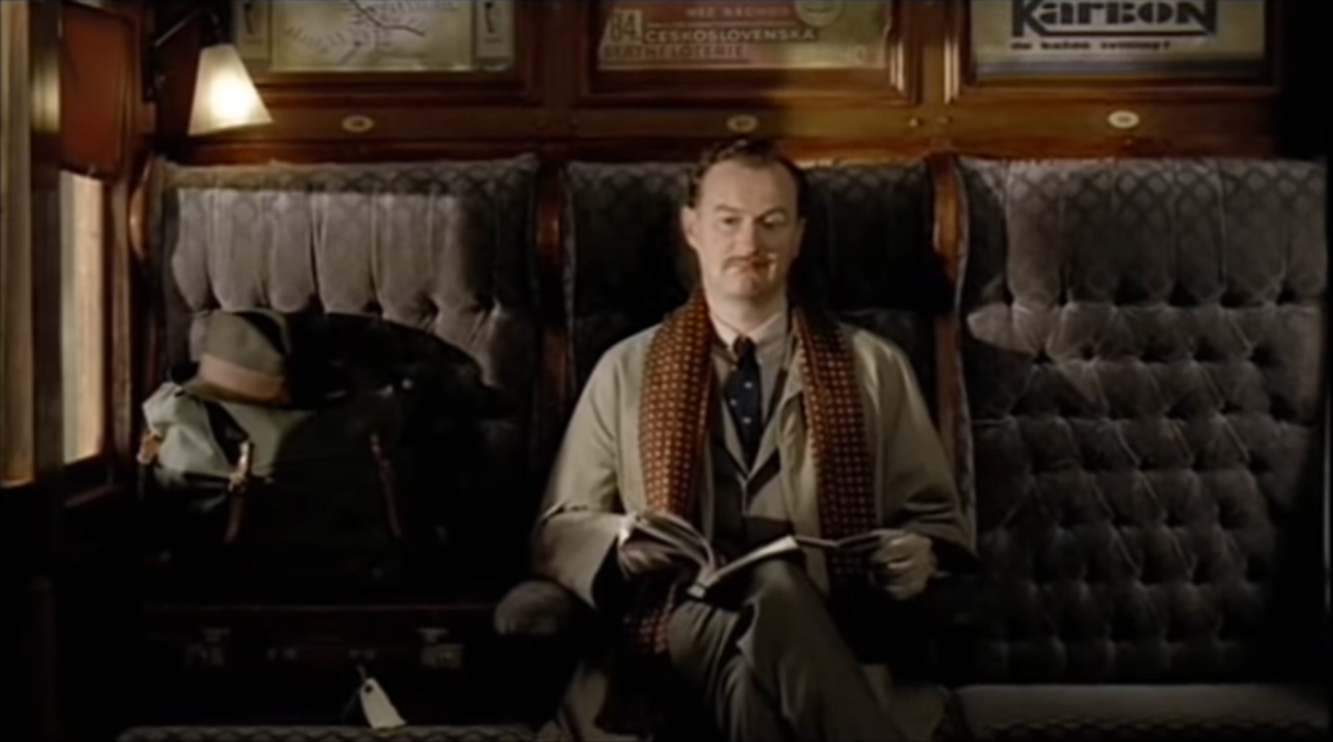
This short film by The League of Gentlemen's Jeremy Dyson is an adaption of one of Robert Aickman's 'strange stories' and tells of a traveller's encounters with four 'cicerones' (guides) inside a cathedral.
Mark Gatiss takes the lead role as 'John Trant' a reserved and slightly stuffy Englishman of indeterminate age sightseeing his way across Europe who, in the great ghostly tradition of M. R. James, goes off in search of a MacGuffin - in this case a painting of Lazarus - and instead finds himself at the centre of a much more unsettling experience among the columns and crypts of 'The Cathedral of Saint Bavon'.
At only twelve minutes in length Dyson has mostly kept true to his source and this is a concentrated dose of Aickman ambiguity as we, along with Trant, are led deeper and deeper into the bowels of the cathedral as the tension builds from no overt source other than Trant's desperate need to find the painting before the cathedral closes, the macabre nature of the images he is confronted with and his reactions to the odd behaviour of the various people he meets. As is the way of things with Aickman little is obvious, much goes unsaid and one is left very much adrift in exquisitely disquieting confusion.
If you wish to learn more about this most singular of authors you can find an interesting documentary about his life and work at this link and another (longer) adaptation of one of his strange stories - 'The Hospice' by clicking here.
..........................................................................................
If you enjoy what we do here on Wyrd Britain and would like to help us continue then we would very much welcome a donation towards keeping the blog going - paypal.me/wyrdbritain
Mark Gatiss takes the lead role as 'John Trant' a reserved and slightly stuffy Englishman of indeterminate age sightseeing his way across Europe who, in the great ghostly tradition of M. R. James, goes off in search of a MacGuffin - in this case a painting of Lazarus - and instead finds himself at the centre of a much more unsettling experience among the columns and crypts of 'The Cathedral of Saint Bavon'.
At only twelve minutes in length Dyson has mostly kept true to his source and this is a concentrated dose of Aickman ambiguity as we, along with Trant, are led deeper and deeper into the bowels of the cathedral as the tension builds from no overt source other than Trant's desperate need to find the painting before the cathedral closes, the macabre nature of the images he is confronted with and his reactions to the odd behaviour of the various people he meets. As is the way of things with Aickman little is obvious, much goes unsaid and one is left very much adrift in exquisitely disquieting confusion.
If you wish to learn more about this most singular of authors you can find an interesting documentary about his life and work at this link and another (longer) adaptation of one of his strange stories - 'The Hospice' by clicking here.
..........................................................................................
If you enjoy what we do here on Wyrd Britain and would like to help us continue then we would very much welcome a donation towards keeping the blog going - paypal.me/wyrdbritain
Sunday, 24 July 2016
Cold Hand In Mine
Robert Aickman
Faber & Faber
Cold Hand in Mine was first published in the UK in 1975 and in the US in 1977. The story 'Pages from a Young Girl's Journal' won the Aickman World Fantasy Award in 1975. It was originally published in The Magazine of Fantasy & Science Fiction in 1973 before appearing in this collection.
Cold Hand in Mine stands as one of Aickman's best collections and contains eight stories that show off his powers as a 'strange story' writer to the full, being more ambiguous than standard ghost stories. Throughout the stories the reader is introduced to a variety of characters, from a man who spends the night in a Hospice to a German aristocrat and a woman who sees an image of her own soul. There is also a nod to the conventional vampire story ('Pages from a Young Girl's Journal') but all the stories remain unconventional and inconclusive, which perhaps makes them all the more startling and intriguing.
I very much enjoyed the first volume of these Faber reprints of Aickman's collections of short stories. The stories are decidedly odd and often end with only the vaguest of resolutions which is kind of fun. This second collection, featuring stories originally published in 1975, is very much more of the same but with the strangeness knob turned way up.
The book opens with 'The Swords' a dark and disturbing story of a young salesman's sexual awakening in the company of an odd young woman from a carnival sideshow. It's eroticised body horror at it's most disquieting mixing potential metaphor - the men at the sideshow piercing the woman's body with their swords - with the virgin narrators own confused, tumbling, feelings of arousal, confusion and (self)loathing at the situation he finds himself in.
'The Real Road to the Church', 'Niemandswasser', 'Pages From a Young Girl's Journal' and 'The Hospice' all tell of people out of place. In the first a young lady relocates herself to a small cottage and has to negotiate the ways of the locals and perhaps losing - or at least putting aside - an aspect of herself. In the second a self absorbed prince removes himself from the world imposing himself in a part of his world where he previously hadn't belonged and through his arrogance finds himself both literally and metaphorically in the no man's water of the title. The third is perhaps the story here I found the least satisfying as it tells of a young girl's visit to Europe in the company of her parents and the slow descent into the thrall of a vampire. Unfortunately she's such a whiney little Anne Rice type that by the end I just didn't care. The fourth was a much more interesting prospect as another fairly repressed man finds himself stranded for the night at a very unusual hospice where the guests are fed huge quantities of food whilst chained to the table and change their appearance during the night. It's very much proto-David Lynch and utterly wonderful.
More fun is had with the relatively straight forward weird fiction delights of 'The Same Dog' whose appearance precipitates the death of a young girl and whose reappearance comes allied with a profound shock.
'Meeting Mr. Millar' is an unusual - and perhaps slightly overlong - ghost story where another of Aickman's characteristically conservative leads is disturbed from his comfortable routine by the comings and goings of the new neighbours downstairs.
The book ends with 'The Clock Watcher', the story of a young wife's obsession with the elaborate clocks of her homeland and of her husband's increasing unease with her and them. It's a story brimming with potential but unfortunately, for me at least, it never truly found its stride and just didn't achieve any notable level of intrigue or enigma.
I have to admit here that I struggled to find my rhythm with this book but I suspect that was mostly due to the distraction of work pressures. There are some fun stories here and a few very enjoyable moments but it just didn't hit as immediately as the first volume. It is however still a very pleasurable trip into a unique imagination.
Buy it here - Cold Hand in Mine
Faber & Faber
Cold Hand in Mine was first published in the UK in 1975 and in the US in 1977. The story 'Pages from a Young Girl's Journal' won the Aickman World Fantasy Award in 1975. It was originally published in The Magazine of Fantasy & Science Fiction in 1973 before appearing in this collection.
Cold Hand in Mine stands as one of Aickman's best collections and contains eight stories that show off his powers as a 'strange story' writer to the full, being more ambiguous than standard ghost stories. Throughout the stories the reader is introduced to a variety of characters, from a man who spends the night in a Hospice to a German aristocrat and a woman who sees an image of her own soul. There is also a nod to the conventional vampire story ('Pages from a Young Girl's Journal') but all the stories remain unconventional and inconclusive, which perhaps makes them all the more startling and intriguing.
I very much enjoyed the first volume of these Faber reprints of Aickman's collections of short stories. The stories are decidedly odd and often end with only the vaguest of resolutions which is kind of fun. This second collection, featuring stories originally published in 1975, is very much more of the same but with the strangeness knob turned way up.
The book opens with 'The Swords' a dark and disturbing story of a young salesman's sexual awakening in the company of an odd young woman from a carnival sideshow. It's eroticised body horror at it's most disquieting mixing potential metaphor - the men at the sideshow piercing the woman's body with their swords - with the virgin narrators own confused, tumbling, feelings of arousal, confusion and (self)loathing at the situation he finds himself in.
'The Real Road to the Church', 'Niemandswasser', 'Pages From a Young Girl's Journal' and 'The Hospice' all tell of people out of place. In the first a young lady relocates herself to a small cottage and has to negotiate the ways of the locals and perhaps losing - or at least putting aside - an aspect of herself. In the second a self absorbed prince removes himself from the world imposing himself in a part of his world where he previously hadn't belonged and through his arrogance finds himself both literally and metaphorically in the no man's water of the title. The third is perhaps the story here I found the least satisfying as it tells of a young girl's visit to Europe in the company of her parents and the slow descent into the thrall of a vampire. Unfortunately she's such a whiney little Anne Rice type that by the end I just didn't care. The fourth was a much more interesting prospect as another fairly repressed man finds himself stranded for the night at a very unusual hospice where the guests are fed huge quantities of food whilst chained to the table and change their appearance during the night. It's very much proto-David Lynch and utterly wonderful.
More fun is had with the relatively straight forward weird fiction delights of 'The Same Dog' whose appearance precipitates the death of a young girl and whose reappearance comes allied with a profound shock.
'Meeting Mr. Millar' is an unusual - and perhaps slightly overlong - ghost story where another of Aickman's characteristically conservative leads is disturbed from his comfortable routine by the comings and goings of the new neighbours downstairs.
The book ends with 'The Clock Watcher', the story of a young wife's obsession with the elaborate clocks of her homeland and of her husband's increasing unease with her and them. It's a story brimming with potential but unfortunately, for me at least, it never truly found its stride and just didn't achieve any notable level of intrigue or enigma.
I have to admit here that I struggled to find my rhythm with this book but I suspect that was mostly due to the distraction of work pressures. There are some fun stories here and a few very enjoyable moments but it just didn't hit as immediately as the first volume. It is however still a very pleasurable trip into a unique imagination.
Buy it here - Cold Hand in Mine
Monday, 27 June 2016
Dark Entries
Robert Aickman
Faber & Faber
Aickman's 'strange stories' (his preferred term) are constructed immaculately, the neuroses of his characters painted in subtle shades. He builds dread by the steady accrual of realistic detail, until the reader realises that the protagonist is heading towards their doom as if in a dream.
Dark Entries was first published in 1964 and contains six curious and macabre stories of love, death and the supernatural, including the classic story 'Ringing the Changes'.
So, after reading a few short stories and him as the editor of a Fontana anthology I finally get to experience Aickman on his own terms. 'Dark Entries' is one of four newly reprinted collections by Faber & Faber and is the earliest of the works and so the perfect place to start.
The first Aickman story I read is featured here but first we have a biographical foreword before the book properly begins with 'The School Friend'. The story tells of the unlikely friendship between two women who find themselves thrown back together after many years only for one of them to find that people are stranger by far than the face they present to the world.
The second story is, in the words of the jacket blurb, 'the classic story 'Ringing in the Changes' which is the only story presented here that I'm already familiar with. It's a brutal and harrowing story that pits a newly married couple against the risen dead in a small coastal town.
Truthfully I have no idea what to make of 'Choice of Weapons'. For much of it it seems like a straight forward love story until the ending spins everything on it's head and left me a tad confused.
This oddity is followed by probably the most straightforward story in the book in the shape of a haunted railway station in 'The Waiting Room' before the book once more earns its 'strange stories' label with 'The View'. Here whilst taking refuge on an island a man finds solace in the arms and house of a beautiful woman but in a place where change is constant he finds it hard to do so.
With the exception of a short remembrance of Aickman by Ramsey Campbell the book ends with the folk horror of 'Bind Your Hair' that places a newly engaged career woman amidst her fiances country family and the very odd and unpleasant goings-on up on the hill; a story I felt could have benefited greatly from being given far more space in the telling.
I really didn't know what to expect of these books. Having read about him and having read two of his stories I was pretty certain I was going to get an old fashioned kind of strangeness and I wasn't disappointed on that score as it was strange to the nth degree. 'Dark Entries' proved to be a most diverting read and I'm very much looking forward to the others.
Buy it here - Dark Entries
Faber & Faber
Aickman's 'strange stories' (his preferred term) are constructed immaculately, the neuroses of his characters painted in subtle shades. He builds dread by the steady accrual of realistic detail, until the reader realises that the protagonist is heading towards their doom as if in a dream.
Dark Entries was first published in 1964 and contains six curious and macabre stories of love, death and the supernatural, including the classic story 'Ringing the Changes'.
So, after reading a few short stories and him as the editor of a Fontana anthology I finally get to experience Aickman on his own terms. 'Dark Entries' is one of four newly reprinted collections by Faber & Faber and is the earliest of the works and so the perfect place to start.
The first Aickman story I read is featured here but first we have a biographical foreword before the book properly begins with 'The School Friend'. The story tells of the unlikely friendship between two women who find themselves thrown back together after many years only for one of them to find that people are stranger by far than the face they present to the world.
The second story is, in the words of the jacket blurb, 'the classic story 'Ringing in the Changes' which is the only story presented here that I'm already familiar with. It's a brutal and harrowing story that pits a newly married couple against the risen dead in a small coastal town.
Truthfully I have no idea what to make of 'Choice of Weapons'. For much of it it seems like a straight forward love story until the ending spins everything on it's head and left me a tad confused.This oddity is followed by probably the most straightforward story in the book in the shape of a haunted railway station in 'The Waiting Room' before the book once more earns its 'strange stories' label with 'The View'. Here whilst taking refuge on an island a man finds solace in the arms and house of a beautiful woman but in a place where change is constant he finds it hard to do so.
With the exception of a short remembrance of Aickman by Ramsey Campbell the book ends with the folk horror of 'Bind Your Hair' that places a newly engaged career woman amidst her fiances country family and the very odd and unpleasant goings-on up on the hill; a story I felt could have benefited greatly from being given far more space in the telling.
I really didn't know what to expect of these books. Having read about him and having read two of his stories I was pretty certain I was going to get an old fashioned kind of strangeness and I wasn't disappointed on that score as it was strange to the nth degree. 'Dark Entries' proved to be a most diverting read and I'm very much looking forward to the others.
Buy it here - Dark Entries
Subscribe to:
Posts (Atom)