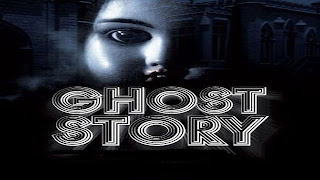
Three years after he made his directorial debut with the Jekyll and Hyde adaptation 'I, Monster' for AmicusStephen Weeks took matters into his own hands with a script he co-wrote with Philip Norman and Rosemary Sutcliff that locates itself in that most classic of settings, the haunted house.
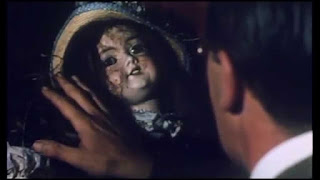
Three university acquaintances meet up at an uninhabited country pile for a weekend of shooting. The mismatched trio, wet and needy Talbot (Larry Dann), bullying Duller (Vivian Mackerrell) and aloof McFayden (Murray Melvin), are, we soon discover, barely on nodding terms and have been gathered together to test whether their presence in the house will bring forth the ghost. Living up to his name the blunt Duller, despite his fervent desire to see a ghost finds nothing but frustration and boredom, MacFayden is unsettled but it's the sensitive Talbot who via a creepy porcelain doll is thrown back in time into the middle of the avaricious and incestuous history of the previous inhabitants of the house, brother and sister Sophy (Marianne Faithfull) and Robert (Leigh Lawson) and their maid Rennie (Penelope Keith) along with the doctor (Anthony Bate) and Matron (Barbara Shelley) of the nearby asylum.
'Ghost Story' was obviously made on a budget much of which I suspect was used up on the odd decision to film mostly in India. Weeks does conjure up an effectively creepy atmosphere via some unusual camera angles, some effective visual sleight of hand and a great score from Pink Floyd collaborator Ron Geesin but the film is poorly lit and let down by some truly desperate acting from the main cast and, particularly in the early part of the film some clumsy attempts at comedy. It does have its moments though and as it builds to a climax there are some very effective moments including one sequence that put me in mind of the glorious hallucinatory ending of the Ealing classic 'Dead of Night' and in the final reckoning 'Ghost Story' provides some entertaining no budget creepiness.
If you enjoy what we do here on Wyrd Britain and would like to help us continue then we would very much welcome a donation towards keeping the blog going - paypal.me/wyrdbritain
Affiliate links are provided for your convenience and to help mitigate running costs.
In this version Freud obsessed psychiatrist Dr Charles Marlowe (Christopher Lee) invents a potion that "destroys the super-ego" rendering people either utterly docile, or competely amoral. It's not long - following two human tests and an animal one that makes this very much not a film for cat lovers - before Marlowe is testing it on himself whereupon he transforms into a grinning, psycopathic, hedonist named Edward Blake.
'I, Monster' has long had a poor reputation mostly due to it's studio bound and slightly talky script and Amicus were never at their best when parroting Hammer's gothic pretentions but with a strong central performance aided by typically solid support from a much underused Peter Cushing and some fairly bog standard support from the reliably terrible Mike Raven it's a solid enough adaptation that's perhaps slightly over-reverential of the source material making it drag a bit as he stretches the story out to fill the run time.
If you enjoy what we do here on Wyrd Britain and would like to help us continue then we would very much welcome a donation towards keeping the blog going - paypal.me/wyrdbritain
Affiliate links are provided for your convenience and to help mitigate running costs.
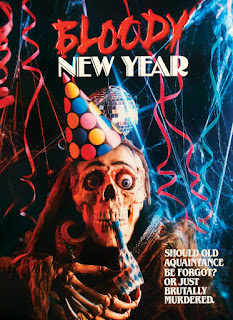
It's 1987 and in an improbable series of events five English teenagers and one American find themselves shipwrecked on an island after fleeing an angry trio of be-denimed fairground workers named Dad, Ace and The Bear. On the island they discover a hotel all decked out to celebrate New Year, in June, where they each experience inexplicable events before falling prey to the spirits in the hotel and the angry fairground folk.
The cast are uniformly terrible and as such you'll be glad to see the
back of them and will care little when they meet their timely demise.
This was the fifth and final horror that director Norman J. Warren made between 1977 ('Satan's Slave') and 1987 and is certainly the weakest. It has some dumb fun ideas but unfortunately they're all ones we've seen before in better movies by the likes of Fulci and Raimi but if you think of it as a big silly tribute to the various things and folks it's cribbed from then it makes for a fun, relentlessly daft, ride.
If you enjoy what we do here on Wyrd Britain and would like to help us continue then we would very much welcome a donation towards keeping the blog going - paypal.me/wyrdbritain
Someone is offing Santas in this wonderfully terrible 1984 slasher directed by and starring Edmund Purdom.
Featuring a brief cameo from Caroline Munro this is a low low budget, barely cohesive (or coherent) attempt at the video nasty market that is neither gory enough nor T&A enough to work. Various Santas are subjected to some inventive ends whilst the murders are investigated by the most inept coppers this side of Keystone but uninspired acting and directing means it never really gets going although it does trigger some unintentional chuckles along the way.
If you enjoy what we do here on Wyrd Britain and would like to help us continue then we would very much welcome a donation towards keeping the blog going - paypal.me/wyrdbritain
Affiliate links are provided for your convenience and to help mitigate running costs.
Here we have another episode from the early 1980s ITV series 'Shades of Darkness' which featured elaborate period pieces adapted from ghostly tales from the heyday of the genre by authors such as May Sinclair, Agatha Christie and Walter de la Mare. 'The Maze' was written by the lesser known C.H.B. Kitchin and revolves around Catherine Frode (Francesca Annis), her husband Arthur (James Bolam) and her daughter Daisy (Sky Macaskill) and an unexpected visitor (Duncan Preston) from Catherine's past within the garden maze of the her childhood home.
If you enjoy what we do here on Wyrd Britain and would like to help us continue then we would very much welcome a donation towards keeping the blog going - paypal.me/wyrdbritain
Affiliate links are provided for your convenience and to help mitigate running costs.
Established in 1958 by Desmond Briscoe and Daphne Oram the BBC Radiophonic Workshop's purpose was to create innovative sounds to be used in radio and television shows. Now most widely remembered for it's groundbreaking work on Doctor Who the Workshop provided startlingly innovative sounds and music for countless shows.
This documentary, first shown in 2003, gives a fascinating overview of this treasured institution and provided a timely celebration of the various talents that found a home there giving many of us a first glimpse of the people who had quickened our pulses and fueled our imaginations.
If you enjoy what we do here on Wyrd Britain and would like to help us continue then we would very much welcome a donation towards keeping the blog going - paypal.me/wyrdbritain
Affiliate links are provided for your convenience and to help mitigate running costs.
The inaugural series of the long running kids drama show Dramarama revolved around - happily for us here - 'Spooky' stories. We've featured episodes from the series on Wyrd Britain before - see here and here - and this episode, 'War Games With Caroline', was the one that launched the series.
It's 1982 and Kevin (Wayne Norman) is obsessed by war and war games and with a desk full of 'Warlord' comics who is once again in trouble for it and stuck in detention with his sniffly teacher Mr Lilly (Adam Bareham). Visiting the teacher to prepare for Founder's Day is an old teacher Mrs Rawley (Faith Brook) whilst Kevin gets visited by a student, Caroline (Lucy Durham-Matthews), who insists it's 1944 and who's worried about an imminent German doodlebug attack on the school.
While some of the acting is of the usual drama school type and the story is a little obvious there's much to like here especially thanks to director John Woods who conjours up some nicely spooky vibes through his simple but effective use of a very mobile camera, some unusual camera angles, a fabulously bizarre corridor scene that would have felt very much at home in an episode of Sapphire and Steel and some great use of shadows that make this ghostly timeslip tale well worth a watch.
If you enjoy what we do here on Wyrd Britain and would like to help us continue then we would very much welcome a donation towards keeping the blog going - paypal.me/wyrdbritain
Affiliate links are provided for your convenience and to help mitigate running costs.
I've always been more inclined towards words than pictures and so chose my comics based primarily on who the writer was but there are a few comic artists whose work I just can't resist, Eddie Campbell is one, Kevin O'Neill and Ted McKeever too and Dave McKean is most definitely another.
Like many it was his eye-popping cover art to Neil Gaiman's Sandman comics - which incidentally I got to see in the really real at an exhibition and they were astonishing - as well as books like Violent Cases, Signal to Noise and Arkham Asylum - that introduced me to his work. In the years since his art and his designs have also graced films (including 'Mirrormask' and Harry Potter's 'Dementors'), books (such as John Cale's autobiography 'What's Welsh for Zen' and Iain Sinclair's 'Slow Chocolate Autopsy') and numerous album covers ( by folks like Dream Theater, Front Line Assembly and Alice Cooper).
Raptor is the latest in a line of creator owned works he's produced and is presented in a beautiful large format and sumptuous edition that allows his paintings the space they deserve. The story is split across two realities featuring 'Sokol', a monster hunter in a fantasy land, and a newly widowed Welsh writer of supernatural stories named 'Arthur'.
As should be expected from McKean it's stunning to look at and filled with beauty. Storywise I think it could have done with a little more space to develop but as a tale of loss, grief and the corrupting influence power it was certainly intriguing and Mckean makes fine use of the medium blending perspectives and bleeding the two realities into each other as Arthur strives for just one more glimpse of his recently deceased wife in what made for a fascinating read that touched on Machen, A.E. Waite and the Golden Dawn.
If you enjoy what we do here on Wyrd Britain and would like to help us continue then we would very much welcome a donation towards keeping the blog going - paypal.me/wyrdbritain
Affiliate links are provided for your convenience and to help mitigate running costs.
What do you get when you cross Hitchcock's Psycho with a Universal Monster movie? Well, according to star Roddy McDowall (The Ballad of Tam Lin) the answer lies in the 'SH' he added to the film's title when he gifted a copy of the movie poster to his co-star, Jill Haworth.
McDowall plays Arthur Pimm the assistant curator of London Museum who keeps his dead mother in his apartment and steals jewellery from the collection for her to wear. Following a fire at the museum's warehouse and the death of the curator the sole surviving artifact, a giant stone Golem, which according to the workmen tasked with installing it, is "full of 'ate!" is put on exhibition. Pimm soon learns how to control the Golem and sends it off to do his nefarious bidding.
Roddy McDowall, Paul Maxwell & Jill Haworth
So the obvious question to be asked has to be was McDowall - and co star Haworth (The Haunted House of Horror, Tower of Evil) who also hated it - correct in his renaming of the movie? Well, kind of. It's pretty much trash but personally I like it very much. McDowall is far too likeable to be taken seriously as the villain and the excellent Haworth is inevitably relegated to eye candy but there's a lightness here and an understated acknowledgenment of the absurdity of the subject matter that culminates in the daftest of finales.
If you enjoy what we do here on Wyrd Britain and would like to help us continue then we would very much welcome a donation towards keeping the blog going - paypal.me/wyrdbritain
Affiliate links are provided for your convenience and to help mitigate running costs.
Here's a lovely little snippet from The Verb on BBC Radio 3 on 26th May 2017 featuring the official 41st best stand up ever Stewart Lee telling poet / presenter Ian McMillan about his love of the bard of London's byways and back streets Arthur Machen and reading an extract from 'Far Off Things' one of Machen's volumes of autobiography and discussing one of his (and mine) favourite Machen novels the much maligned 'The Green Round'.
If you enjoy what we do here on Wyrd Britain and would like to help us continue then we would very much welcome a donation towards keeping the blog going - paypal.me/wyrdbritain
Affiliate links are provided for your convenience and to help mitigate running costs.
"As Gregor Samsa awoke one morning from uneasy dreams, he found himself transformed in his bed into a gigantic..."
I don't think we've had an Oscar winning film on Wyrd Britain before, they're generally not really the type of films we bother with here but we definitely have now.
The film stars Richard E. Grant as Kafka desperately struggling to complete the opening line of 'The Metamorphosis' hampered by writers block and a stream of unwelcome distractions and unable to decide just what it is that 'Gregor Samsa' (played here by Crispin Letts - son of Doctor Who producer Barry) has transformed into. These distractions include a man (Ken Stott) with an unhealthy amount of knives searching for his missing friend 'Jiminy Cockroach', a room full of dancing ladies and a kindly fancy dress saleswoman (and balloon animal sculptor) (Phyllis Logan).
It's fantastic fun, gloriously daft and hugely enjoyable. Stott, perhaps best known for his stint playing DI John Rebus, is both terrifying and a picture of childlike joy and nobody does comedic existential angst quite like Richard E. Grant. Capaldi's script and direction is absurd and witty and makes perfect use of (what was apparently) his wife's slip of the tongue to create something bonkersly wonderful.
If you enjoy what we do here on Wyrd Britain and would like to help us continue then we would very much welcome a donation towards keeping the blog going - paypal.me/wyrdbritain
Affiliate links are provided for your convenience and to help mitigate running costs.
For '3 Wyrd Things' I ask various creative people whose work I admire to tell us about three oddly, wonderfully, weirdly British things that have been an influence on them and their work - a book or author, a film or TV show and a song, album or musician.
This month: J.M. Walsh
Jamie Walsh is the owner / publisher of Broodcomb Press and under various guises the writer of books published under that banner. His works touch on many of the touchstones that we hold so dear here at Wyrd Britain such as Arthur Machen, Sylvia Townsend Warner and Algernon Blackwood exploring fictions hinterlands with an emphasis on the strange and the uncanny.
If you haven't already then we at Wyrd Britain heartily recommend that you dig into the dark delights of Broodcomb's catalogue at... www.broodcomb.co.uk
Neil Miller Gunn wrote numerous novels, and the best of them are astonishingly immersive experiences of worlds that – even when recognisable – remain elusive and undefined.
Part of this is a curious reticence in his writing to naming the numinous, which lends his narratives a consuming hesitance towards the exploration of wonder. I intuit a little embarrassment in the books as speaking aloud would run counter to the grain of his Highland gruffness, yet also a defiance because, for Gunn, aspects of being human that reach out of the ordinary are the chief part of life.
For all its relative opaqueness, his writing is remarkable because the effect is of a ‘pointing towards’ that which in nature and human experience is (in a non-religious sense) sacred or divine, without ever coming out and naming it (if that is ever possible). Reading his books over the years, I became convinced he was a figure of Highland Zen only to find in his autobiography, ‘The Atom of Delight’, that he actually was deeply taken with Eugen Herrigel’s ‘Zen in the Art of Archery’, finding much in it that resonated with his world view.
The numinous is found in most of his novels, particularly ‘The Well at the World’s End’ and ‘The Other Landscape’, yet an early loose trilogy of novels creates worlds of the human sacred that are among the most engrossing I’ve ever read. ‘Sun Circle’ puts the reader in Dark Ages tribal Scotland, Christianity newly arrived but in great tension with the old religion, at the time of Viking raids. It recalls William Golding’s ‘The Inheritors’ and, in a more oblique way, Sylvia Townsend Warner’s ‘The Corner That Held Them’, in the ability to see the world as the characters would have seen it. One character’s dawning realisation of what happens at the stones lives with me to this day as a moment of unfolding terror.
It is the second of the loose trilogy, ‘Butcher’s Broom’, that I return to. The novel is set in the Highland Clearances, but the heart of the book is less the historic and economic drivers than the effects on one community, which Gunn draws so carefully that the strangeness of how such communities worked becomes seductive, and the descriptions of the combined waulking and ceilidh feel familiar and deeply, deeply other at the same time – a human existence that is both within reach and lost forever.
Even the novels that are resolutely of this world retain this sense of disquiet, as if the locations and events exist at least partly in myth. Plotwise, ‘The Lost Chart’ is a standard-for-its-time spy narrative… and yet the characters move in a twilight world that seems unconnected to our own. ‘The Drinking Well’ is about disgrace and change and the lure of politics and the modern… and yet the book begins and ends at a mythic source that makes all human concerns so much fluff. The scene where young Iain Cattanach is driving the sheep when the blizzard beds in is more dread-inspiring and consuming than any thriller.
It’s doubtless overstating things, but Neil M. Gunn is a lost Nobel Laureate.
I bought this for next to nothing, and you can still pick up copies for a couple of pounds, which seems remarkable. If ever there was a film deserving of the full pomp of a Eureka Masters of Cinema release, it’s Lynne Ramsay’s ‘Ratcatcher’.
What’s most remarkable is that I’ve seen this film a number of times, and even now the details of it swim about in my memory as if I’m viewing it underwater. Whenever I think about the film, what comes to mind are not films that feel thematically similar but Tarkovsky films: ‘Stalker’ and ‘Mirror’. If pinned down to explain why, I don’t think I could give a coherent answer.
Part of it is the sense I have that – for all ‘Ratcatcher’s anchorage to a particular time and place (and politics) – the film becomes archetypal. Set in Glasgow in 1973 at a time of strikes, redevelopment and relocation, I’ve the feeling I’m watching a film that has deep bones that reach far into human experience. Made in 1999, the film looks back a quarter of a century but equally could be a document of a centuries-old way of life.
There are two scenes in particular that stand out as moments that are both resonant and weird. I won’t describe them in detail. The first concerns one of the adult characters, seen after an act of violence (and I suspect retributive violence) that points to a world the young protagonist will doubtless inherit. It is a moment of glimpsed dread that worked its way into my dreams when I first saw the film.
The second concerns the fate of Kenny, a mouse, who goes on a journey, footage of which (strangely and impossibly) exists—
I bought this on vinyl when it came out, and although the vinyl was lost the album has remained one I never tire of listening to, and still sounds inventive and new. The wealth of ideas in Spoonfed Hybrid is remarkable considering they were a duo; the album sounds as though Pale Saints, a string quartet, a coldwave outfit and Jan Švankmajer were in the same accident and they all walked away essentially unharmed—
I’ve never got to the bottom of the lyrics, and even today details are new. (In writing this, it’s only now (28 years later) that I’ve realised ‘Boys in Zinc’ must be a reference to the extraordinary book by Svetlana Alexievich about the experiences of Russian boys and men in Afghanistan.) The songs surprise me every time I listen to them: I’ve heard them so many times yet they always feel subtly different, new. I understand intellectually they haven’t changed in the meantime, but emotionally I’m not quite so certain—
‘A Pocketful of Dust’ is a case in point. I’ve no idea what it’s about, yet the tale the song tells is one I know at the level of my own lived experience. It’s a torch song, weird and committed, yet also a dark folk tale. ‘Boys in Zinc’ is beautiful, and the closing seconds spiral upwards. ‘Messrs. Hyde’ – only on the accompanying 7” – is (ironically considering the album was not released on 4AD) two minutes of disquieting piano-led anxiety that contains elements of ‘The Serpent’s Egg’-era Dead Can Dance, This Mortal Coil and Bauhaus. And I’m reasonably certain other admirers of the album would reject those entirely in favour of another three, perfectly-valid comparisons.
Strangely, the album did well in France, and I hear elements even today in bands like Audiac. If the record is referenced at all, however, it’s smoothed into ‘shoegazing’ or dismissed as ‘dreampop’. Spoonfed Hybrid is neither; it’s a beautiful and unsettlingly strange album that was never repeated.
If you enjoy what we do here on Wyrd Britain and would like to help us continue then we would very much welcome a donation towards keeping the blog going - paypal.me/wyrdbritain
Affiliate links are provided for your convenience and to help mitigate running costs.
The ITV children's television series 'Dramarama' launched itself into a nations nightmares with it's inaugural 'Spooky' series of seven chillers including the fabulous Alan Garner scripted haunted house story 'The Keeper' and an episode, 'The Exorism of Amy' which I must admit terrified a young me. This episode, the series' third, subjects a deeply unpleasant late night radio DJ, played with smarmy abandon by Nicholas Ball (Hazell) to a series of phonecalls from quite literally the caller from Hell (Christopher Reich) while his harrassed and bullied producer, played by Gwyneth Strong (Nothing But The Night), remains oblivious to these calls assuming him to be simply cracking under the weight of his own ego and of course she may well be right.
There's some great soundwork here - and a groovy eighties pop soundtrack including Japan's 'Ghosts' over the end credits - and strong performances throughout including by Godfrey James, who had a great career in movies and TV beloved of us here including Witchfinder General, The Oblong Box, The Blood on Satan's Claw, The Land That Time Forgot, At the Earth's Core and Doctor Who: Underworld, as the security guard Vernon and a tiny cameo from Edward Judd (The Day the Earth Caught Fire) as the announcer. Despite this the episode never really quite manages to elicit any real sense of trepidation which with it's confined setting it could have done so easily and as can be seen from some other episodes from the 'Spooky' series the producers had no real qualms about traumatising their young audience so a bit of a miss but still an engaging curio.
If you enjoy what we do here on Wyrd Britain and would like to help us continue then we would very much welcome a donation towards keeping the blog going - paypal.me/wyrdbritain
Affiliate links are provided for your convenience and to help mitigate running costs.
Ruth and Oliver grew up next door to each other on Heaven's Hill where, with the help of Oliver's invalid mother, they used to play a game of her invention called 'International Travel' that cast the pair as globe trotting adventurers. Actual adulthood brought a more mundane reality as Ruth became a teacher and Oliver went off to work for - whisper it - GCHQ with an interest in number stations. Mundane that is until Ruth receives a visit from MI5 and learns that Oliver has gone missing following the receipt of some oddly specific messages that, impossibly, bear a striking resemblance to their childhood game.
What follows is a rollicking mash-up of all your favourite ITC shows such as 'The Champions', 'Jason King' and 'The Prisoner' alongside 'The Avengers' and a very healthy serving of 'Sapphire and Steel' through which Russell launches his characters on a mind bending journey through time that allows them to reinvent themselves as uber cool & hip super spies as they trace the source of the enigmatic messages.
Lots of the comfortable old tropes are present and correct as Ruth and Oliver - at least in one reality - gallivant across countries in a sport car, display a fantastic array of remarkable skills, evade Russian and Chinese spies, come to the aid of a blackmailed air hostess and there's even mention of a dastardly criminal mastermind although, and I have mentioned this to Ray, I can't help but feel that he missed a trick by not including a criminal organisation with an unlikely acronym for a name in there somewhere.
Don't be fooled though this is no mere pastiche but a love letter to a genre now pretty much consigned to history (and blogs like this one) but one written with an awareness of both it's absurdities and it's joie de vivre as the mundane, workaday Ruth, with her never ending piles of marking and lesson planning, and Oliver, with his slovenly lifestyle, not forgetting the grimy, black bag era spying of the MI5 agents is contrasted beautifully with the day glo adventuring of the 'International Travel' Ruth and Oliver.
It's hugely good fun and, if like me (and Ray), you grew up intoxicated by the likes of Pertwee, Rigg, McGoohan and McCallum then 'Heaven's Hill' is going to transport you back to that spy-fi heyday of the late 60s and early 70s and leave you yearning for a cravat or cat suit of your very own as you drink martinis for breakfast whilst lighting your imported Turkish cigarettes with the laser lock pick hidden in the heel of your patent leather shoes.
If you enjoy what we do here on Wyrd Britain and would like to help us continue then we would very much welcome a donation towards keeping the blog going - paypal.me/wyrdbritain
Affiliate links are provided for your convenience and to help mitigate running costs.
When Jill (Georgina Kean) and Steve Lancaster (Jasper Jacob) go to stay at their Uncle Mark's house Jill finds herself repulsed by the old oak tree in the garden and troubled by visions of flames.
This, the third episode of the mid 70s Thames Television series 'Shadows', is to my mind one of the gems of the entire run. Written by Stewart Farrar, author of "What Witches Do" and perhaps the chief popularist of Wicca during the 1970s and 80s this is a light hearted and slightly frivolous tale of a, sort of, haunting and an old wrong remedied which showed that Farrar was willing to embrace the funny side of his obviously deeply held beliefs.
Director Vic Hughes made something of a career out of scaring kids with stints working on 'The Tomorrow People', 'Chocky' and the 'Spooky' first series of Dramarama and here he crafts a gentle spell punctuated by a seance scene that's guaranteed to put the wind up any watching young uns with a fine performance from Kean who would later be seen in kids fantasy programme 'King of the Castle'. The cast is rounded out by two minor Doctor Who alumni ('The Ice Warriors' & 'The Time Monster' respectively) with a solid, if brief, appearence by Neville Barber (as Uncle Mark) and an enjoyably enigmatic performance from Wendy Gifford as the "herbalist" next door.
If you enjoy what we do here on Wyrd Britain and would like to help us continue then we would very much welcome a donation towards keeping the blog going - paypal.me/wyrdbritain
Affiliate links are provided for your convenience and to help mitigate running costs.