1967s 'Torture Garden' was the second of the Amicusportmanteau movies and, to these eyes at least, the worst of the seven. Starring, at the insistence of the American money men, Burgess Meredith and Jack Palance, and consisting of several stories by 'Psycho' author, Robert Bloch (who also adapted them), it's a hammy and bloodless affair.
With a framing device based around a carnival sideshow where, for a price, 'Dr Diablo' (Meredith) provides an extra scary experience for a group of punters allowing them a look through the shears of 'Atropos' (one of the Fates) at "things that can be". The "things" they see involve a homicidal psychic cat, a jealous piano, movie robots and Edgar Allan Poe and, with the exception of the last one, they are all as daft as they sound.
Meredith is in full 'Penguin' mode here hamming it up terribly, and I've never been an admirer of Palance, although he is at least playing somewhat against type here. Peter Cushing is relegated to a supporting role in the Poe segment and there are several Brit stalwarts like Michael Ripper and Maurice Denham striving valiantly too rescue the thing but the stories are weak and, whilst I've always liked how Amicus strove to present their stories with a more contemporary and even transatlantic setting in contrast to Hammer's gothic trappings this one feels both too American and not American enough. As always with these anthologies though the stories are quick and director Freddie Francis always had a masterful eye but this is one of the those movies that is worth watching more for it's place in history than for it's merits.
If you enjoy what we do here on Wyrd Britain and would like to help us continue, then we would very much welcome a donation towards keeping the blog going - paypal.me/wyrdbritain
Affiliate links are provided for your convenience and to help mitigate running costs.
In this version Freud obsessed psychiatrist Dr Charles Marlowe (Christopher Lee) invents a potion that "destroys the super-ego" rendering people either utterly docile, or competely amoral. It's not long - following two human tests and an animal one that makes this very much not a film for cat lovers - before Marlowe is testing it on himself whereupon he transforms into a grinning, psycopathic, hedonist named Edward Blake.
'I, Monster' has long had a poor reputation mostly due to it's studio bound and slightly talky script and Amicus were never at their best when parroting Hammer's gothic pretentions but with a strong central performance aided by typically solid support from a much underused Peter Cushing and some fairly bog standard support from the reliably terrible Mike Raven it's a solid enough adaptation that's perhaps slightly over-reverential of the source material making it drag a bit as he stretches the story out to fill the run time.
If you enjoy what we do here on Wyrd Britain and would like to help us continue then we would very much welcome a donation towards keeping the blog going - paypal.me/wyrdbritain
Affiliate links are provided for your convenience and to help mitigate running costs.
Whilst his work has never been properly acknowledged in the hallowed halls and his name is missing from books detailing the works of the great artists of 20th century Britain here at Wyrd Britain we would like to take a moment to acknowledge and tip our hats to a man who's art thrills me as much as an adult as it did as a child, Tom Chantrell.
If, like me, you grew up watching horror and science fiction movies then there's every chance you are as familiar with Chantrell's work as with any other artist you could care to name.
In a career as a graphic designer and poster artist that spanned some six decades Chantrell was responsible for painting many of the most iconic images in movie history, from the 'Carry on...'films, to 'One Million Years BC', from 'Death Race 2000' to 'Come Play With Me', from 'Dawn of the Dead' to that film with the annoying robots and the shiny sword things as well as producing unforgettable book covers like the one that adorns Dennis Gifford's 'A Pictorial History of Horror Movies' and album covers for the various Geoff Love movie theme collections.
His long standing relationship with the Hammer studio meant that they would often sell a movie to potential investors based solely on a title and a Tom Chantrell poster design before even a word of the script had been written.
We at Wyrd Britain think it's high time that the work of this amazing artist was celebrated more widely and we are very happy to able to share with you this rather lovely documentary made at the end of last year featuring his family and various fans that celebrates an artist of rare talent.
If you enjoy what we do here on Wyrd Britain and would like to help us continue then we would very much welcome a donation towards keeping the blog going - paypal.me/wyrdbritain
Affiliate links are provided for your convenience and to help mitigate running costs.
Written by 'Psycho' author Robert Bloch the movie revolves around a Scotland Yard Detective's rather lacklustre investigation of the disappearance of the latest tenant, a famous horror movie actor, and the stories he's told of the fates of the previous occupants.
We have shadows of Bloch's most famous creation here with two tales of madness and two of the supernatural. The stories are of variable quality with the third story featuring Christopher Lee being the standout but each has its charms as Peter Cushing elevates the second simply by his presence and Jon Pertwee and Ingrid Pitt's joyously hammy performances in the fourth are a sheer delight
In contrast to its title the movie is a remarkably bloodless affair - not a single drop - and seems designed to play to a slightly different audience to its brother portmanteaus. It's great fun though. It knows it's silly but tries to play it as straight as possible right up to the point where it just can't hold it in anymore and sticks some rubbish fangs onto The Doctor.
If you enjoy what we do here on Wyrd Britain and would like to help us continue then we would very much welcome a donation towards keeping the blog going - paypal.me/wyrdbritain
Affiliate links are provided for your convenience and to help mitigate running costs.
Five passengers board a train from London to (the fictional town of) Bradley. They all settle into the same compartment where they're joined by an old man by the name of 'Dr Schreck' who proceeds to use a tarot deck, his "house of horrors", to tell their fortunes. Spoiler - they're all doomed!
The most striking thing about the movie is the casting; Peter Cushing and Christopher Lee are quite understandable (not to mention pretty much compulsory) as are the host of reliable familiar faces littering each segment such as Michael Gough and Bernard Lee but the other four men in the compartment make for a strange bunch. Neil McCallum was a jobbing actor with nothing of note on his resume before this (or after to be honest), Alan Freeman was a popular BBC radio DJ presenting the long running 'Pick of the Pops' show who had no prior acting experience, Roy Castle was a comedic light entertainer making the shift into movies and who later that same year would again share a bill with Peter Cushing in 'Dr. Who and the Daleks' (UK / US) (also made by Amicus) and, perhaps strangest of all, future Hollywood royalty Donald Sutherland who having studied in the UK had appeared in a movie with Christopher Lee the previous year, the Italian horror 'Castle of the Living Dead ' (UK / US), and would make a movie for Hammer, 'Fanatic', that same year and then episodes of 'The Avengers' and 'The Saint' before Hollywood beckoned.
The five stories revolve around several established horror tropes - a werewolf, a killer plant, voodoo, vengeful body parts and vampires - to varying degrees of success and seriousness. I have a real soft spot for this movie and for me it's Lee versus the disembodied hand that is the standout segment although perhaps the most memorable is Roy Castle's jazz voodoo story - also featuring Kenny Lynch, the Tubby Hayes Quartet and a great tune - but the general goofiness of Castle's performance and some casual racism have always grated on me slightly. McCallum's werewolf tale is the most Hammeresque of the five tales with it's big old house, ancient curses and hidden crypts whereas Freeman versus the foliage and Sutherland's sanguinary spouse most closely ressemble the Amicus template of movies to come although neither is particularly memorable.
It's far from being the best of the Amicus portmanteaus - I'll let you debate which is - but to my mind it's definitely the most fun. For the most part it's tongue is firmly planted in it's cheek and even when it's being serious director Francis seemingly can't help injecting a hint of silliness - Michael Gough taunting Lee with paper cut-out chimps. Like I said earlier I have a enduring soft spot for this movie, it's one of several that I turn to when I need a smile putting on my face as it never fails. Very few of it's constituent parts - one, maybe - would be able to hold their heads high in more rarified company but all together here they complement each other wonderfully.
If you enjoy what we do here on Wyrd Britain and would like to help us continue then we would very much welcome a donation towards keeping the blog going - paypal.me/wyrdbritain
Affiliate links are provided for your convenience and to help mitigate running costs.
'Scream and Scream Again' was the first time the three titans of horror movies, Peter Cushing, Christopher Lee and Vincent Price, had appeared in a movie together which, as you can tell from the movie poster, was a big deal with the three sharing top billing. Unfortunately, Cushing is only in it for about 5 minutes and never shares a scene with either of the other two who also only meet for a single, brief, scene at the very end and are both little more than supporting cast in the rest of the movie.
Made by Gordon Hexler for Amicus Productions, his second film in a row to feature both Lee and Price (after 'The Oblong Box'), and based on the novel 'The Disorientated Man' by the pseudonymous Peter Saxon, it's a strange sort of movie all round being built around three narrative strands that, to varying degrees, feel entirely unconnected until they all come together in the finale.
The first strand features a jogger trapped in a hospital bed, cared for by an uncommunicative nurse (Uta Levka), who keeps waking up to find another limb has been removed. The second strand concerns an un-named Eastern European military junta where various high ranking officials are being 'spocked' to death with some sort of vulcan neck pinch whilst the third, and main, storyline tells of the police investigation into a series of violent, vampiric murders of young women picked up in a London hippie club.
I like this film a lot but truthfully they could have easily ditched the entire Eastern European storyline and made more of the other two for a far more cohesive film. As I said Cushing makes no more than a cameo appearance and Lee's combined scenes don't add up to much more. Price is as reliable as ever but the film really belongs to Michael Gothard as Keith the vampire and Alfred Marks as the sardonic Detective Superintendent Bellaver, the copper hunting him down. It has it's flaws for sure but it tried to do something a bit different to the norm for which I'll always give it kudos and whilst it doesn't entirely succeed it certainly makes for an entertaining watch.
If you enjoy what we do here on Wyrd Britain and would like to help us continue then we would very much welcome a donation towards keeping the blog going - paypal.me/wyrdbritain
Affiliate links are provided for your convenience and to help mitigate running costs.
Known in the US by the much more relevant name 'Horror Hotel', 'The City of the Dead' was made in 1960 by the production team of Milton Subotsky and Max Rosenberg who would, just two years later, go on to form the legendary Amicus studio. Written by 'Night of the Eagle' screenwriter George Baxt, funded in part by Nottingham Forest FC and featuring Christopher Lee and Valentine Dyall (Doctor Who's 'The Black Guardian' and the voice of 'Deep Thought' in The Hitchhiker's Guide to the Galaxy) this British made movie, featuring predominantly British actors was set in the US with the cast adopting American accents (with various degrees of success) in order to maximise the movies appeal overseas.
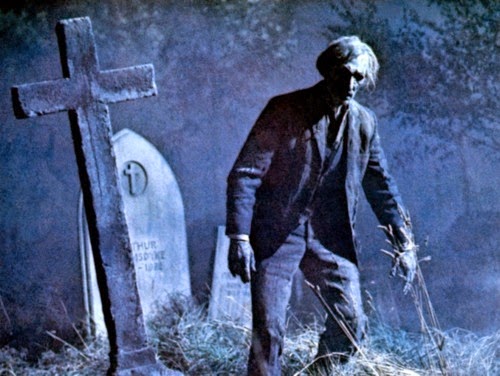
It opens in the town of Whitewood, Massachusetts in 1692 where Elizabeth Selwyn (Patricia Jessel) is being burned as a witch whilst simultaneously cursing the town. Along with her fellow devil botherer, Jethrow Keane (Dyall), she survives into the 20th century where she runs the mist wreathed towns sole mist wreathed hotel and sacrifices young, nubile virgins - women only, no men need apply - twice a year on two dates that seem peculiarly close together. Into that hotel comes a young student working on her thesis on the devil worshipping witches of misty Massachusets who, while lying around in her negligee reading ancient tomes, begins to hear scary chanting from beneath the floorboards and surprisingly cool jazz from the hotel lobby before being dragged to her stabby, devily doom. Hot(ish) on her mist wreathed heels comes her brother and boyfriend wondering why she hasn't been in touch for 2 weeks and it's not long before they too are caught up in the evil mist wreathed antics.
There's some lazy direction, watch out for two almost identical scenes in the mist wreathed street one featuring our doomed student Nan (Venetia Stevenson) and the other, her brother, Richard (Dennis Lotis), and the movie is generally a fairly sluggish affair. It does though look nice despite being seemingly entirely filmed in a studio, the mist wreathed street and graveyard of Whitewood appearing suitably dilapidated and I've always thought there was definite Lovecraft-esque vibe to the movie no doubt a result of its American scriptwriter and his decision to locate the movie in Massachusets; the university could easily be Arkham's Miskatonic University and mist wreathed Whitewood could certainly pass for Dunwich and it's a shame he went with old fashioned witchery rather than fully committing and adding in an 'Old One' or two.
It's very much a transition into the Amicus aesthetic, with the mist wreathing,
the aged buildings and the graveyard they are still firmly embedded in the gothic
trappings that worked so well for Hammer but its contemporary setting, the focus on liberated(ish) young women, the
university campus and the jazz soundtrack all show
the nascent stages of a new sensibility and offer glimpses of the direction Subotsky and Rosenberg were going to push
their brand of horror movie in once their new production company was up and running and as such what we get is an intriguing mish mash of slightly missed opportunities that is never less than watchable but equally is never more than either.
If you enjoy what we do here on Wyrd Britain and would like to help us continue then we would very much welcome a donation towards keeping the blog going - paypal.me/wyrdbritain
Affiliate links are provided for your convenience and to help mitigate running costs.
Directed by the great Roy Ward Baker (Quatermass and the Pit (1967) The Vampire Lovers (UK / US) and The Monster Club (UK) and numerous episodes of ITV and ITC spy-fi serials including The Avengers, The Saint and The Champions), Vault of Horror was the sixth of the seven portmanteau horror films made by Amicus Productions. It consists of five stories wrapped in a framing story of five men in an elevator finding themselves trapped in a clean and well lit basement that handily has five chairs and a ready supply of booze. In the great tradition of these sort of things each man then tells a story, in this case of a recurring dream.
Unlike other portmanteaus that often featured at least one comedic story in order to lighten the mood, this one's the other way round with 4 of the 5 stories in 'Vault of Horror' being very much played for dark laughs in the estimable EC Comics tradition. From the lamentable fangs of the bourgeois patrons of the vampire restaurant in 'Midnight Mess' via a fabulous slapstick performance by Glynis Johns as the bullied wife of obsessive neat freak Terry-Thomas in 'The Neat Job' to venerable actor Curt Jurgens wrestling with a rope in 'This Trick’ll Kill You' and Robin Nedwell and Geoffrey Davies riffing on their characters from the hugely successful 'Doctor...' comedies in 'Bargain in Death'. The final story, 'Drawn and Quartered', featuring a magnificantly hirsute Tom Baker - soon to be de-bearded and be-scarfed in the role we all know him for - is the exception to the frivolity in a voodoo tale of artistic revenge.
In a slightly odd twist 'Vault of Horror' takes most of it's stories, from the pages of 'Tales from the Crypt' comic book rather than from the one whose name it bears and whilst being eminently watchable and featuring some good performances from some fine actors it is a rather slight and disposable sort of thing which isn't really meant to be an insult. When I'm in the right sort of mood this is one of my go to movies as for the expenditure of very little effort it provides plenty of smiles.
If you enjoy what we do here on Wyrd Britain and would like to help us continue then we would very much appreciate a donation towards keeping the blog going - paypal.me/wyrdbritain
Made (and released) in 1972 'Asylum' is perhaps one of the least celebrated of Amicus Productions' portmanteau movies and undeservedly so. It's framing story tells of the arrival of Dr. Martin (Robert Powell) at the titular establishment where he is challenged by Patrick Magee's Dr. Lionel Rutherford to interview the inmates and identify the hospital's previous head who has been committed there following a breakdown.
The frame and the four tales that follow are all written by Psycho author Robert Bloch and whilst eschewing the more gothic trappings of the Hammer movies still drink from the same well with stories concerning voodoo, soul transference and magic.
Director Roy Ward Baker, who had previously directed 'Quatermass and the Pit' and 'The Vampire Lovers' (UK / US) for Hammer and various episodes of ITC spy-fi series like 'The Saint' & 'The Avengers' and would go on to direct another Amicus anthology 'The Vault of Horror' (UK / US) , brings a practised eye to the proceedings and the end result is nicely claustrophobic with a rare narrative logic for the telling of the stories and a brutally satisfying ending.
If
you enjoy what we do here on Wyrd Britain and would like to help us
continue then we would very much welcome a donation towards keeping the
blog going - paypal.me/wyrdbritain
Made by Amicus in 1972 'Tales From the Crypt' is a portmanteau horror movie consisting of 5 stories taken from the American EC Comics ('Tales From the Crypt', 'Vault of Horror', 'Haunt of Fear') imprint. As is generally the case with the Amicus anthologies it stars a host of very familiar British actors of the day including Ralph Richardson, Peter Cushing, Joan Collins, Geoffrey Bayldon and Patrick Magee.
Eschewing the rural and gothic trappings of many Hammer movies Amicus set it's horror very much in the 'modern' era which for me at least has always made the presence of the Cryptkeeper a bit of an anachronism but in the form of Ralph Richardson that's not a difficult thing to overlook. As ever with EC stories there is a strong moralistic undertone to each of the tales as various unrepentant murderers, cheaters, misers and general, all-round, cads receive their well earned comeuppances.
It's great fun, made quickly and slickly with a great cast indulging in some wonderfully hammy acting and a zombie Peter Cushing. What more could anyone ever want from life.
If you enjoy what we do here on Wyrd Britain and would like to help us continue then we would very much welcome a donation towards keeping the blog going - paypal.me/wyrdbritain
Affiliate links are provided for your convenience and to help mitigate running costs.


 /
/  ), '
), '

 /
/  ), '
), ' /
/  ), '
), ' /
/  ), '
), ' /
/  ), '
), ' /
/  ).
). 
 /
/  ) (also made by Amicus) and, perhaps strangest of all, future Hollywood royalty
  /
/  ), and would make a movie for Hammer, '


 /
/ 

 /
/