Originally published in 1955 in Lady Cynthia Asquith's anthology 'The Third Ghost Book' and subsequently housed in 'Dark Entries', the first of Robert Aickman's own collections, 'Ringing the Changes', is a quintessential example of his mastery of the strange tale.
Honeymooning couple Gerald and Phrynne Banstead visit the out of season seaside town of Holihaven only to have their senses assaulted by the constant ringing of the church bells and the stench they experience during an evening walk on a dark beach and despite the warning that the bells are "ringing to wake dead" the couple, foolishly, opt to stay.
If you enjoy what we do here on Wyrd Britain and would like to help us continue then we would very much welcome a donation towards keeping the blog going - paypal.me/wyrdbritain
Affiliate links are provided for your convenience and to help mitigate running costs.
Jeremy Dyson, the off camera 'League of Gentleman' member, has long been known in these pages as a devotee of author and conservationist Robert Aickman being responsible for both a short film, 'The Cicerones', and a radio play, 'Ringing the Changes', based on Aickman's stories.
Aickman was the author of, to use his term, "strange stories", stories that often defy easy categorisation or even easy reading and here Dyson presents a light hearted and engaging exploration of the appeal of the man's literary endeavours, with help from author Ramsey Campbell, TVs Mark Gatiss, Tartarus Press' Ray Russell and others, and makes the case for the man to be given his place among the first rank of writers of the weird and the supernatural.
If you enjoy what we do here on Wyrd Britain and would like to help us continue then we would very much welcome a donation towards keeping the blog going - paypal.me/wyrdbritain
Any affiliate links are provided for your convenience and to help mitigate running costs.
There is, perhaps, little new information here for horror devotees but as an introduction and an overview to the genre it's hard to beat and Gatiss is always an engaging host.
If you enjoy what we do here on Wyrd Britain and would like to help us continue then we would very much welcome a donation towards keeping the blog going - paypal.me/wyrdbritain
Any affiliate links are provided for your convenience and to help mitigate running costs.
The Road is one of the lost television plays of Nigel Kneale. Originally filmed in 1963 for the BBC's First Night series no copies are known to exist, thanks to the corporations trigger-happy delete and reuse policies, with only the script to remind us of what was, The Road has long been a Holy Grail for Kneale fandom. Whilst 'lost' recordings do still appear occasionally from the dim, dark recesses of production and distribution company vaults the chances of ever getting to see these missing shows are slim to say the least so it was with excited trepidation when, in 2018, news was received that a new version was in production with writer and comedian Toby Hadoke given the go-ahead by both the BBC and the Kneale estate to take a run at remodelling the script as a radio drama.
Making only minor adjustments and assembling a small, strong cast Hadoke and director Charlotte Riches make a solid go of telling the story of a night in the woods in 1768 as amateur scientist Sir Timothy Hassall (Adrian Scarborough) and renowned philosopher Gideon Cobb (Mark Gatiss) along with Hassall's wife Lady Lavinia (Hattie Morahan - the daughter of the original lost play's director, Christopher Morahan), Cobb's educated slave Jethro (Colin McFarlane) and others investigate strange noises amongst the trees.
It's a convincing adaptation of a solid and fairly typical Kneale story that exists in that hinterland between horror and science fiction that he made his own and has similarities with his more famous works, The Stone Tape and Quatermass and the Pit. As ever Kneale makes good use of his opportunities to comment on the vicissitudes of our times and his pessimistic outlook on the future. The ending, whilst generally easy to anticipate, hits suitably hard and the whole thing is helped along by some uncovered, archive recordings from the BBC Radiophonic Workshop that had been used in the original play.
If
you enjoy what we do here on Wyrd Britain and would like to help us
continue then we would very much welcome a donation towards keeping the
blog going - paypal.me/wyrdbritain
Any affiliate links are provided for your convenience and to help mitigate running costs.
It's 2099 where, following various environmental disasters which have reduced human knowledge, changed the Earth's orbit, split much of the UK into islands and vastly reduced the human population, we find Professor Nebulous (Mark Gatiss), destroyer of the Isle of Wight and head of KENT (Key Non-judgmental Environmental Taskforce), investigating environmental dangers as he attempts to restore the world while also taking in laundry to supplement their funding.
Nebulous ran for 3 series on BBC Radio 4 between January 2005 and June 2008 with the first episode being remade in 2019 as the animated pilot you can see below.
The show is an affectionate spoof on the cornerstones of Wyrd Britain such as Quatermass, Doctor Who and Doomwatch and indeed the finale of the pilot episode revolves around a notable reference to The Day of the Triffids movie. It features a strong cast including the likes of the series' writer and producer Graham Duff as Rory Lawson and the great David Warner as Nebulous' nemesis Doctor Klench alongside guest stars such as David Tennant, Peter Davison and Kate O'Mara. Not every joke lands cleanly and episodes are often a little too crammed for their own good but such is the curse of the radio play with it's need to avoid dead air but the series as a whole is a thoroughly enjoyable pastiche of the type of shows we champion here which deserves it's place alongside them.
You can watch the animated pilot below with the rest of the series available to own on disc or download from your retailer of choice or you can listen to them here - https://archive.org/details/nebulous5
If you enjoy what we do here on Wyrd Britain and would like to help us continue then we would very much welcome a donation towards keeping the blog going - paypal.me/wyrdbritain
Affiliate links are provided for your convenience and to help mitigate running costs.
Squire John Martin (Wilf Scolding) is brought before 'the hanging judge' George Jeffreys (Elliot Levey) for the murder of Anne Clark (Jessica Temple) who, in the words of the prosecutor Dolben (Peter Capaldi) “was one to whom Providence had not given the full use of her intellects.”, and who has, since her murder, been heard and seen around the village.
Originally published in 1911 in 'More Ghost Stories' this is perhaps one of M.R. James' lesser stories but one eminently suitable for a low-key adaptation. Screenwriter / director Mark Gatiss does just this with a minimal but well chosen cast although, as welcome a presence as Simon Williams is, Gatiss' decision to retain the presence of the narrator is an odd one that splits the telling over different eras pulling us jarringly from the story. It is short on chills but with an excellent cast and a lively script that keeps the line between haunting, madness and revenge nicely blurred it's an entertaining enough watch
If you enjoy what we do here on Wyrd Britain and would like to help us continue then we would very much welcome a donation towards keeping the blog going - paypal.me/wyrdbritain
Affiliate links are provided for your convenience and to help mitigate running costs.
In a career lasting only 6 years, curtailed by his death at just 25 from tuberculosis, Aubrey Beardsley created a body of work that has remained vibrant and vital to this day. His darkly erotic illustrations for Thomas Malory's 'Le Morte d'Arthur', Oscar Wilde's 'Salome' and for 'The Yellow Book' the periodical that he created and curated for publisher The Bodley Head continues to be amongst the defining art the era.
To coincide with the current exhibition of Beardsley's drawings at Tate Britain the BBC and Beardsley fan Mark Gatiss have produced this fascinating little documentary detailing the life and work of this most original and enduring artist.
If
you enjoy what we do here on Wyrd Britain and would like to help us
continue then we would very much appreciate a donation towards keeping
the blog going - paypal.me/wyrdbritain
Mark Gatiss has been on a seemingly one man crusade to bring back the glory days of the BBC ghost story and over the last few years has produced several sympathetic contributions to the series including an M.R. James adaptation, 'The Tractate Middoth'.
This contribution from 2018 has shades of the late 70s tale 'A Ghostly Voice' in its setting as a radio personality known for his readings of classic ghostly tales begins to experience unsettling events on his return to his old studio.
Here we have a typically strong performance from Simon Callow as 'Aubrey Judd' and also from Anjli Mohindra (Rani from The Sarah Jane Adventures) as his producer, 'Tara', in a tale that continually references modern technology whilst retaining a real period feel. Gatiss' script is sensitive and his direction is measured and in the grand tradition the reveals and the suspense are allowed to build slowly as Judd slowly sinks into the clutches of the ghostly presence although the final reveal is a little heavy handed. It is though a respectful but entirely modern contribution to the venerable series that retains all the flavours of the originals whilst adding some new ones of its own.
If
you enjoy what we do here on Wyrd Britain and would like to help us
continue then we would very much appreciate a donation towards keeping
the blog going - paypal.me/wyrdbritain
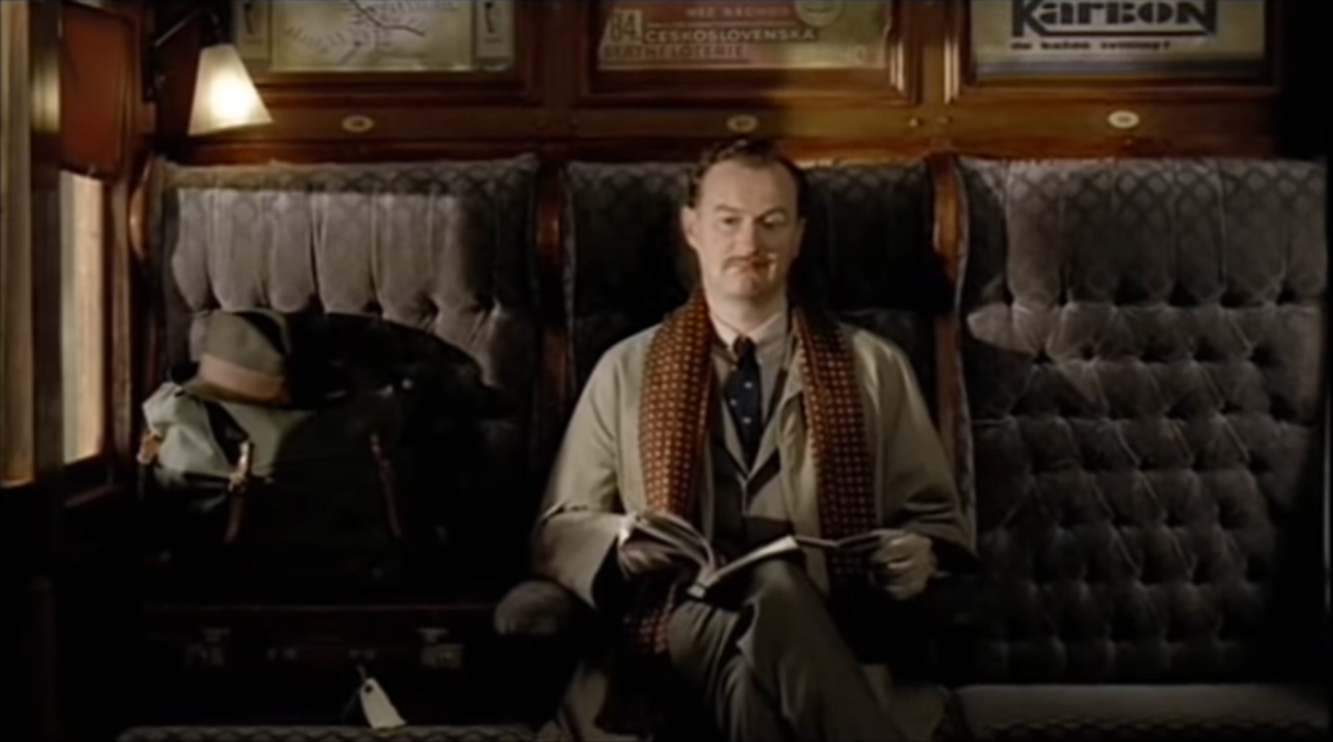
This short film by The League of Gentlemen's Jeremy Dyson is an adaption of one of Robert Aickman's 'strange stories' and tells of a traveller's encounters with four 'cicerones' (guides) inside a cathedral.
Mark Gatiss takes the lead role as 'John Trant' a reserved and slightly stuffy Englishman of indeterminate age sightseeing his way across Europe who, in the great ghostly tradition of M. R. James, goes off in search of a MacGuffin - in this case a painting of Lazarus - and instead finds himself at the centre of a much more unsettling experience among the columns and crypts of 'The Cathedral of Saint Bavon'.
At only twelve minutes in length Dyson has mostly kept true to his source and this is a concentrated dose of Aickman ambiguity as we, along with Trant, are led deeper and deeper into the bowels of the cathedral as the tension builds from no overt source other than Trant's desperate need to find the painting before the cathedral closes, the macabre nature of the images he is confronted with and his reactions to the odd behaviour of the various people he meets. As is the way of things with Aickman little is obvious, much goes unsaid and one is left very much adrift in exquisitely disquieting confusion.
If you wish to learn more about this most singular of authors you can find an interesting documentary about his life and work at this link and another (longer) adaptation of one of his strange stories - 'The Hospice' by clicking here.
If
you enjoy what we do here on Wyrd Britain and would like to help us
continue then we would very much welcome a donation towards keeping the
blog going - paypal.me/wyrdbritain
With it's long history of producing M.R. James stories for it's 'A Ghost Story for Christmas' and with horror aficionado Mark Gatiss on the payroll it seems strange that it took the BBC so long to pair the two together but for Christmas Day 2013 they did just that.
The Tractate Middoth is the story of the search for a missing will, disguised and hidden inside a Jewish text, that will deprive villainous John Eldred (John Castle) of a misappropriated inheritance and instead allow it to pass to it's rightful recipient Mary Simpson (played by Wyrd Britain legend Louise Jameson) and her daughter. Into this is thrown a young librarian, William Garrett (Sacha Dhawan), whose encounter with a terrifying, cobwebby spectre leads him to committing himself to the ladies' cause.
The Tractate Middoth is certainly one of James' more slight tales and as such Gatiss, sitting for the first time in the director' chair, has wisely kept the runtime short. This does still leave both script and cast a fair amount to fit into 36 minutes but they do so whilst keeping things suitably sedate. The cast are well chosen and produce solid if maybe slightly uninspired performances with Castle's twitchy, restless, haunted Eldred being the standout. The initial reveal of the spectre is somewhat botched by simply showing too much too soon but later appearances are handled with a far more deft touch.
As a piece it certainly doesn't rival the early adaptations such as 'Lost Hearts' or 'Whistle and I'll Come To You' but as something to while away bit of a quiet and wintery evening it serves it's purpose.
If
you enjoy what we do here on Wyrd Britain and would like to help us
continue then we would very much welcome a donation towards keeping the
blog going - paypal.me/wyrdbritain
'Crooked House' was a three episode mini series written and co-produced by Mark Gatiss in 2008. The series is an obvious homage to Gatiss' love affair with the Gothic supernatural horrors of writers such as M.R. James and the films of the Hammer and Amicus studios and it could easily have been presented in that most Amicus of formats, the portmanteau, but instead here we have three separate episodes featuring interlinked tales narrated by Gatiss' museum curator.
The tale telling is triggered when new homeowner Ben (Lee Ingleby) unearths a door knocker that he takes to museum curator Gatiss who believes it to be a remnant of the locally infamous, but now demolished, Geap Manor.
The curator tells two tales of the Manor, one from the 18th century and another from the early 20th before the third episode transpires in 'real time' so to speak.
There's a nice period feel to the whole thing and it does come across as a labour of love but it also comes across as a bit, well, cheap looking. The stories though are suitably creepy, particularly the third, and there's a perfectly predicable but also perfectly correct ending to the whole thing.
Montague Rhodes James (1862 - 1936) was an English writer of some of the most enduring ghost stories of all time.
He attended King's College, Cambridge as an undergraduate, then as a don and finally as provost, a post he subsequently held at Eton College until his death. His work as a mediaevalist was profound and still well respected but it is for his 30 ghost stories that he is most keenly remembered.
His fans have been many and diverse numbering amongst them, H.P. Lovecraft, Kingsley Amis and Ruth Rendell. His stature as our pre-eminent writer of ghost stories has been cemented in the late 20th and early 21st as he has become the most popular source for the BBC's annual 'A Ghost Story for Christmas' with 9 of the 12 films being adapted from his works; most recently Mark Gatiss' adaptation of 'The Tractate Middoth' screened on Christmas Day 2013.
Also screened that day was this excellent documentary also by Gatiss of the life and influence of James to which I now direct your attention.




 - or watch it below.