Made by HTV West - who were also responsible for such wyrd wonders as 'Children of the Stones', 'Into the Labyrinth', 'Arthur of the Britons' and 'Robin of Sherwood' - 'Sky' is the story of a young man with solid blue eyes and strange powers found, buried under some leaves, in the woods who turns out to be a traveller from another time and dimension who has landed in 1970's Britain by mistake (as if anyone would go there on purpose). Needing to find the 'Juganet' (a circle of power) that will enable him to complete his journey he co-opts the help of a trio of kids but ranged against them are the forces of nature in the shape of trees (leaves seem to particularly dislike him), wildlife and a spontaneously generated 'human' named Ambrose Goodchild (Robert Eddison) as the Earth tries to rid itself of this anomaly.
Sky - the character - is an utterly alien presence who considers himself
almost a god and views his helpers with a disdain bordering on contempt which makes him difficult to like. We assume his motives are pure - he is the title character after all - but his manner is less than endearing. Marc Harrison plays him with an ethereal otherworldliness that keeps him above and beyond his mortal helpers.
Written by the Doctor Who writing team of Bob Baker and Dave Martin the show is unapologetically odd. It makes no bones of it's contempt for the short-sightedness and self-destructive nature of contemporary society and like many of it's contemporaries it has at its core an ecological and almost neo-pagan sensibility that revolves around earth magic and, of course, ancient stone monuments.
There are some definite pacing issues and it certainly could have benefited from trimming off an episode but it is, on the whole, a wonderfully disconcerting watch and another in that great 1970s tradition of making shows for kids that had the power to actually terrify them. Scenes of Sky and his cohort being attacked by plants and animals soundtracked with a tumultuous, synthesised, atonal, sonic squall (courtesy of Eric Wetherell) are still as effective as they were 43 years ago and the series remains as disturbingly strange and enjoyable as it ever was.
If
you enjoy what we do here on Wyrd Britain and would like to help us
continue then we would very much welcome a donation towards keeping the
blog going - paypal.me/wyrdbritain
Here, in a free-wheeling discussion with journalist and author John Higgs, Mr. Moore gives forth on his theories
of the artistic and cultural life of the 20th century via H.P. Lovecraft
as a barometer of his time, the development of science fiction,
politicians and pigs.
I will happily listen to Moore talk on any topic as he's always captivating and full of interesting connections and insights but here especially he is talking about things I find particularly fascinating and hopefully you do too.
If
you enjoy what we do here on Wyrd Britain and would like to help us
continue then we would very much welcome a donation towards keeping the
blog going - paypal.me/wyrdbritain
We've previously featured another episode from the 1976 BBC 2 Playhouse series 'The Mind Beyond' on Wyrd Britain with the episode 'Stones', a very enjoyable rural horror about a politician's dangerously daft plan to relocate Stonehenge to London's Hyde Park.
This episode, 'The Man with the Power', was written by Evan Jones (who also wrote oddball WWII football movie 'Escape to Victory') this is the story of builders labourer Boysie (Willie Jonah) who discovers that the 'second sight' he inherited from his mother is getting stronger when he remotely experiences his colleague's (Johnny Briggs - Coronation Street's Mike Baldwin) automobile accident. Awed by his gift and by the various reactions of those around him he embarks on a spiritual quest that leads him to the Devil and beyond.
It's an odd one this. Apart from a nicely twitchy turn by Geoffrey (Catweazle) Bayldon as a paranormal investigator and a show stealing appearance by Cyril Cusack as another sensitive the acting is pretty poor throughout with both Jonah and Vikki Richards, who plays his girlfriend Gloria, indulging in some serious scenery chewing. The dialogue is clunky and the characters are pretty much universally unlikeable with Briggs' Brian (and others) spouting some dodgy 1970s racial politics. There's an underlying theme of the responsibilities of power and the corrupting influence of material goods and a general gist that we are possibly watching the wilderness years of a new messiah but it's pretty clumsily done and the plot is generally unfocused repeatedly heading off in strange directions that are rarely fully explored such as Boysie's encounter with the old lady and the unexpectedly homoerotic turn that Boysie's
ultimate meeting with the Devil takes.
But, with all that said, it did keep me watching; I just don't know why.
Did I enjoy it? No, not particularly. Would I watch it again? Maybe, but probably not. Do I recommend it? Not really. Yet, here it is. Make of it what you will.
If
you enjoy what we do here on Wyrd Britain and would like to help us
continue then we would very much welcome a donation towards keeping the
blog going - paypal.me/wyrdbritain
Bod was (most famously) a 13 episode animated series created in 1975. It was based on a quartet of books by Joanne and Michael Cole (who also created 'Fingerbobs'), featured narration by John Le Mesurier and music by Derek Griffiths (including that instantly recognisable theme tune). It's fabulous stuff and has deservedly earned it's place in the annals of children's television and in the hearts of successive generations.
Particularly it would seem in the heart of the animator behind HappyToast where it shares space with 2000ADs most iconic character Judge Dredd because he has created this most wonderful mash-up of the two which also features the Angel Gang, the four Dark Judges and a perfect Le Mesurier impersonation.
This has been around for a while now and deserves lots more love because it's a gloriously daft work of twisted genius and I absolutely adore it.
If
you enjoy what we do here on Wyrd Britain and would like to help us
continue then we would very much welcome a donation towards keeping the
blog going - paypal.me/wyrdbritain
Matthew Gore is an ordinary sort of 12 year old; he can't draw particularly well, he's average at maths and isn't much good at cricket; that is until someone else takes up residence in his head. That someone is an extra-terrestrial entity named Chocky and unusually for these sort of things she's not there to cause trouble.
Published in 1968 'Chocky' was John Wyndham's final novel. A YA novel of sorts; it's rather gentle story marks a departure from the more overt post-apocalyptic scenarios - The Day of the Triffids, The Chrysalids - that he was known for and in it's place is essentially a science fiction family drama that offers a different take on the idea of a possession or haunting.
Adapted by former Doctor Who script editor Anthony Read (who also wrote episodes for both Sapphire and Steel and The Omega Factor) the show for the most part stays very close to the source material with a few minor changes such as making Chocky telekinetic and allowing her a physical manifestation of sorts.
It's a beautifully made series that just like the book exists in the hinterland between a kids story and one with a more adult nature. The cast are uniformly excellent with Wyrd Britain regular, James Hazeldine (The Omega Factor, The Last Train, Ride, Ride) and Carol Drinkwater (All Creatures Great and Small) as Matthew's parents providing solid performances around which the show revolves and with Andrew Ellams producing a nicely measured performance as Matthew pulling off that most rare feat for a child actor of not being precocious or irritating. My only complaint would be that the book's weak third act isn't improved any by seeing it on film.
The success of the series led to two more being produced that took Matthew and his alien friend on further adventures which we'll return to another time.
If
you enjoy what we do here on Wyrd Britain and would like to help us
continue then we would very much welcome a donation towards keeping the
blog going - paypal.me/wyrdbritain
For '3 Wyrd Things' I asked various creative types whose work I admire to tell us about three oddly, wonderfully, weirdly British things that have been an influence on them and their work - a book or author,
a film or TV show
and a song, album or musician.
First up, Paul Magrs.
Paul Magrs lives and writes in Manchester. In a twenty-five year writing career he has published novels in every genre from Literary to Gothic Mystery to Science Fiction for adults and young adults. His most recent books include the concluding volume in a science fiction trilogy for kids - ‘The Heart of Mars’ (Firefly Press), and ‘Fellowship of Ink’ (Snow Books) which continues the multi-volumed saga of Brenda, the long lost Bride of Frankenstein. He has taught Creative Writing at both the University of East Anglia and Manchester Metropolitan University, and now writes full time
Paul's writing is always an absolute joy to read; it's 'War of the Worlds' as written by Alan Bennett and it's 'Hammer House of Are You Being Served'. His work is gloriously individual and utterly rooted in everything that makes British science fiction and horror so much fun and we are honoured to have him write the first in this new series.
More info on Paul's writing can be found on his website - Life on Magrs.
Books
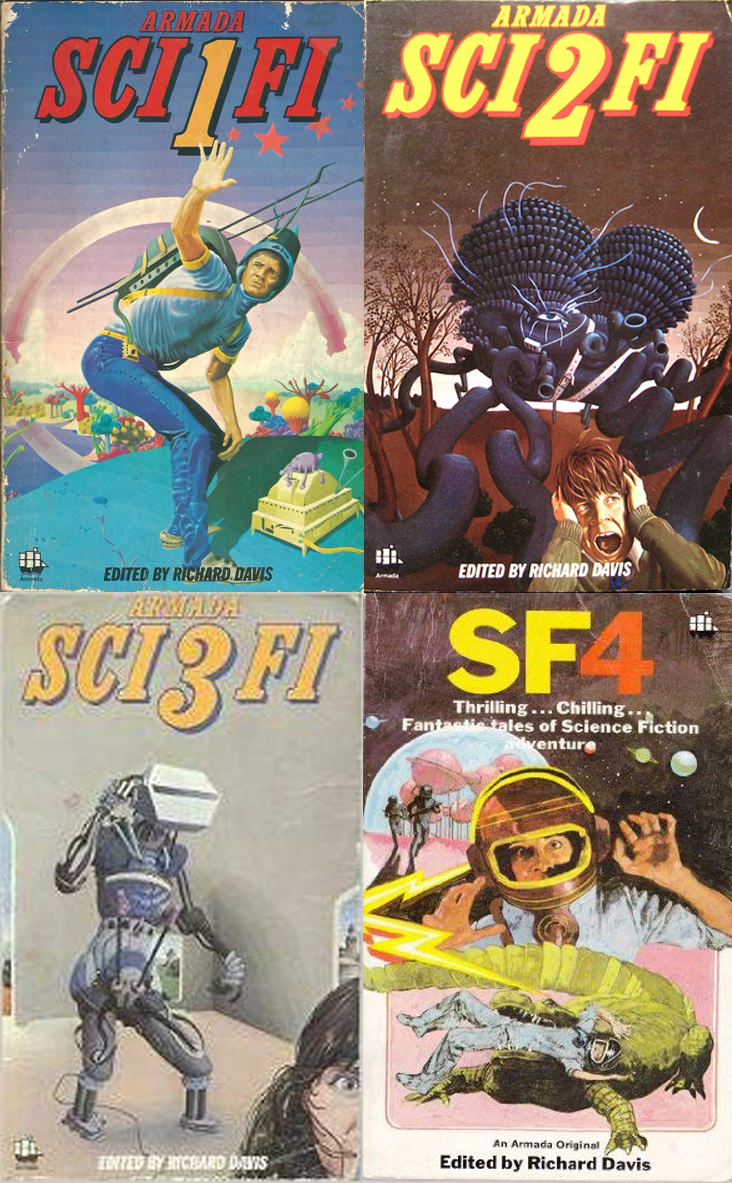
Armada was the most amazing and – I think – undervalued of children’s publishers in Britain of the Seventies. Never as classy as Puffin or Piccolo, their books were readily found in the paperback carousels of newsagents and motorway service station shops. A little cheaper, a little tackier and often a lot more fun. My favourite thing they did was their anthologies: umpteen volumes of ghost tales, mostly edited by the remarkable Mary Danby, and six books of Monster stories curated by the semi-legendary R. Chetwynd-Hayes. Best of all, to my mind, were the Armada Sci-Fi Books one through to four. Every story is a gem – juxtaposing shops and tower blocks with alien visitors and space fleets from afar. Richard Davis was the editor and these books are vanishing from Ebay, from endangered bookshops and from the face of the earth itself. They must be collected and preserved.
TV
‘Three Salons at the Seaside’ is the most wonderful piece of telly I know. It’s a forty minute fly-on-the-wall documentary from 1994, produced for the BBC and directed by Philippa Lowthorpe. All it asks is that we sit quietly in the corner of three different hair salons in Blackpool during a rainy Monday (it feels like) as the sky blows and glooms outside and the elderly ladies come trogging in, in twos and threes, to have their rinses and blow-waves done. We eavesdrop on alarming conversations about death and disaster and all manner of frailties and scandal. We discover the secret of the communal funeral handbag and we marvel, basically, at these wonderful, watchful, eloquent faces as they mull over the meaning of everything, sitting under the driers. Outside a young girl flies back and forth on roller skates and the music is just exquisite; jaunty, hopeful and achingly nostalgic. It’s the best bit of telly there’s ever been, in my humble opinion.
Record
For a record I’d like to pick out Geoff Love’s ‘Space Themes’ – a picture of the cover appeared recently on this page. That marvellously copyright-infringement-dodging painting drew my eye back in 1978, when Fine Fare opened a late-opening megastore in our town precinct and offered all kinds of fantastic records and stuff to lavish your pocket money on. This album – joined by many other Geoff Love classics – has lived in my treasured collection ever since. The rendition of the Doctor Who theme is like the pulsating, thrilling, technicolour cinematic version that the Seventies failed to bring us.
Many years later, in 2011, when I was writing Doctor Who stories for AudioGo I played this version of the theme to myself, to get me in the mood for a day’s recording near Charlotte Street in Soho. I sat outside a Greek café at eight in the morning, anticipating a day in studio creating a story I’d cheekily called ‘Tsar Wars’ – a kind of retelling of ‘Nicholas and Alexandra’ set in 1970s outer space.
We had a rather large cast arriving at about nine o’clock. I was there early, eating a bacon sandwich, sipping frothy coffee, enjoying the sun sliding over the canyons of Fitzrovia. The Geoff Love Dr Who theme was playing loudly and… at that very moment Tom Baker came galumphing round the corner. He was swinging a bag of cakes and sweets he was bringing to share with everyone at the recording.
It was a completely magical moment. There was no one else there on the street. He noticed me and gave a jaunty wave. And that moment became one of my favourites of all time: set to the tune of that disco-era Doctor Who.
If
you enjoy what we do here on Wyrd Britain and would like to help us
continue then we would very much welcome a donation towards keeping the
blog going - paypal.me/wyrdbritain
Alex Schwartz had a
promising future - until he contracted an unfortunate bout of vampirism,
and agreed (on pain of death) to join the Laundry, Britain's only
counter-occult secret agency. His first assignment is in Leeds -
his old hometown. The thought of telling his parents that he's lost his
old job, let alone them finding out about his 'condition', is causing
Alex more anxiety than learning how to live as a vampire secret agent
preparing to confront multiple apocalypses.His only saving grace
is Cassie Brewer, a student appearing in the local Goth Festival, who
flirts with him despite his awkward personality and massive amounts of
sunblock. But Cassie has secrets of her own - secrets that make Alex's night life seem positively normal .
Let me start by saying Gideon Emery has ruined these books. I tried reading one recently and just couldn't do it without my internal monologue defaulting to a piss poor imitation of his voice and so I had to give up and revert back to the fantastic audio versions that he reads.
'The Nightmare Stacks' is another Bob-less Laundry book and one that's going to blow the whole secret open as Britain is invaded by magical elfy types from another dimension.
The story follows Alex Schwartz one of the newly recruited 'Phangs' (vampires) - left over from a previous novel - as he scouts a new Laundry headquarters in Leeds. The book is very much in the tradition of the series - lots of policy wonking - and tapping into a particular literary trope - in this case the fantasy novel - but like the superhero one that preceded it things have gone really overt as the endgame comes slowly into sight. I'm not entirely in favour of this as I do prefer the more covert side of things and I think this and it's predecessor have been by far the weakest books in the series but Stross is an eminently readable (Damn you Emery!) listenable writer and this series is pretty much always a delight to read / hear.
'Stigma' is one of the three non M.R. James adaptations made by the BBC for their 'A Ghost Story for Christmas' and the first of the two that broke with the tradition of adapting a classic ghostly tale.
Written in 1977 by screenwriter Clive Exton (10 Rillington Place, Agatha Christie's Poirot, Jeeves & Wooster) it tells the story of a couple Katherine (Kate Binchy) & Peter (Peter Bowles) and their teenaged daughter Verity (Maxine Gordon) who move to a house in the country beside a stone circle (Avebury) and unwisely decide to remove one of the stones from their garden. A sudden gust of wind coincides with the lifting of the stone and the beginning of Katherine's troubles.
The enigmatic nature of stone circles has long been a source of
inspiration for writers with a tendency towards the wyrd and the 70s
seemed a particularly fertile time for dramas centred around them with 'Children of the Stones' and 'Stones' appearing in early 1977 and 1976 respectively and the 'Ringstone Round' shenanigans of the 'Quatermass Conclusion' in 1979 (and I'm positive there were many more).
As a traditional Christmas ghost story it kind of misses the mark a little with it's summery, contemporary setting but it is a very effective and haunting, body horror with a fine central performance from Binchy. The writing is tight with not a second of the limited run time wasted and it's only the clunky bit of exposition at the end that slightly mars a nicely macabre tale.
If you enjoy what we do here on Wyrd Britain and would like to help us continue then we would very much welcome a donation towards keeping the blog going - paypal.me/wyrdbritain
Affiliate links are provided for your convenience and to help mitigate running costs.
"No spaceships, no ray guns, no men in silver suits. It was about atmosphere, fear and creaky stairs." - P.J. Hammond
Below is a short - very short - discussion about Sapphire and Steel from a show called 'Top Ten TV'. Presented by Nick Frost it includes contributions from writer PJ Hammond and lead actor David McCallum alongside the usual vaguely irritating types that populate these sort of shows. It's an innocuous but fun little watch and it uses 'Bela Lugosi's Dead' by Bauhaus as background music which always adds to the proceedings.
If
you enjoy what we do here on Wyrd Britain and would like to help us
continue then we would very much welcome a donation towards keeping the
blog going - paypal.me/wyrdbritain
Alan Garner's 'To Kill A King' was the final episode of the supernatural anthology series 'Leap In The Dark' that ran for 4 series on BBC2 between 1973 and 1980. Whilst the early series were documentaries the latter two consisted of various dramas written by the likes of Garner, Fay Weldon (author of 'The Life and Loves of a She-Devil') and (the writer of 'Penda's Fen') David Rudkin.
In 'To Kill A King' Garner tells an autobiographically tinged story of an author, Harry (Anthony Bate, Oliver Lacon in 'Tinker, Tailor, Soldier, Spy'), haunted by a disconnect with his restless muse as he battles against writer's block or of man rapidly descending into depression and madness as he rages against the turmoil of his mind.
Garner has spoken in the past of his struggles with depression and in many ways this seem like an exploration of its causes as Harry is pressured from all sides - by colleagues, family, fans but most of all by himself - and as a result 'his head' is submerged in muddy water unable to see the light, a terrifying prospect that throws him into even deeper water.
As you may have inferred the play is heavy on symbolism with Harry reaching a decision as he emerges from a dark tunnel and the idea of inspiration as a transmission from elsewhere embodied by the presence of Jodrell Bank Observatory at the end of his garden and the plethora of communications technology - typewriter, telephone, television - that haunts him and it's not until he uses 'his head' to break their hold that his muse settles and his block lifts.
The finished piece is an oddly compelling collision of supernatural tale with psychodrama that offers an interestingly ambiguous take on both.
If
you enjoy what we do here on Wyrd Britain and would like to help us
continue then we would very much welcome a donation towards keeping the
blog going - paypal.me/wyrdbritain
'The Waiting Room' finds a brother and sister having to spend the night in a deserted and isolated railway station after missing the last train home. Whilst there they experience a 50 year time slip to 1925 where they are witness to a train crash before a slip back to their own time sees those same events begin to repeat themselves.
'The Waiting Room' despite it's nicely dingy single set never really manages to achieve a satisfying level of claustrophobia and you can't quite shake the feeling that you are watching a village hall am-dram production with one standout actor amongst it's cast. Agutter is, of course, rock solid and anchors the proceedings nicely but her co-star, Paul Henley, is way out of his depth and hamming it up something terrible.
With all that said though I do quite enjoy this one. It's very old fashioned even for 1975, extremely well mannered and is very much a hark back to the classic Edwardian ghost tale which I'll probably always have a soft spot for.
If
you enjoy what we do here on Wyrd Britain and would like to help us
continue then we would very much welcome a donation towards keeping the
blog going - paypal.me/wyrdbritain
Devotees of British supernatural TV of the 60s and 70s have become grudgingly used to the idea that many of the shows of the time are lost to us due to the cost cutting practise of 'wiping' and the lack of a system for safely archiving. Amongst those lost to time are some 90 odd episodes of Doctor Who, much of the first series of Quatermass and the entire first two series of early 70s supernatural detective series 'Ace of Wands'.
Created in 1970 by Trevor Preston and Pamela Lonsdale, Ace of Wands told of the escapades of stage magician and detective 'Tarot' (Michael Mackenzie), his pet owl Ozymandias and various assistants including antiquarian bookseller Mr Sweet (Donald Layne-Smith) and, in the third series, a brother and sister duo by the name of Chas (Roy Holder) and Mikki (Petra Markham). Originally envisioned as kid friendly show about a flamboyant detective, over the three series, the show becomes progressively more concerned with the supernatural especially with the arrival in series two of writer P.J. Hammond.
Following on from his contributions to AoW Hammond would, of course, go on to create and write Sapphire and Steel but it is here that he first took his cop show chops (earned on shows such as Dixon of Dock Green and Z-Cars) and married it with a love of the odd. His third series storylines - 'The Meddlers', 'Peacock Pie' & 'Beautiful People' - show hints of what was to come but truthfully with storylines that include people being turned into dolls the whole thing has a similar vibe to what Hammond would later create in S&S. Ace of Wands walked a fine line between the ostentatious spy-fi, detective fiction of the ITC shows and the Earth bound sci-fi of Pertwee era Doctor Who whilst also tapping into the zeitgeist and embracing the supernatural shenanigans that would characterise much of the 1970s TV we love so much here at Wyrd Britain such as 'The Stone Tape' and 'The Children of the Stones' all the while managing to just about keep things kid friendly and rocking a killer theme tune by Andy Bown.
It is an absolute shame that so much of this series is lost to us but as the recent(ish) Doctor Who finds (of episodes from 'The Web of Fear' and 'The Enemy of the World') show there's always a chance that some of the earlier episodes will resurface but for now we have only the third series and that's certainly no bad thing.
The first episode of season three is below and the rest are in the playlist here.
If you enjoy what we do here on Wyrd Britain and would like to help us continue then we would very much welcome a donation towards keeping the blog going - paypal.me/wyrdbritain
Affiliate links are provided for your convenience and to help mitigate running costs.
William Hope Hodgson
(1877-1918) is acknowledged as one of the undisputed masters of the sea
story. There has never been a collection of his very best short stories
offered to the trade. Hodgson's sea stories have unusual authenticity
owing to his having spent a lot of time on merchant's ships-he left his
family in 1890 at the age of thirteen to spend eight years at sea, where
the experience of mistreatment, poor pay, and worse food was contrasted
by Hodgson's immeasurable fascination with the sea. His obsession for
the sea fills his writings. This volume collects the very best of
Hodgson's sea stories-which has not been done before-with some of the
most exciting and dramatic creatures of fantasy on the written page,
exhibiting the sea in all her moods: wonder, mystery, beauty, and
terror."This collection brings together the very best of his short
stories, together with a sampling of his poetry. It includes a variety
of his sea horrors along with two non-fantastic pieces: "On the Bridge,"
a journalistic story written immediately after the sinking of the
Titanic which attempts to show some of the various factors which
contributed to the tragedy, and the suspenseful nonfiction story
"Through the Vortex of a Cyclone," which is based on Hodgson's own
experiences at sea." - From the Introduction by Douglas A. Anderson
Hope Hodgson's Carnacki stories have long been a favourite of mine and are at the centre of my love of a supernatural detective yarn but I never really had any real desire to read much else by him. A year or so ago I listened to an audio of 'The House on the Borderland' which I thoroughly enjoyed but again no real impulse to dig any further until I stumbled across this collection of his nautical horrors collected together by Douglas A. Anderson. Now. part of the reason I'd not dug any further into Hodgson's stories is a disinterest in nautical tales but as it was in my hand I thought I'd give them a go.
As a young man Hodgson had spent a number of years at sea in the merchant navy and so the sea loomed large in his stories even featuring in one of his Carnacki tales, 'The Haunted Jarvee', which is included here. A particular favourite of his was the 'Sargasso Sea', a legendary 'sea of weed' that ensnares unwary ships and holds them trapped as the crew either slowly starves or become food for the creatures that call it home. Several of these Sargasso stories feature here and they range from the enigmatic ('The Voice in the Dawn') to the dynamic (the two parts of 'The Tideless Sea') to the dreadful ('The Finding of the Graiken').
Some of the stories such as 'The Wild Man of the Sea', 'On the Bridge' and the fantastic 'Through the Vortex of a Cyclone' are fairly straight adventure fare - the latter sourced from experience - but for me it's the stranger stories that made the bigger impact such as the fungal body horror of 'The Voice in the Night', the unlikeliness of 'The Stone Ship' and the bittersweet final voyage of 'The Shamraken Homeward-Bounder'.
I must admit the constant nautical setting did wear at me somewhat - even the words 'poop deck' stopped making me smirk - and at times I found myself flagging a bit but Hodgson spins a good yarn and few of those included here hang around long enough to truly wear one's patience but as I said earlier nautical stories were never of much interest and whilst this did nothing to change my mind on that score it is a very recommended collection.
If
you enjoy what we do here on Wyrd Britain and would like to help us
continue then we would very much welcome a donation towards keeping the
blog going - paypal.me/wyrdbritain
I've had the great pleasure of being on the receiving end of Keith's promos for a good few years now and it's always been an absolute delight. This new five track EP featuring four new tunes and a remix of a tune from Keith's earlier album - A Rest Before the Walk - by Wyrd Britain faves Revbjelde is no different.
Musically he walks a capricious, queasily disconcerting and idiosyncratic path. With his sounds balancing on the edges of radiophonic playfulness and acid folk's twisted pastoralism filtered through the dark prism of Coil-esque post-industrial decay he has assembled another collection of deliciously serpentine and indefinably nebulous psychedelia fuelled by oneiric logic and arcadian phantasms.
Hammer House of Horror is a well remembered anthology TV series made and broadcast in 1980 by the venerable old studio in conjunction with ITC Entertainment (creators of shows like The Prisoner, Captain Scarlet and the Mysterons, Jason King & The Saint amongst many others).
'The House that Bled to Death' was the fifth episode and - due to one scene in particular - remains the most referenced of the series. It's a haunted house tale with a twist in the tail that concerns a young family who buy a house notorious for being the location of a brutal murder. Inevitably strange events begin to plague them culminating in the exuberant gorefest of the birthday party and as an aside for anyone unfamiliar with the scene who's troubled by that description of a children's party watch for the anticipatory relish on the faces of at least two of the kids moments before the blood starts flowing.
The cast consists of various UK TV stalwarts most of whom have done time in Doctor Who and assorted Brit soap operas all give reliably solid performances in an enjoyably callous story.
If
you enjoy what we do here on Wyrd Britain and would like to help us
continue then we would very much welcome a donation towards keeping the
blog going - paypal.me/wyrdbritain


 - or watch it below.


 - or watch it below.


 - or watch it below.


 - or watch it below.


 - or watch it below.