There is, perhaps, little new information here for horror devotees but as an introduction and an overview to the genre it's hard to beat and Gatiss is always an engaging host.
If you enjoy what we do here on Wyrd Britain and would like to help us continue then we would very much welcome a donation towards keeping the blog going - paypal.me/wyrdbritain
Any affiliate links are provided for your convenience and to help mitigate running costs.
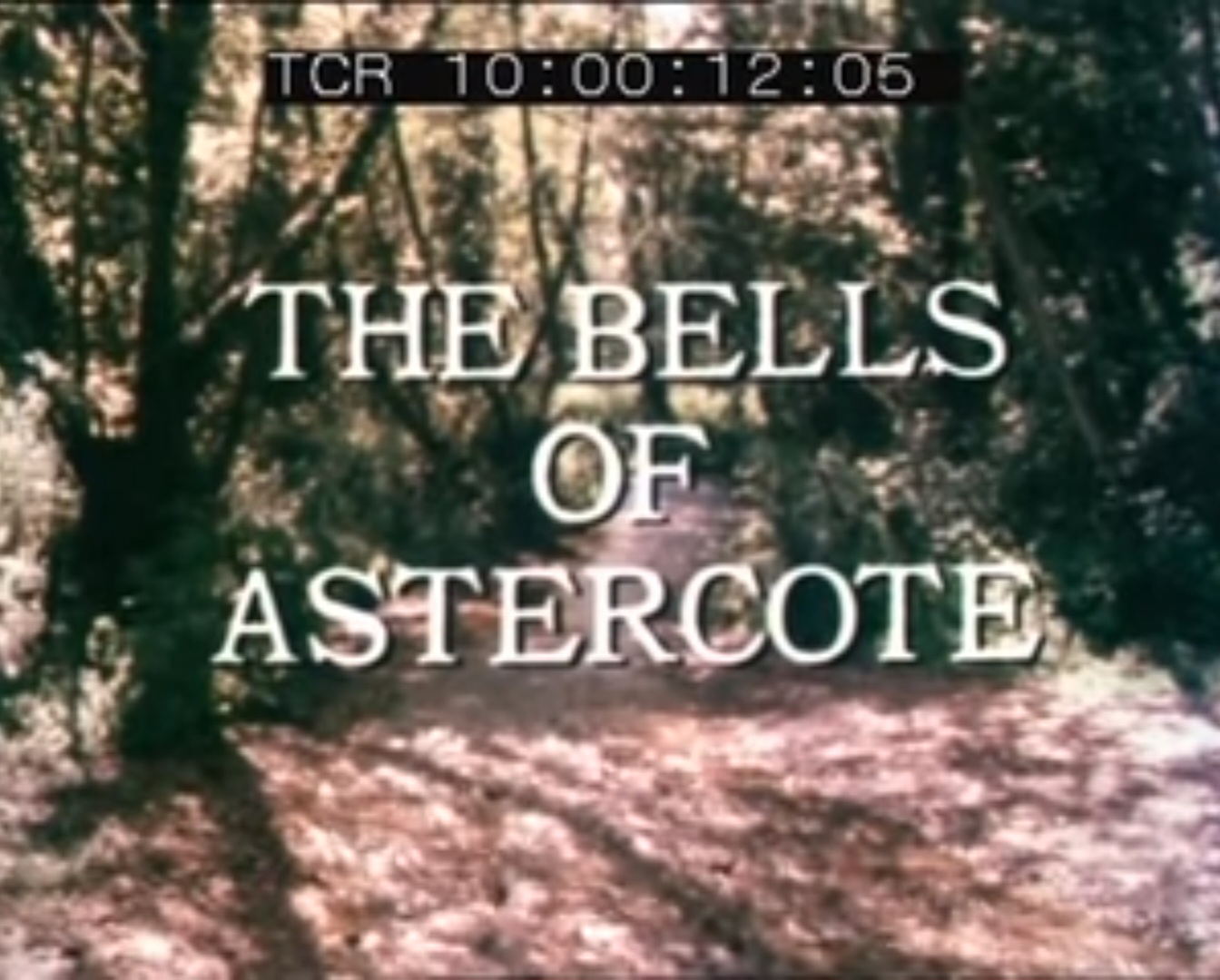
Mair (Siobhan Brooks) and her brother Peter (Ifor Williams) are new to the village of Charlton Underwood, living in the controversial new housing estate on the edge of the old town. Chasing their dog into the nearby wood one day they meet a local man named Goacher Tranter (John Branwell) and the remains of the even older town of Astercote that had been wiped-out during the black death. Hidden in the ruins and guarded by the innocent Goacher is a chalice, the communion cup from the devastated vilage church, which the locals believe protects them from the return of the plague. However, when the chalice goes missing things deteriorate quickly in the town as a sickness takes hold and the already tense relationship between the working class villagers and the middle class new arrivals threatens to boil over.
Director Marilyn Fox has a track record for television of this type being responsible for, amongst other things, 288 episodes of 'Jackanory", along with adaptations of Edith Nesbit's 'Five Children and It' and C.S. Lewis' 'The Lion, The Witch and the Wardrobe' and it's immediately apparent that she has a real eye for the uncanny in a story with Astercote's obvious similarity to M.R. James' 'A Warning to the Curious'. Based on the 1970 children's novel by Penelope Lively it's an enjoyable enough story of fear of change and of the other, timeless themes but presented in a manner that feels really quite dated and, like the novel, there's almost no actual supernatural forces at work here beyond belief, superstition and suspicion but they all cast heady spells.
The cast are, mostly, competent if uninspiring with the two leads being too shrill for my ears and too drama school for my liking and there are far too many suspect Somerset accents on display but the various members of the Tranter family are convincingly rustic without degenerating into bumpkins and Janis Winters is an enjoyably no nonsense district nurse, "Mother, you can't have a touch of the black death!"
'The Bells of Astercote' is certainly not on a par with the classics of supernatural television made for young people but it has it's moments and almost certainly deserves the opportunity to reach a wider audience.
If you enjoy what we do here on Wyrd Britain and would like to help us continue then we would very much welcome a donation towards keeping the blog going - paypal.me/wyrdbritain
Any affiliate links are provided for your convenience and to help mitigate running costs.
I'm possibly stretching my own rules for Wyrd Britain to the very edge of breaking point with this one but personally I'm fascinated by the times and the music covered in this BBC radio documentary and in Berlin of the cold war era in particular and thought there was just enough of a relevance to some of the things I feature on here to justify it's inclusion - click here if you disagree. If you were to search through my music collection I would hazard a guess that at least half, if not more, of the music in there was either made in Germany during the 60s, 70s and 80s or was profoundly influenced by it.
The documentary takes David Bowie's relocation to Berlin as it's focus discussing what drew him to the city and from there looks at some of the astonishing music being made in Germany by the likes of Can, Cluster, Neu!, Kraftwerk and Faust and later Einsturzende Neubauten and others but all the time keeping the history in the context of how these musical mavericks influenced musicians in the UK (and beyond) amongst them Brian Eno, John Foxx and Katharine Blake (who all feature here in some form) that would in many ways define music through the end of the 20th century and well into the 21st.
If you enjoy what we do here on Wyrd Britain and would like to help us continue then we would very much welcome a donation towards keeping the blog going - paypal.me/wyrdbritain
Any affiliate links are provided for your convenience and to help mitigate running costs.
Pat Mills (writer) Tony Skinner (writer) Jim Elston (artist) Kevin Wicks (artist) Liam Sharp (artist) 2000AD Finn is a cab driver by day, and a witch by night, part of a coven dedicated to protecting humanity from the agents of the old 'Great Ones', the ancient intergalactic beings who separated humanity from their beastly nature, and have maintained control ever since. These arcane and anarchic adventures from Pat Mills, Tony Skinner, Jim Elston, Kevin Wicks, and Liam Sharp are collected for the first time.
Jumping from the pages of Crisis' 'Third World War' the character of Paul, otherwise known as the eco-warrior Finn, got his own relatively short lived series in 2000AD. Going for a much more fantastical storyline than the near future dystopia of 3WW, here, Finn is the hit-witch for a Cornish coven battling the alien 'Newts' and their human agents, 'The Shining Ones', who run the world as opposed to the 'eco-terrorist' character at war with the corporate state.
This version of Finn is magically endowed and his enemies are intergalactic aliens and super-powered yuppies which for me isn't as interesting as the other incarnation but it's certainly good cosmic pulp fun. Whilst Mills and Skinner have had to tone down the pagan politics and disguise it's ecological agenda for this swap to 2000AD it's definitely still there at the root of the story so it's heart remains in the right place and the artists are perfectly suited to this more fantastical and superheroic iteration so I'll definitely be there for a second volume but superheroes aren't particularly my thing so I'd love to get the third 'Third World War' collection first.
If you enjoy what we do here on Wyrd Britain and would like to help us continue then we would very much welcome a donation towards keeping the blog going - paypal.me/wyrdbritain
Affiliate links are provided for your convenience and to help mitigate running costs.
After walking out on her controlling boyfriend, Paul (Peter Blake), and being hassled at some traffic lights by a couple of drunk 'punks' (Ray Burdis & John Blundell), Mandy (Julie Neesam) takes pity on an old lady (Avis Bunnage) waiting at a bus stop in the rain at night and offers her a lift. Unfortunately Mandy's good deed won't go unpunished as she begins to suspect that the hairy handed old lady isn't quite what she seems.
Taking a well known urban myth as it's basis and at under 20 minutes long it's a perfectly formed, bite sized short made on an obviously tiny budget most of which probably got spent on the Porsche. I'm guessing this is a copy of a copy of a copy of a copied VHS video tape that someone found in a pond so the picture quality will evoke feelings of deep nostalgia for people of a similar age to me and who also grew up watching knock-off copies of video nasties but it means most of the film is really dark and it's quite difficult to make out much in the scenes inside the car - this one is the brightest of the ones currently online - but it's well worth sticking with.
There's very little available info that I can find beyond cast, crew and the 1978 release date and that those who have seen mostly saw it in the cinema as a support (let's bring those back?) but there are a couple of memories of TV showings so if you know any more please comment below.
If you enjoy what we do here on Wyrd Britain and would like to help us continue then we would very much welcome a donation towards keeping the blog going - paypal.me/wyrdbritain
Any affiliate links are provided for your convenience and to help mitigate running costs.
"You must learn to live with your own conscience, your own morality,
your own decision, your own self. You alone can do it. There is no
authority but yourself."
Made by Dutch film-maker Alexander Oey this documentary charts the history of the anarchist punk band, Crass.
Visiting with founding members, drummer Penny Rimbaud and artist Gee Vaucher at the band's Dial House home and singer Steve Ignorant at his local pub (and in his garden) this fascinating documentary explores the history of one of the most important and yet under-appreciated groups to come out of the punk scene and one that fully embraced the counterculture ethos of earlier generations and tied a generally experimental ethos to both life and music.
Released in 2006 the documentary predates much of the renewed activity by various band members and the critical and popular reappraisal that has followed and the band members seem at ease and content with their lives and their legacy. I was too young to experience Crass during their existence but they came to mean a tremendous amount to young me when I first heard them at the tail end of the 80s, a few years after they called it a day, and the artistic and social ethos they championed is still very much part of my life to this day.
If
you enjoy what we do here on Wyrd Britain and would like to help us
continue then we would very much welcome a donation towards keeping the
blog going - paypal.me/wyrdbritain
Any affiliate links are provided for your convenience and to help mitigate running costs.
New edition of the author's only book, first published in 1934 by Philip Allan as part of their "Creeps" series. This edition adds an eleventh story, "The Author's Tale," and introduction, "The Quest For Lewis," by Richard Dalby.
Somehow I'd managed to completely miss out on the limited output of L.A, Lewis, the author of 11 stories that more than live up to the title they were given
Squadron Leader Leslie Allin Lewis was a veteran of both the first and second world wars flying Sopwith Camels in WWI and Hurricanes in WWII before being invalided out in the early 1940s. In the time between the wars he wrote the 10 stories that were published in 1934 under this title with anthologist and ghost story expert Richard Dalby tracking down and adding the 11th some 60 years later having discovered it published in a 1935 anthology.
It's a very - and I really do mean very - fine collection. Unsurprisingly, some stories work better than others and Lewis' aviation background makes several appearances which were of the least interest to me mostly due to my indifference - bordering on antipathy - to stories of flying which I sure goes a long way towards my feeling that they were the weakest stories here.
Lewis is perhaps best remembered - if he's remembered at all - for his story 'The Tower of Moab', a tale - based on a real building - of Heaven and Hell and of obsession and madness which is a sublime piece of writing. The rest of the book tells stories of ghostly revenge ('The Dirk'), astral music ('The Chords of Chaos'), possession ('The Meerschaum Pipe') and demonic children ('The Child') that show an imagination willing to travel to the darkest limits and show what a shame it was that he destroyed his later stories in a fit of manic depression as he deserves to be far more widely read.
If
you enjoy what we do here on Wyrd Britain and would like to help us
continue then we would very much welcome a donation towards keeping the
blog going - paypal.me/wyrdbritain
Any affiliate links are provided for your convenience and to help mitigate running costs.
To date Paul Magrs has written nine novels featuring the dynamic duo of Brenda, a Whitby B&B owner with a past as unconventional as her present, and Effie, her junk shop owning, witch neighbour, six of which have been featured and praised here on Wyrd Britain.
This three part radio play version, starring Joanna Tope as Brenda and Monica Gibb as Effie, was aired on BBC Radio in 2009 and features the stories of, 'The Night Owl', 'The Vintage Costume Hero Ball' and 'Our Frank', which will be mostly familiar to readers of the novels but, for those who aren't, what you'll get is - if you'll excuse the horribly reductive analogy - Alan Bennett does Hammer Horror. Magrs has an often gloriously silly imagination that is steeped in the classics of British sci fi and horror and his stories are joyous, celebratory, and occasionally vicious, mash-ups of said classics interlaced with that very British, bawdy 'Carry On...' sensibility - "I know what I'm talking about when it comes to people putting the willies up ya!" - and they are fantastic fun.
If you enjoy what we do here on Wyrd Britain and would like to help us continue then we would very much welcome a donation towards keeping the blog going - paypal.me/wyrdbritain
Affiliate links are provided for your convenience and to help mitigate running costs.
This fabulously bonkers documentary was made in 1974 by the BBC for their "Tuesday Documentary' strand and follows the entertainingly pompous Daniel Farson, the great nephew of Bram Stoker, as he takes us on a rambling examination of the impact of his great uncle's creation.
Farson indulges in a roaming exploration of the various ways Stoker's story has been monetised from Dracula ice lollies and Hammer Studios via naked bisexual Vampyres and school teachers on Romanian package tours through Denholm Elliot and homicidal divorcee fantasists to two bonkers exorcising priests and a wonderfully straight talking Benedictine monk.
With the exception of the lolly buying schoolkids and the Highgate Cemetery keeper most everyone here is fantastically and almost comedically posh and the documentary wanders completely off the point about three quarters of the way through and never finds it's way back but it's great fun and a real time capsule brimming with unlikely treasure like the footage of the London bookshop with it's spinners full of paperback treasures.
If you enjoy what we do here on Wyrd Britain and would like to help us continue then we would very much welcome a donation towards keeping the blog going - paypal.me/wyrdbritain
Any affiliate links are provided for your convenience and to help mitigate running costs.
I was never a goth but I have always been, let's call it, goth adjacent in my tastes and I have many, much played, goth records in my collection that sit very happily alongside the more industrial music that I love. With this in mind when I saw this book on the shelf in the shop I couldn't resist the chance to delve deeper into the history of the genre and to see if I could find any new music for my shelves.
Covering what I shall glibly refer to as the golden years of goth, Cathi Unsworth takes us on an enjoyable and comprehensive journey through it's formative and chart years. The focus here revolves inevitably around the likes of Siouxsie and the Banshees and The Cure but every good story needs a central spindle to revolve around and beyond them all of the expected characters are here - The Sisters of Mercy, Bauhaus, Joy Division, Killing Joke, The Gun Club, Echo and the Bunnymen, The Cramps - along with very many more with all the stories told in the light of the politically turbulent times in which they transpired.
There's been a few goth overviews appearing over the last year and I was unsure which to chose. This one, I will admit, was the first that came to hand but proved to be a fine choice that filled in gaps in my knowledge, provided me with lots of new things to listen to and did it in an enjoyably relatable way and truthfully what more could anyone want.
If you enjoy what we do here on Wyrd Britain and would like to help us continue then we would very much welcome a donation towards keeping the blog going - paypal.me/wyrdbritain
Affiliate links are provided for your convenience and to help mitigate running costs.
Regular Wyrd Britain readers may have noticed that I have a soft spot for the late 60s and early 70 horrors where the gothic was melded with the modern and dusted with a sprinkling of (usually poorly understood) groovy, countercultural cool. So, it'll probably come as no surprise when I tell you that I'm a fan of Christopher Lee's final two Dracula movies that were made and released in the early 70s, 'Dracula A.D. 1972' and 'The Satanic Rites of Dracula' (presented below with it's awful US title) despite their well deserved reputations.
Written by 'Doctor Who' ('Inferno', 'The Mind of Evil'), 'Ace of Wands' and future 'Sapphire and Steel' writer Don Houghton, who'd also written the previous movie and who would subsequently write the following one,'The Legend of the 7 Golden Vampires', the film incorporates distinct spy-fi elements - giant computers, tiny tape recorders and weaponised plagues - mixed with ostentatious occult dialogue - "Evil rules, y'know - it really does! .. Nothing is too vile; nothing is
too dreadful - too awful; you need to know the terror, the horror,
Lorrimer; to feel the threat of disgust - the beauty of obscenity!" - in an attempt to revitalise the series, it didn't work.
Dracula, for me at least, works best on a human level as a man who's just looking for love and lunch and so this version of him as the enigmatic head of a genocidal global cabal seems odd and Lee made a much more likely world dominating villain as Scaramanga in the following years' 'The Man with the Golden Gun' and had made his disatisfaction with the movie known long before release. Peter Cushing, reprising the role of Lorrimer Van Helsing, is, as always, perfect and it's always a treat to see him and Lee together even in the scene where one of them is doing a terrible Bela Lugosi impersonation but the stand-out scene is with Freddie Jones who, in his brief appearence as Dr. Julian Keeley, delivers the lines quoted above to a Cushing who's slowly realising the depth of his friends madness.
You have to admire Hammer and Houghton's ambition but the film just doesn't have the necessary spark to do what they wanted it to and has the feel of an ambitious but overlong TV pilot along the lines of 'Baffled!' or 'Spectre'. Shorn of his gothic trapping the Count looks a little silly and much of the plot feels entirely pointless but there's an overabundance of energy with the likes of Joanna Lumley, Michael Coles, Richard Vernon and William Franklyn fighting bikers, snipers and biters whilst fashioning improvised stakes and crosses before the movie ends with the single most novel (note I didn't say good) take on a Dracula staking ever filmed, death by prickly thorns (and fence). But as I said at the start, I kind of love it. For me what it is far outweighs what it isn't and what it is is fun, not at all horrifing or terrifying or even suspenseful and it is, in so many ways, just bad but I still love it.
If you enjoy what we do here on Wyrd Britain and would like to help us continue then we would very much welcome a donation towards keeping the blog going - paypal.me/wyrdbritain
Any affiliate links are provided for your convenience and to help mitigate running costs.
Originally published in the Pall Mall Budget on the 21st June 1894 and then, a year later, in the collection that bore it's name, it's the story of a bacteriologist, an anarchist and a vial of 'Asiatic Cholera'. It's an odd but amusing little story of braggadocio and zealotry with an anticlimatic ending but it's, as you would expect, wonderfully read by Jones.
If you enjoy what we do here on Wyrd Britain and would like to help us continue then we would very much welcome a donation towards keeping the blog going - paypal.me/wyrdbritain
Affiliate links are provided for your convenience and to help mitigate running costs.
Made in 1998 - around the time the duo were doing the first series of 'This Morning With Richard Not Judy' - for BBC2s 'Monster Night' it's a fun roast of those god-awful '100 Greatest...' clip shows in a format that pre-empts Gogglebox by some 15 years and will leave you with a new understanding of the tumultuous life of Mike Gatting.
If
you enjoy what we do here on Wyrd Britain and would like to help us
continue then we would very much welcome a donation towards keeping the
blog going - paypal.me/wyrdbritain
Affiliate links are provided for your convenience and to help mitigate running costs.
"This cannot be the Rhondda Valley. I've never seen anythng like it."
As a result of the disasterous first test of their Iron Mole drilling machine Dr Abner Perry (Peter Cushing) and David Innes (Doug McClure) find themselves lost in the subterranean world of Pellucidar. A land of rubbery dinosaurs ruled over by the lady eating, telepathic pterodactyl-like Mahars. Luckily though the nicer locals - including Princess Dia (Caroline Munro), Ghak the Hairy One (Godfrey James) and Ra (Cy Grant) - speak English and so David sets about uniting the tribes to defeat the Mahars.
"They're so excitable. Like all foreigners."
Based on the Edgar Rice Burroughs novel, scripwriter Milton Subotsky and director Kevin Connor go all out for silly fun with this technicolour adventure romp. The cast spend much of the film running around a fiery set made entirely out of health and safety nightmares while battling beaky dinosaurs and their piggy henchmen to a soundtrack from ex-Manfred Mann woodwind player Mike Vickers. Cushing - a year away from playing a Moff in his slippers and scolding the Green Cross Code Man - looks especially frail here but is channelling his Dr and playing his part entirely for laughs, gets all the best lines and has great chemistry with McClure who seems to be thoroughly enjoying Cushing's performance.
“You cannot mesmerize me. I’m British!"
Even on it's original release 'At the Earth's Core' was ridiculed for it's effects (and pretty much everything else) and it must be admitted it is spectacularly cheap looking and primitive even for the time it was made but personally I'll take wobbly sets, rubber monsters and a bow-legged Peter Cushing over slick effect every time and I bloody love this film.
If you enjoy what we do here on Wyrd Britain and would like to help us continue then we would very much welcome a donation towards keeping the blog going - paypal.me/wyrdbritain
Affiliate links are provided for your convenience and to help mitigate running costs.
Read by Christopher Lee, 'The Hound of Death" was first published in the collection of the same name in 1933, which, unusually for Agatha Christie, consisted of several stories of a supernatural bent.
The story of an Englishman intrigued by the story of a young Belgian nun who is believed to have conjured a bolt of lightning killing a group of invading German soldiers and destroying her convent and leaving behind only the outline of a hound scorched into the ruins. Visiting her in her new home in Cornwall he discovers her wracked by hallucinations and under the treatment of a young and ambitious doctor.
There is much here that will be familiar to Christie fans but this unusual foray into the realms of the supernatural makes for an enjoyably heady mix particularly when narrated by so distinctive and iconic a voice as Lee's with all it's associated cultural weight.
If
you enjoy what we do here on Wyrd Britain and would like to help us
continue then we would very much welcome a donation towards keeping the
blog going - paypal.me/wyrdbritain
Any affiliate links are provided for your convenience and to help mitigate running costs.