Sunday, 27 May 2018

Ride, Ride

sRide, Ride by Michael Hastings from Tales of Unease
'Tales of Unease' was a short lived series of supernatural tales based on stories from the horror anthologies of the same(ish) name compiled by John Burke (the second of which is probably best known for it's supremely creepy cover photo) screened in 1970.  

Myles Reithermann stars as 'Arth' an art student who meets a mysterious young woman (Susan George) at a party who begs him to give her a lift home before suddenly disappearing along the way.

Story wise it's a bit on the slight side with Reithermann seeming a tad out of his depth as the lead and George has little to do except look ethereal but there's some strong support from Janet Lees Price and 'The Omega Factor's' James Hazeldine however the half hour run time means they're both underused.  It is though an interesting little take on a fairly well used ghost story trope that does what it does well enough without overstaying it's welcome.

Enjoy.


..........................................................................................

If you enjoy what we do here on Wyrd Britain and would like to help us continue then we would very much welcome a donation towards keeping the blog going - paypal.me/wyrdbritain

Affiliate links are provided for your convenience and to help mitigate running costs.

Wednesday, 23 May 2018

The Uncertainty of All Earthly Things

The Uncertainty of All Earthly Things by Mark Valentine from Zagava
Mark Valentine
Zagava

This is his first short story collection for five years and offers twelve previously uncollected stories and an unpublished journal of story ideas and reading notes. His fiction ranges from the Triple Headed King of Sancreed, Cornwall to the unknown god of Palmyra, from a Venusian commodore to the lost composer of Stonehenge, and takes us on a search for the cockatrice and a quest for books not found in any library.
All of the stories suggest that other dimensions may be encountered in the most unexpected ways, whether through the hymn-singing of an old tramp, or as part of a Shakespeare play. And in the previously unpublished ‘Notes on the Border’, Valentine explores bookshops, old churches, folklore and the uncanny, with insights into stories as yet unwritten..


This newest collection of shorts from Mark Valentine finds him exploring ephemeral landscapes of the unknowable and the inimitable.  Mark tells stories of the borderlands, of the thin places where glimpses are caught of the otherwheres or where the truly (un)lucky get to tread on soil unused to human feet.  He tells stories of those liminal places where a travellers only map would be the tales told of them.

In these handsomely presented pages - this is my first taste of Zagava's fare and huge kudos to them for producing a thing of real craft - we are introduced to faded gods and fading con-men ('To the Eternal One'), to musicians ('Listening to Stonehenge'), to artists ('As Blank as the Days Yet to Be') and to their devotees ('Goat Songs') who through their particular ways can open pathways to places and experiences beyond the mundane.  We are allowed a peek behind masks, both literal and figurative, of actors and audience alike as characters and character blur ('In Cypress Shades'), behind the mask of reality itself to worlds beyond ('The Uncertainty of All Earthly Things') and indeed behind the mask of the author as we are treated to extracts from Mark's diaries that reveal the genesis of some of his stories including some of his wonderful Connoisseur tales.

As ever with Mark we are taken on journeys both sinister and beautiful (often simultaneously) to places terrifying and beguiling (often simultaneously) in the company of the lost, the curious, the brave and the foolish and in each we can see ourselves as they react to the outrageous in deeply human ways.  It is this that for me is the true magic in Mark's writing in that as he conjures up the most deliciously unexpected experiences he presents them with such a beautifully real sense of humanity that they seem all the more genuine and all the more disturbing.

....................................................

'The Uncertainty of All Earthly Things' is available in two limited editions from the publisher.
The numbered edition is available here and the (more expensive but extremely limited) lettered version is available here.

You can follow Mark's terrific Wormwoodiana blog here.

..........................................................................................

If you enjoy what we do here on Wyrd Britain and would like to help us continue then we would very much welcome a donation towards keeping the blog going - paypal.me/wyrdbritain

Thursday, 17 May 2018

New Radiophonic Workshop mini-documentary

The Radiophonic Workshop documentary
Made by the good people at Resident Advisor this is a 2018 short documentary on the sonic wizards of the BBC Radiophonic Workshop.

For long time fans there's not really anything new here but featuring brief soundbites from the various members of the current touring band - Paddy Kingsland, Roger Limb, Peter Howell, Dick Mills, Mark Ayres and Kieron Pepper - as they prep for a performance alongside archive footage of Delia Derbyshire and Daphne Oram it makes for an interesting snapshot of the continuing legacy of these unique musicians.


..........................................................................................

If you enjoy what we do here on Wyrd Britain and would like to help us continue then we would very much welcome a donation towards keeping the blog going - paypal.me/wyrdbritain

Sunday, 13 May 2018

A Woman Sobbing

Dead of Night: A Woman Sobbing
'A Woman Sobbing' was made for the 1972 BBC anthology series 'Dead of Night' and is one of only three episodes left out of the seven broadcast as part of the series.

Written by John Bowen (who had previously written the rural horror classic 'Robin Redbreast' and who would go on to script two episodes of 'A Ghost Story for Christmas') the story concerns bored and lonely housewife Jane (Anna Massey) who, frustrated by her quiet country life and annoyed by her brattish children, begins hearing the titular sounds coming from the attic. At first suspecting some elaborate plot on the part of her dull and aloof but essentially good natured husband (Ronald Hines) to drive her mad she soon starts to believe that the presence in the attic is of a more supernatural nature.

Anna Massey Dead of Night A Woman Sobbing
It is horrendously sexist in parts but also features a fantastically intense central performance from Massey who veers between vulnerable and vitriolic as the intensity of her experiences escalate and Hines who gives a sympathetic performance as a man out of his depth trying to help his wife through, what to him, appears to be depression or schizophrenia.  It is in that ambiguity of whether Jane is under malign influence or becoming increasingly unwell or perhaps both that the episode handles particularly well. There is a fairly obvious interpretation of the story that can be made from the title and the location of the sobbing but director Paul Ciappessoni manages, with the exception of one slightly out of place and heavy-handed moment towards the end, to keep away from any overt statements and we are left very much to make up our own minds.

Buy it here - Dead of Night (DVD) - or watch it below.


..........................................................................................

If you enjoy what we do here on Wyrd Britain and would like to help us continue then we would very much welcome a donation towards keeping the blog going - paypal.me/wyrdbritain

Thursday, 10 May 2018

Judge Anderson: Year One

Judge Anderson year one by Alec Worley from Abaddon Books
Alec Worley
Abaddon Books

The untold story behind Mega-City One's most famous telepath and Judge Dredd partner, Judge Anderson, in her first year on the job!
Mega-City One, 2100.  Cassandra Anderson is destined to become Psi-Division’s most famous Judge, foiling supernatural threats and policing Mega-City One’s hearts and souls. For now, she’s fresh out of Academy and Psi-Div themselves are still finding their feet. 
Heartbreaker: After a string of apparently random, deadly assaults by customers at a dating agency, Anderson is convinced a telepathic killer is to blame. Putting her career on the line, the newly-trained Psi-Judge goes undercover to bring the romance-hating murderer to justice, with the big Valentine’s Day parade coming up.
The Abyss: Sent to interrogate Moriah Blake, leader of the notorious terror group ‘Bedlam,’ Anderson gets just one snippet of information – Bedlam’s planning on detonating a huge bomb – before Blake’s followers take over the Block. It’s a race against time, and Anderson’s on her own amongst the inmates.
A Dream of the Nevertime: Anderson – a rookie no more, with a year on the streets under her belt – contracts what appears to be a deadly psychic virus, and must explore the weirdest reaches of the Cursed Earth in search of a cure. She must face mutants, mystics and all the strangeness the land can throw at her as she wrestles weird forces.

I thoroughly enjoyed the couple of early Dredd books that have appeared over the last few years (see here & here) and so when I noticed this one I couldn't resist and jumped right in.

Leaving aside the very inaccurate cover art that has left Anderson's uniform bereft of shoulder eagle and chain this is a fairly accurate rendition of the Anderson that we all fell for in The Dark Judges storyline.  She's irreverent and fearless but here is wracked with doubts over the judge system and beset by worries that she's not up to the job.  It's not something I really buy into.  the years at the academy would have weeded that out of her but it does add a dimension to her interior monologue that Dredd obviously lacks.

The 3 and a smidge stories collected here are solid action pieces with the psi judge taking down various rogue psychics, mutants and terrorists across Mega City One and the Cursed Earth.  Worley has a fairly solid hand on the craziness of Dredd universe but has kept a fairly tight rein so the Valentine Parade feels suitable OTT rather than just silly and Marion the cow-bot is a sympathetic character behind the John Wayne-isms.

As I said I found the soul searching to be a little forced and given too central a place in the stories but other than that this proved to be another successful and very readable collection of stories allowing us a glimpse at the unreported years of some of 2000ADs finest.

Buy it here - Judge Anderson: Year One

..........................................................................................

If you enjoy what we do here on Wyrd Britain and would like to help us continue then we would very much welcome a donation towards keeping the blog going - paypal.me/wyrdbritain

Sunday, 6 May 2018

The Plague of the Zombies

The Plague of the Zombies by Hammer Studios
Made in 1966, just two years before George Romero revolutionised the genre, Hammer Studios gave the world what is perhaps the last great entry in the voodoo zombie genre.  'Plague of the Zombies' is the story of a small Cornish mining town plagued by a number of unexpected deaths.  To help him find the cause of this epidemic the doctor (Brook Williams) calls on the aid of his old tutor (Quatermass and the Pit's Andre Morell) who arrives to find a village in turmoil with even the Doctor's wife ('Servalan' herself Jacqueline Pearce) succumbing to the mystery affliction .

'Plague...' is in many ways fairly typical Hammer with it's period setting and it's backlot sets but behind this is a movie that is straining to break free of the confines of the studios reliance on the great monsters.  Beyond the shuffling creatures we have a story about class conflict and economic exploitation as the arrogant upper class Squire (John Carson) exercises power of life and (un)death over the villagers exploiting their lives and labours for his own greed while the educated gentlemen doctors strive to cure the plague and free the village.

With the exception of one rather vicious dream sequence it lacks much of the gore laden sensibility that would come to characterise the zombie genre but what we do have is a sympathetic script anchored by top notch performances from the cast - Morrell was one of the studios best and Pearce always shines even when, like here, her appearance is fleeting.  The end result is still very much a Hammer movie but one with an eye to where horror scripts would be heading in the coming decades. 

Buy it here - Plague of the Zombies (Blu-ray + DVD) [1966] - or watch it below.


..........................................................................................

If you enjoy what we do here on Wyrd Britain and would like to help us continue then we would very much welcome a donation towards keeping the blog going - paypal.me/wyrdbritain

Friday, 4 May 2018

The Man From the Diogenes Club

Kim Newman's The Man From the Diogenes Club from Titan Books
Kim Newman
Titan Books

The debonair psychic investigator Richard Jeperson is the Most Valued Member of the Diogenes Club, the least-known and most essential branch of British Intelligence. While foiling the plot of many a maniacal mastermind, he is chased by sentient snowmen and Nazi zombies, investigates an unearthly murderer stalking the sex shops of 1970s Soho, and battles a poltergeist to prevent it triggering nuclear Armageddon. But as a new century dawns, can he save the ailing Diogenes Club itself from a force more diabolical still?
Newman’s ten mischievous tales, with cameos from the much-loved characters of the Anno Dracula universe, will entertain fans and newcomers alike.

For the last few years Titan Books have been reprinting Kim Nerwman's novels such as the Anno Dracula series, An English Ghost Story, Professor Moriarty and The Secrets of Drearcliff Grange School and now they've finally got to the one I've been waiting for.

There was much to like in the first Anno Dracula book - and by much I mean loads - but the part that really resonated with me was the use of Arthur Conan Doyle's Diogenes Club as the base of the secret service under the guidance of Mycroft Holmes.  A quick search showed me that Newman had written three books around this club and that they were now commanding eye-watering prices.  Well, the first one has finally been reprinted and it was well worth the wait.

This first collection of Diogenes stories focuses on flamboyant psychic investigator Richard Jeperson as he rampages around 1970s and 1980s (and into the 90s) England battling zombie nazis, witches, golems, snowmen, ghost trains and evil geniuses.  Jepperson is a pitch perfect amalgam of all your favourite spy-fi characters such as Jason King (who he looks like) and John Steed mixed with a healthy splash of the Jon Pertwee incarnation of the Doctor and a heritage of psychic detectives and adventurers such as Thomas Carnacki and Flaxman Low.

It's a glorious romp of a book and is tremendous fun throughout.  It feels like an unapologetic return to the pulp horror supernatural shenanigans of the era of it's setting.  There is so much fun to be had here cavorting around the last quarter of the 20th century and taking in the sites and sounds of the secret history of these decades and for those of you who weren't born or were elsewhere there's even a handy glossary of some of the more particular references although - and this is something mentioned in a story ('The Man Who Got Off the Ghost Train') but isn't featured in the glossary - as a Welshman and as a fan of the admittedly unattractive looking stuff I need to add that 'lava bread' (sic) is neither dry nor in fact bread but this is my tiny obligatory quibble with what is fantastic collection and a joyful mash up of all the best supernatural and sci-fi shenanigans of 60s and 70s British TV and is heartily and unreservedly recommended.

Buy it here - The Man From the Diogenes Club

Saturday, 21 April 2018

The Scarlet Soul: Stories For Dorian Gray

The Scarlet Soul: Stories For Dorian Gray, Mark Valentine, Swan River Press
Mark Valentine (ed)
Swan River Press

"Yet it was watching him, with its beautiful marred face and its cruel smile." — Oscar Wilde

Art, obsession, love, lust, sorcery—ten contemporary writers respond to the imperishable themes of Oscar Wilde’s great Decadent romance, The Picture of Dorian Gray. What happens when a face, a form, an uncanny force changes everything we thought we knew? What survives of us when we stray into a borderland of the mind, where our deepest urges seem to call up remorseless powers?

Whether in fantastic imaginary realms or in the gritty noir of today, these new stories, all especially written for this anthology, take us into some of the strangest and darkest places of the psyche. These ten boldly original portraits in the attic take many disturbing forms, revealing strong truths about the secrets of our selves, our society, and our very souls.


I don't quite know what it was about the book but from the moment the teenage me saw the bright yellow 'Complete Works of Oscar Wilde' with it's Aubrey Beardsley illustration (of 'Salome' if memory serves) I desperately wanted to read it.  It was a very out of character choice as at the time my reading materials of choice were post apocalypse sci fi, beat fiction and underground comics so when I saw, what I presumed to be, a book of drawing room farces sporting that stark and stunning erotic cover art I just couldn't resist.  I can't remember much about the whole but I do recall enjoying various shorts and trying, failing and skipping the plays but mostly I remember 'The Picture of Dorian Gray' and the impact it made.  I became mildly besotted with it, nothing about it was like anything I'd read beyond those tedious group reads they make you do in school but living the lifestyle I did and with no knowledge of what to follow it with it lapsed into memory and it was many years before I pursued more literature of it's kind.

In his introduction Mark Valentine relates his own entanglement with the book and of his fascination with it's themes of identity, behaviours and destiny before handing us over to the ten authors chosen to reflect and reinterpret these themes.
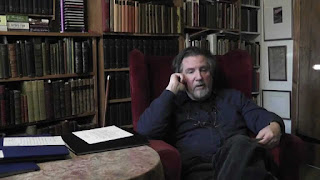
Reggie Oliver at home by R.B. Russell
Reggie Oliver (photo by R.B. Russell)
Reggie Oliver opens the book proper with a search for 'Love and Death' as art and life collide with terrible results.  I have long harboured a desire to read some of Oliver's work as I'd heard nothing by praise but my only previous encounter was a M.R. James pastiche which moved me not but here finally I see what the fuss is about as this is a fantastically powerful tale.

Caitriona Lally's 'This is How it Will Be' is certainly no less powerful but it's story of identity loss (or perhaps identity theft would be a more appropriate term) comes with the extra frisson of frustrating believability as it reduces you to uncomfortably berating the narrator for her passivity, her malleability and her gullibility in the knowledge that in doing so you are, perhaps, behaving no differently from her new friend.

Lynda E. Rucker's 'Every Exquisite Thing' is a tricksier affair that chases love or at least the ghost of it to various locations only to find it unknowing and disheartening .  It seemed to me to speak of hidden lives and the reinventions of self and of a futile desire for stability amidst change.

John Howard
John Howard
I've had the great pleasure to read a few things by John Howard over the last couple of years and he never disappoints.  His stories are often gut-wrenchingly acute dissections of life and love and in 'Speck' he takes us on an exploration of lives and identities used and discarded, of the callous disregard of others and of innocence and kindness.

D.P. Watt's tale of psychic vampirism, 'Doreen', is a jarring contrast to the subtlety of the previous and feels in many ways to be a hark back to the macabre tales of old but with a touch of the Beryl Cook in it's cast and milieu.

Rosanne Rabinowitz brings us right up to date with a harrowing and odd tale of two women caught up in the upsurge of racist idiocy that followed the E.U. vote in 'All That's Solid' while Avalon Brantley offers a tale redolent of Victorian houses filled with artistic gentlemen of impeccable manners and indulgent habits. Of discussions over brandy and cigars and of falls from grace as inevitable as they are improbable.

Timothy J. Jarvis' story within a story - that great tradition of the ghostly tale - 'The Yellow Book' layers the weird and the mundane to create an oddly soap operatic folk horror whereas in 'A Labyrinth of Graves' John Gale offers a tale of love, jealousy, rage, regret and longevity as we are offered fleeting glimpses of the long existence of a god and the mutual impact of the life and death of one particular devotee.

The book ends with 'The Anatomy Lesson of Professor Stebbing' by Derek John a light footed and fun steampunkish yarn concerning the titular 'scientist' and his machine to modify and manipulate the soul.

When I begun this book I was definitely expecting a parade of stories more directly linked to the original but what I got was something far more diverse and significantly more interesting.  There are moments when the link seems particularly tenuous but once you accept this the quality of the individual pieces shines through and what you get is a set of thought provoking and hugely enjoyable stories by a group of very interesting new (to me at least) writers assembled by one of the pre-eminent writers of (and about) the weird working today.

Available direct from the publisher.

..........................................................................................

If you enjoy what we do here on Wyrd Britain and would like to help us continue then we would very much welcome a donation towards keeping the blog going - paypal.me/wyrdbritain

Friday, 20 April 2018

Music Has The Right To Children

Boards of Canada Music Has The Right To Children
Today - 20/04/18 - marks the 20th anniversary of the release of the debut Boards of Canada album, 'Music Has The Right To Children'.

The work of two brothers, Michael Sandison and Marcus Eoin, Boards of Canada have carved a uniquely enigmatic path through the world of electronic music.

The record is a mesmerisingly oneiric and disturbingly beautiful meditation on childhood and memory.  It's detuned and hallucinatory qualities derived from vintage synthesizers, treated voices and library melodies provided the template for the entire hauntology movement.

It is an album that was born from half remembered memories, childhood fears and hazy nostalgia that exists in a place that is utterly timeless.


..........................................................................................

If you enjoy what we do here on Wyrd Britain and would like to help us continue then we would very much welcome a donation towards keeping the blog going - paypal.me/wyrdbritain

Sunday, 15 April 2018

The Thirteenth Reunion

Hammer House of Horror The Thirteenth Reunion
Hammer House of Horror was an anthology series created by the titular studio and ITC Entertainment (home of shows such as The Prisoner, Jason King and The Saint as well as the various Gerry Anderson programmes) that was broadcast in 1980. Somewhat appropriately there were 13 episodes made each with a different writer and cast exploring the various plot favourites of the Hammer Studios such as satanism, murder, witchcraft and voodoo but stripped of the gothic trappings that characterised the movies which makes it perhaps more redolent of Amicus Productions.

'The Thirteenth Reunion' was the second episode on the series and was written by Jeremy Burnham (co-writer of the amazing 'Children of the Stones') and directed by Peter Sasdy (director of Nigel Kneale's brilliant 'The Stone Tape' and various Hammer movies including 'Countess Dracula').  It tells the story of a reporter's investigation of a health farm and of the secret society that lurks behind it's facade.

Hammer House of Horror The Thirteenth Reunion Julia Foster and Warren Clarke
The episode isn't entirely successful as it never quite seems to decide whether or not it wants to be scary or funny and winds up not really being either.  It does have it's moments though along with some really good casting with Warren Clarke providing what's possibly the best scene of the episode and Doctor Who regular Kevin Stoney is an imposing presence as the doctor in charge. The main problem is lead actress Julia Foster who strives valiantly but seems like she would be far more at home in a sitcom (which is in no way meant to be an insult) and certainly doesn't conform to the body type they keep branding her as and which they've hidden under some truly hideous costume choices.  The end result is certainly not one of the best remembered episodes of the series (I'm sure we'll get to them in due time) but with a pedigree like the one that Burnham and Sasdy bring it was an irresistible choice for sharing here and the big reveal when it comes is fun.

Buy it here - Hammer House Of Horror - Complete Collection [DVD] [1980] - or watch it below.


..........................................................................................

If you enjoy what we do here on Wyrd Britain and would like to help us continue then we would very much welcome a donation towards keeping the blog going - paypal.me/wyrdbritain

Tuesday, 10 April 2018

Holy Terrors: A Collection of Weird Tales by Arthur Machen

Holy Terrors: A Collection of Weird Tales by Arthur Machen fromm Tartarus Press
Arthur Machen
Tartarus Press

A collection of weird tales by Arthur Machen featured in the portmanteau film Holy Terrors by Obsolete Films.
Contents: The Cosy Room, The White Powder, The Bowmen, Ritual, The Happy Children, Midsummer, Afterword, The Friends of Arthur Machen

Penguin Books published a collection of Machen's writings under the title 'Holy Terrors' in 1946, this isn't it.  This one is a recent collection from Tartarus Press that takes it's name and it's contents from a recent portmanteau film featuring the 6 short stories reprinted in this book (see below for the trailer).

Perhaps the most well known Machen tale here is the alchemical experimentation of 'The White Powder' although the inclusion of 'The Bowmen' perhaps challenges that but then is it famous as a Machen story or as the myth of the 'Angels of Mons'.  We also get the enigmatically pagan 'Midsummer', the reportage of 'Ritual', the quietly powerful 'The Happy Children' and an unexpected crime caper in 'The Cosy Room'.

At 70 pages it makes for a quick but enjoyable read that offers a fleeting insight into the scope of Machen's imagination if perhaps not into the best of it.


..........................................................................................

If you enjoy what we do here on Wyrd Britain and would like to help us continue then we would very much welcome a donation towards keeping the blog going - paypal.me/wyrdbritain

Sunday, 8 April 2018

The Day of the Triffids (1981)

The Day of the Triffids (1981)
It's 1981 and I'm an 11 year old geek besotted by science fiction, comics and Hammer horror movies and into my world arrives a show about the end of the world and walking, killer plants and there begins an obsession that continues to this day.

Brought to the screen by producer David Maloney, who had previously been responsible for the first three series of Blake's 7 and who with a different hat on had directed several Doctor Who serials during the 60s and 70s including the classics  Genesis of the Daleks and The Talons of Weng-Chiang, this version, unlike the previous Howard Keel fronted version - which you can watch here - is a pretty faithful adaptation of the novel.

The Day of the Triffids (1981) John Duttine and Emma Relph
John Duttine plays Bill Masen who, whilst recovering from eye surgery resulting from a close encounter with a triffid's stinger, fortunately misses out on watching the spectacular meteor shower that blinds the majority of the worlds population.  Travelling through a desolated London he rescues Josella Playton (Emma Relph) before joining forces with a group of fellow survivors with plans on how to survive the catastrophe; plans derailed somewhat by the arrival of Jack Coker (Maurice Colbourne).

The end result is a fantastically atmospheric and bleak adaptation with some terrific performances from Duttine, Colbourne and Relph (who after a slightly stiff start improves noticeably through the series as she relaxes into her character).  The triffids are well realised if a little tottery and aren't particularly frightening but then they were never the main jeopardy in the story, that was always the other people.

Many of the TV shows beloved of Wyrd Britain - Children of the Stones, The Owl Service or The Changes - screened originally when I was a bit too young to be watching (or remembering) but this one, like Sapphire and Steel and The Quatermass Conclusion was mine.  I remember being there to watch it and being utterly mesmerised by it. I loved it on first viewing and still do today.


..........................................................................................

If you enjoy what we do here on Wyrd Britain and would like to help us continue then we would very much welcome a donation towards keeping the blog going - paypal.me/wyrdbritain

Tuesday, 3 April 2018

A Twist in the Eye

Charles Wilkinson
Egaeus Press

Throughout the sixteen stories collected in this remarkable book Charles Wilkinson explores themes of place, ritual, identity, death and transmutation with a rare, if not utterly unique, confidence. They are enigmatic but never vague, dreamlike but never illogical, horrifying but only occasionally visceral. Few writers can write ‘weird’ with so convincing a voice.

I first read a Charles Wilkinson story in issue 35 of Supernatural Tales, it was a thoroughly enjoyable slice of weird fiction with an ending that I thought arrived far too suddenly which slightly marred the experience.  I was really impressed and invested in a copy of his collection issued by Egaeus Press back in 2016 and having spent the last two days immersed in it I'm still impressed, with reservations, but definitely impressed.

There are two or three obvious touch points to Wilkinson's writing - Robert Aickman, Arthur Machen and Algernon Blackwood - and from the first he takes the sense of the strange in the mundane and in the liminality of new homes, guest houses and childhood abodes and in the unapologetic stylistic conceits of the jump cut endings and an oblique take on narrative flow.  From Machen and Blackwood in particular we see an embracing of the elsewhere and the otherhere.  The worlds within and beyond the natural where soul, spirit and anima are as ephemeral, as elusive and as dangerous as smoke.

As for my reservations well it remains the same as from my first reading.  Wilkinson crafts a beautifully realised story into which we are dropped and instantly and wonderfully submerged and there are storyworlds here that I could happily inhabit for days but with Wilkinson the ending is apt to burst through at any moment jarring us back into the mundane world.  It seems to me that many of his ideas could do with a bit more room, a novella (or even longer) would allow his ideas room to stretch and for their conclusions to arrive more organically and with a more deliberate pace.  But, and I want to stress this next part, this is just a reservation.  I adored this book and if I read another one half as good this year I'll be very happy indeed.

Available from the publisher at the link at the top of this review.

..........................................................................................

If you enjoy what we do here on Wyrd Britain and would like to help us continue then we would very much welcome a donation towards keeping the blog going - paypal.me/wyrdbritain

Sunday, 1 April 2018

Ripping Yarns: The Curse Of The Claw

Ripping Yarns was a series of, well, ripping yarns created and written by Michael Palin and Terry Jones to pastiche the 'Boys Own' adventure stories of their youths.  Among their targets were staples of the genre such as PoW stories, country house murder mysteries, public school hi-jinx and, in the case here, curses from the remote parts of the British Empire.

Taking a playful swipe at W.W. Jacobs' 'The Monkey's Paw', 'The Curse of the Claw' is the story of Sir Kevin Orr, newly widowed on his 60th birthday, who receives unexpected visitors who break his lonely vigil and to whom Kevin tells the story of the curse.

It's a gentle and fairly typical piece of post-Python comedy, very much of it's time and certainly not the best of the series but it retains much of it's charm and Palin is always very watchable.

Buy it here - Ripping Yarns - The Complete Series[DVD] [1976] - or watch it below.


..........................................................................................

If you enjoy what we do here on Wyrd Britain and would like to help us continue then we would very much welcome a donation towards keeping the blog going - paypal.me/wyrdbritain

Wednesday, 28 March 2018

In A Glass Darkly

J. Sheridan Le Fanu
Wordsworth Editions

This remarkable collection of stories, first published in 1872, includes Green Tea, The Familiar, Mr. Justice Harbottle, The Room in le Dragon Volant, and Carmilla. The five stories are purported to be cases by Dr. Hesselius, a 'metaphysical' doctor, who is willing to consider the ghosts both as real and as hallucinatory obsessions. The reader's doubtful anxiety mimics that of the protagonist, and each story thus creates that atmosphere of mystery which is the supernatural experience. 

This is my first time digging into a book full of Le Fanu's stories and I found it to be a bit of a pick 'n' mix.

The book tells 5 stories from the files of Dr. Hesselius, an occult detective of sorts, although he himself appears only in one of tales with the 5 being presented as being posthumously selected from his archives.

It's the final story here that's undeniably the most renowned and justifiably so.  'Carmilla' is an unsettling tale of vampirism which while lacking in suspense due to the delivery method (it's told by the 'victim') it manages to hold a tantalising level of menace.

At the other end of the scale is 'The Room in Le Dragon Volant' a frankly risible locked room mystery that was a chore to plough through.

The opening two stories, 'Green Tea' and 'The Familiar' are odd little tales of manifestations induced by overindulgence and guilt and neither tale really sparkles although the latter has the edge but it's the fourth story, 'Mr. Justice Harbottle', that was probably the great surprise of the book with it's deliciously macabre tale of a corrupt judge and his unearthly comeuppance.

I have to admit I struggled a little with this book; mostly with Le Fanu's now quite dated prose style - which had never previously been an issue when encountering his stories in various anthologies - but also because I just didn't think all that much of the opening story, 'Green Tea', ground to a halt and put the book down for a while.  When I returned to it more prepared for it's idiosyncrasies I got more out of it and with the exception of that lousy crime story it proved to be an enjoyable read.

Buy it here - In A Glass Darkly (Wordsworth Mystery & Supernatural) (Tales of Mystery & the Supernatural) by Sheridan Le Fanu ( 2007 )

..........................................................................................

If you enjoy what we do here on Wyrd Britain and would like to help us continue then we would very much welcome a donation towards keeping the blog going - paypal.me/wyrdbritain